


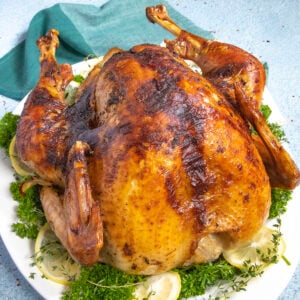
This Cajun turkey gets a spicy Cajun butter injection and a garlicky Creole butter under the skin, then roasts in the oven until it turns juicy, tender, and golden. No fryer needed. Plus, a rich dark roux pan gravy made right from the drippings.
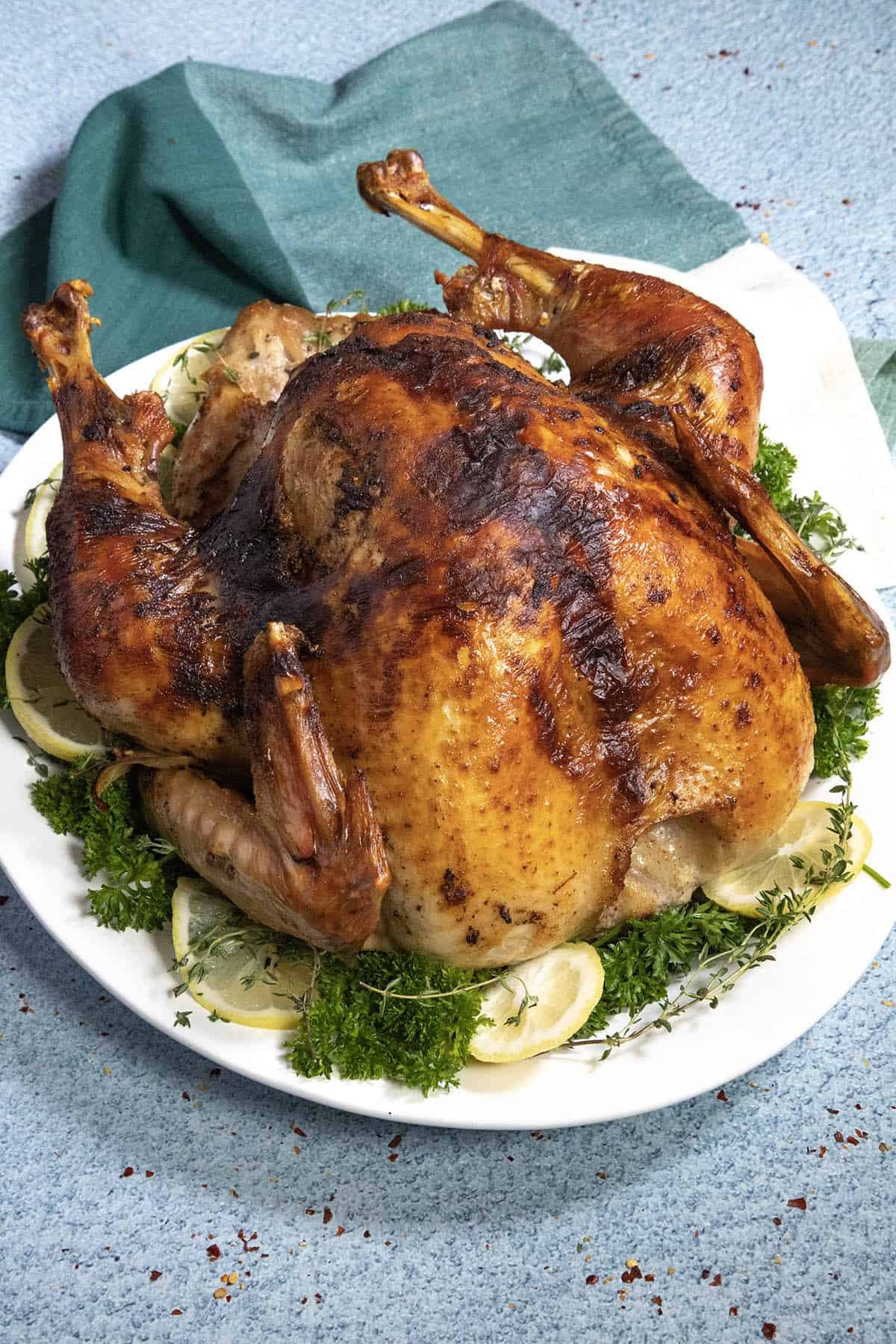
Every year at Friendsgiving, the table is split right down the middle. Half of our friends want a classic roast turkey. The other half wants something a bit less outside the norm. This Cajun turkey makes everybody happy. It looks like the traditional bird and carves like the traditional bird, but every bite is packed with big, juicy flavor.
Honestly, turkey can be boring. The solution is getting flavor deep into the meat, not just on the skin. I do this by injecting the bird with a spicy Cajun butter, then working a garlicky Creole butter right under and over the skin. You get a very juicy turkey with Cajun and Creole spices in every slice. It's nicely spiced, not hot, so everyone at the table can dig in. You'll see the juices flowing when you carve it.
And the gravy! I make a dark roux pan gravy straight from the drippings. It needs no extra seasoning, since all that Creole butter is already in there, and it comes together perfectly. BOOM.
Then there are the leftovers. Seasoned turkey makes every soup, stew, and sandwich infinitely better. I can't wait to show you. Let's make it!
What Is Cajun Turkey?
Cajun turkey is a whole turkey seasoned and injected with Cajun or Creole spices and butter. In Louisiana, cooks often deep fry it, but you don't need a fryer to get the flavor. With this version, we're roasting it in the oven, so it fits right into a regular holiday meal. No special set up or equipment needed.
Cajun and Creole seasonings include a lot of the same spices, like paprika, garlic, onion, cayenne, and black pepper. Creole blends usually included more on herbs like oregano and thyme. I use my homemade Creole seasoning here, but my homemade Cajun seasoning works great, too. Your choice!
Ingredients
The full ingredients list with measurements is in the printable recipe card at the bottom of the post.
- Whole turkey. I used a 13-pound bird. Skip turkeys labeled "enhanced" or pre-brined (they already contain salt solution), or skip the dry brine if that's what you have.
- Kosher salt for the dry brine.
- The Cajun butter injection. Melted butter, chicken broth, Louisiana-style hot sauce, Worcestershire sauce, Creole seasoning, garlic powder, onion powder, and cayenne.
- The Creole compound butter. Softened butter, Creole seasoning, fresh garlic, fresh thyme, and smoked paprika.
- Aromatics. Onion, green bell pepper, celery, a head of garlic, and a lemon. These flavor the bird from the inside and the drippings from below.
- Chicken broth for the roasting pan.
- For the gravy. Pan drippings, turkey or chicken stock, and flour.
You'll also need a meat injector and a good instant-read thermometer.
How to Make Cajun Turkey
Dry brine the turkey. One to two days ahead, pat the turkey dry and season it all over with kosher salt, inside the cavity and under the breast skin. Set it on a rack in a sheet pan and refrigerate it uncovered for 24 to 48 hours. The salt seasons the meat and dries the skin so it roasts up nice and golden. If you prefer a wet brine, my Big Flavor Turkey Brine works, too.
Make the injection. Whisk together the melted butter, broth, hot sauce, Worcestershire, Creole seasoning, garlic powder, onion powder, and cayenne while it's still warm. If your seasoning has any larger bits, strain it so it doesn't clog the needle.
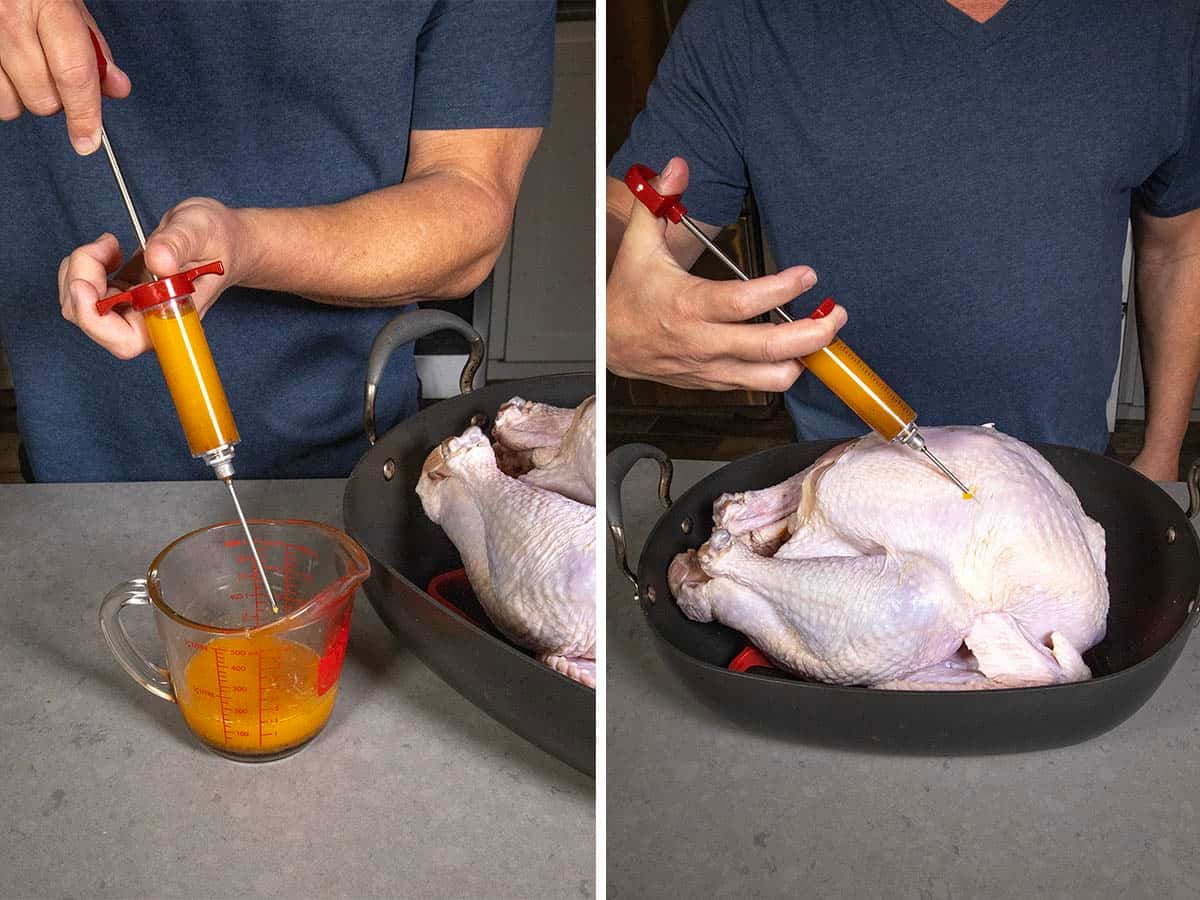
Inject the turkey. Inject small amounts into the breasts, thighs, and drumsticks. Push the needle in once, then fan it through several angles as you slowly press the plunger. That spreads the flavor without poking a hundred holes in the skin. Wipe off any that leaks out.
I recommend this meat injector from Amazon (affiliate link, my friends). It's inexpensive and reliable.
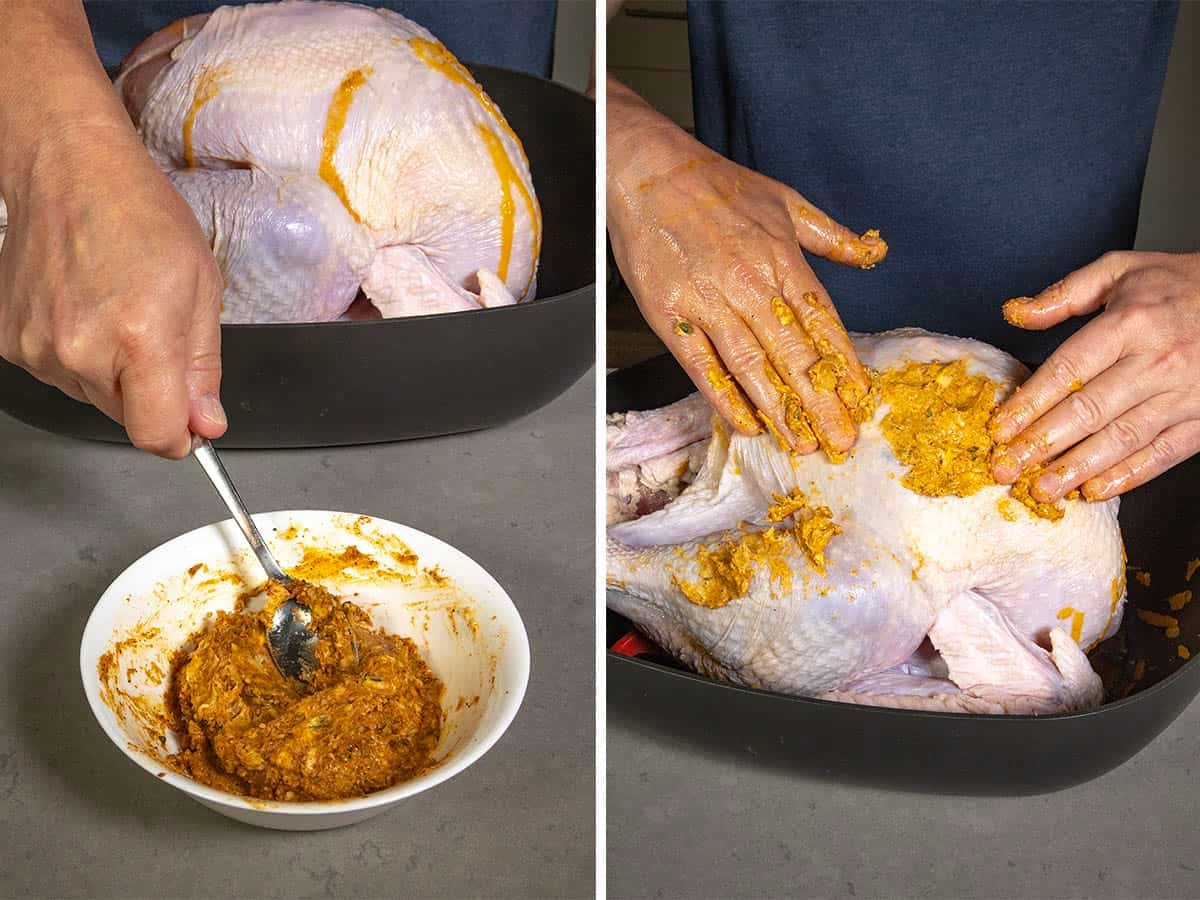
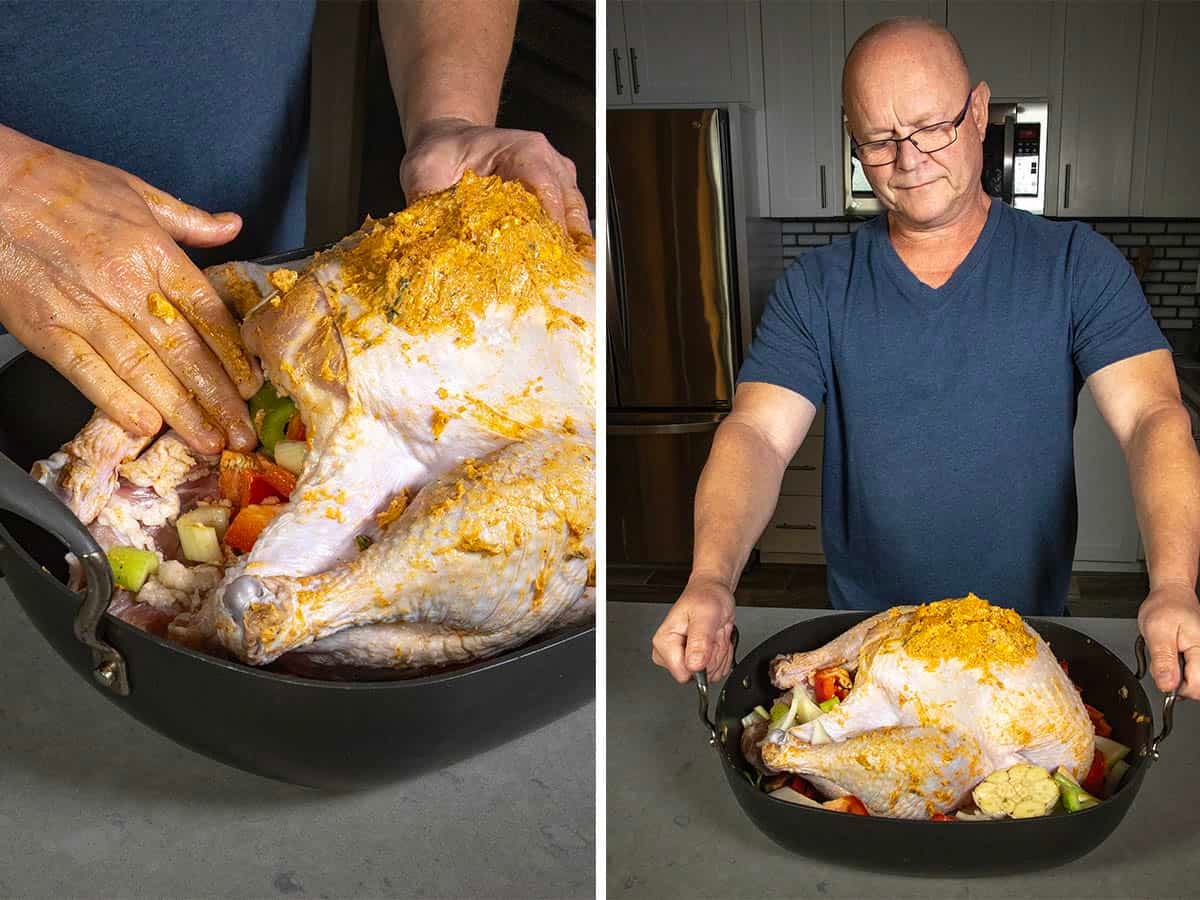
Butter it up. Mash the softened butter with the Creole seasoning, garlic, thyme, and smoked paprika. Gently loosen the skin over the breasts and thighs with your fingers. Push about two-thirds of the butter underneath and spread it around, then rub the rest over the outside.
Prep the pan. Tuck half the onion, bell pepper, and celery into the cavity along with the garlic and lemon. Scatter the rest in the roasting pan and pour in the broth. Set the turkey on top and let it sit at room temperature for 45 to 60 minutes while the oven heats.
You can see I have a bit more butter to rub in on the top.
Roast hot, then lower. Set the rack in the middle of the oven. Too close to the heating element and the Creole butter browns faster than you want. Roast at 425°F for 30 minutes, then lower the heat to 325°F and keep roasting. My 13-pound turkey needed about 2 more hours. Tent the breast with foil if it starts browning too fast, and add a little broth to the pan if it runs dry.
Baste (optional). Spoon the pan juices over the turkey 2 or 3 times during the 325°F stage. Stop basting for the last 30 minutes so the skin can crisp up.
Check the temperature. The turkey is done when the thickest part of the breast reads 165°F and the thigh reads 175°F. Trust the thermometer, not the clock.
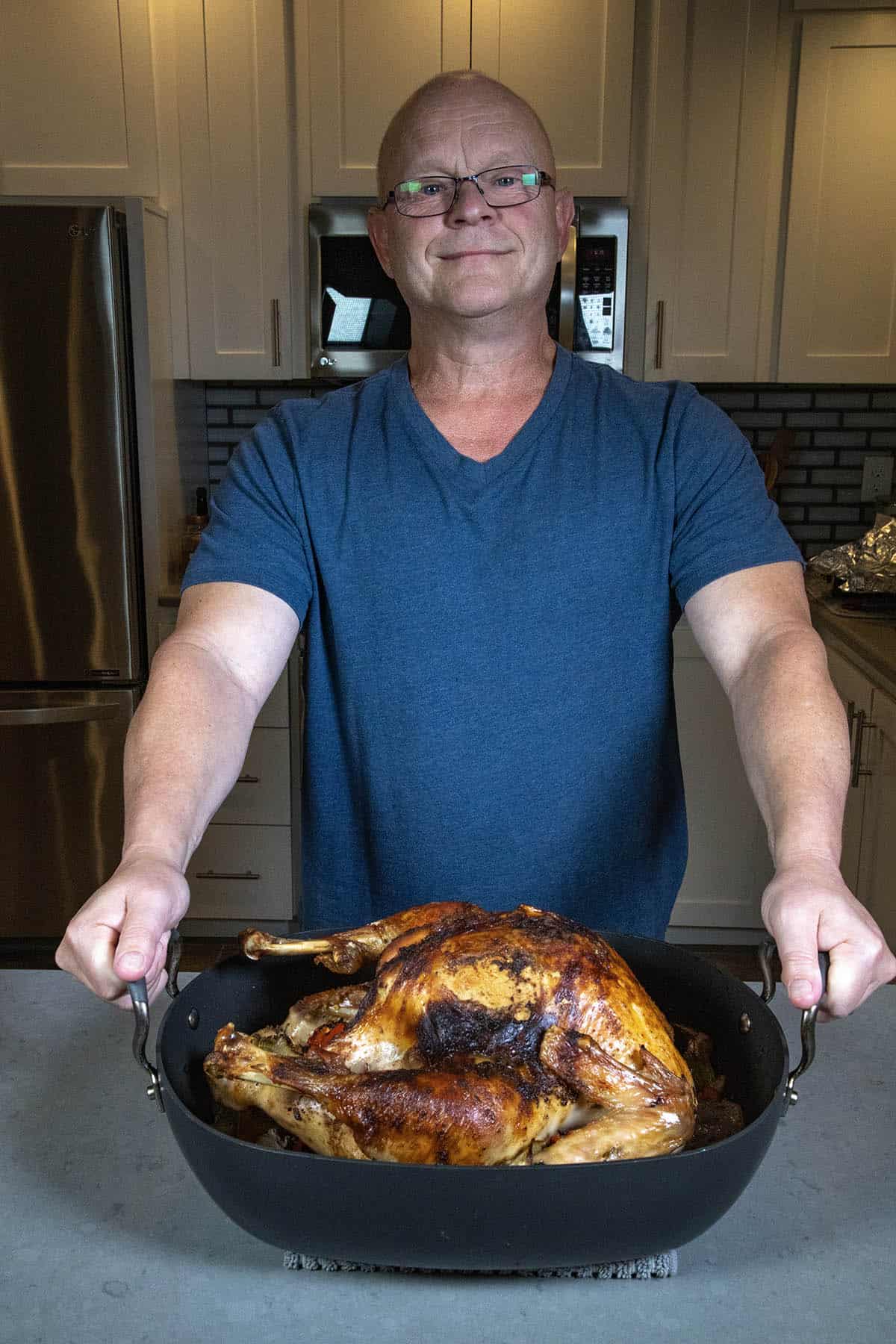
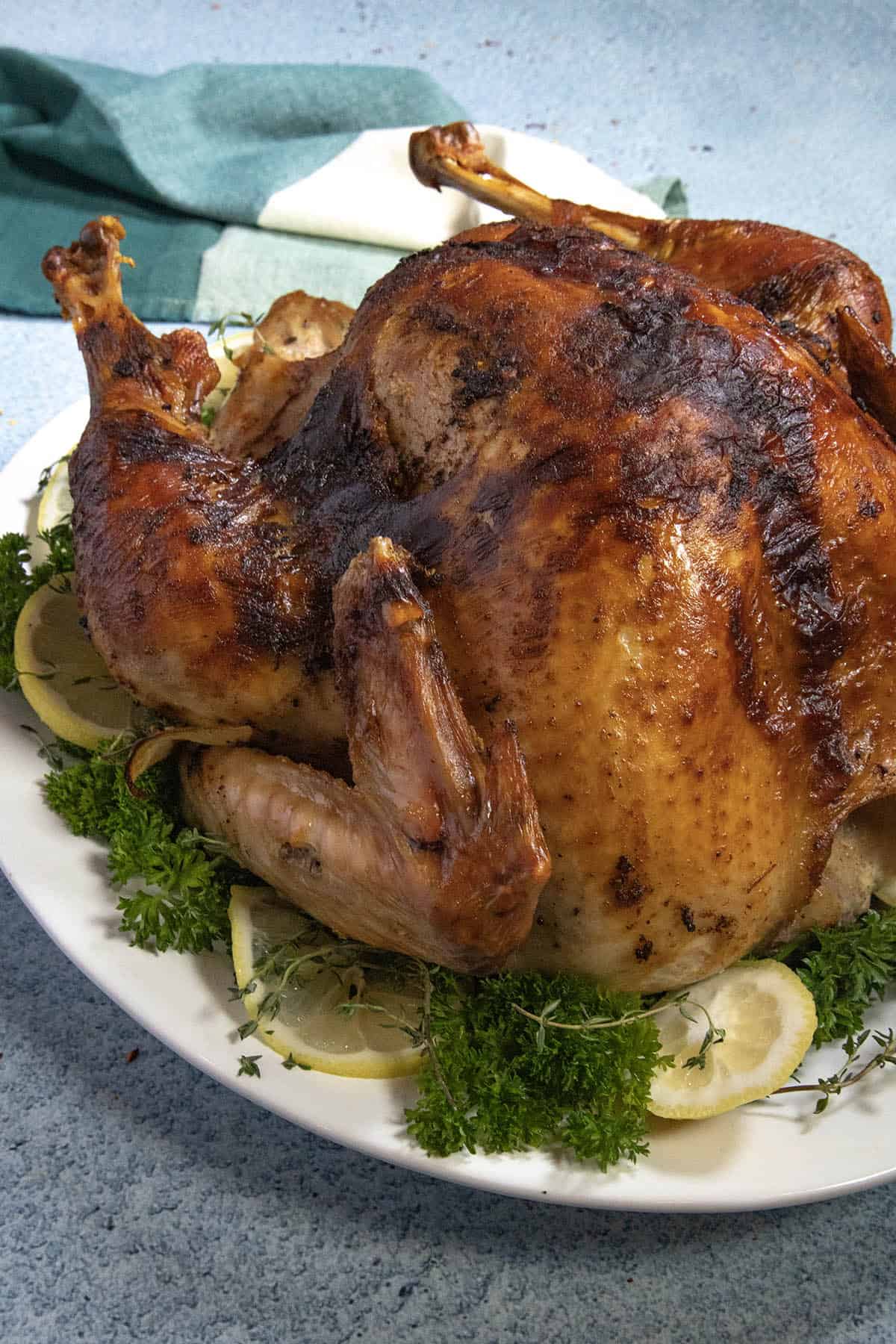
Rest. Move the turkey to a cutting board, tent it loosely with foil, and let it rest for 30 to 45 minutes. The juices settle back into the meat, and you get time to make the gravy.
How to Make Cajun Pan Gravy
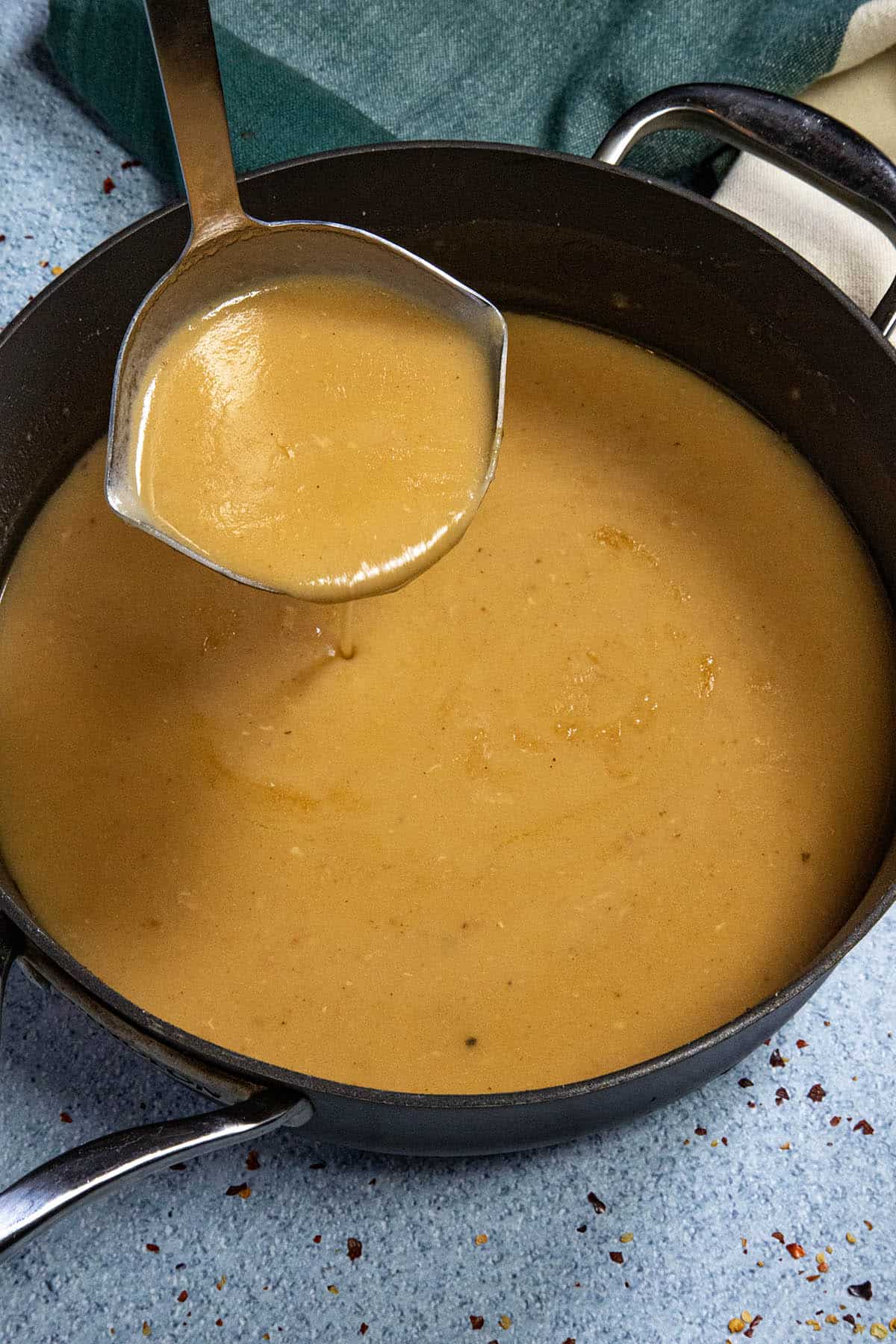
This gravy is the secret weapon. It starts with a roux, which is just fat and flour cooked together until it darkens and turns nutty. This is the base of so much Cajun and Creole cooking, from gumbo to étouffée, some of my favorite food in the world.
Collect the drippings. Strain the pan drippings into a fat separator and toss the roasting vegetables. I use the OXO Fat Separator from Amazon (affiliate link, my friends). It make it very easy. The fat floats up to the top and you can pour out the drippings without the fat.
Set the roasting pan over two burners, pour in a cup of stock, and scrape up all the browned bits. That's big flavor right there. Add it to the defatted drippings, plus enough stock to make about 4 cups of liquid. Keep it warm.
Cook the roux. Heat 6 tablespoons of the skimmed fat in a heavy skillet or saucepan over medium-low heat. Top it up with butter if you're short. Whisk in the flour and stir constantly for 10 to 15 minutes, until it turns somewhere between peanut butter and milk chocolate. Go lighter or darker depending on your preference. Darker means deeper, nuttier flavor. Lower the heat if it starts to smoke.
Add the liquid. As soon as the roux hits the color you want, slowly whisk in the warm liquid. Have it ready before the roux gets close, because the roux keeps darkening until the liquid goes in. Careful, it sputters at first.
Simmer. Let it bubble for 10 to 15 minutes, until it's thick enough to coat a spoon. Taste it before adding anything. The drippings have all that Creole butter, so you likely won't need more than a pinch of salt and pepper.
Boom! Done! Carve that turkey and pass the gravy.
Turkey Cooking Times by Weight
My 13-pound turkey took about 2 hours and 30 minutes total: 30 minutes at 425°F, then about 2 hours at 325°F. That works out to roughly 11 to 12 minutes per pound. Use these estimates for an unstuffed turkey with this method of high heat, then lower heat:
- 10 to 12 pounds: about 2 to 2 1/4 hours total
- 12 to 14 pounds: about 2 1/4 to 2 3/4 hours total
- 14 to 16 pounds: about 2 3/4 to 3 1/4 hours total
- 16 to 20 pounds: about 3 1/4 to 4 hours total
- 20 to 24 pounds: about 4 to 4 3/4 hours total
Ovens and turkeys vary, so start checking the temperature early. Begin checking about 30 minutes before the low end of your range. The turkey is done at 165°F in the breast and 175°F in the thigh, no matter what the clock says. A stuffed turkey takes longer.
How to Spatchcock a Cajun Turkey
Want it done faster? Spatchcock it. Set the turkey breast side down and cut out the backbone with sturdy kitchen shears. Flip it over and press down hard on the breastbone to flatten it.
Inject and butter it the same way. A spatchcocked turkey has no cavity, so spread all the aromatics in the roasting pan and lay the turkey on top. The vegetables become a rack and still add lots of flavor to the drippings. Roast at 450°F for about 75 to 90 minutes for a 12- to 14-pound bird, until it reaches the same temperatures.
Don't toss the backbone! Roast it in the pan for extra drippings, or simmer it in water with a little onion and celery while the turkey roasts. Homemade stock for your gravy. BOOM!
Optional Glazes for Cajun Turkey
I roast mine without a glaze, because I love that crispy skin. If you want a sweet-heat finish, try one of these glaze options. Warm the ingredients together until smooth, then brush the glaze on during the last 20 to 30 minutes instead of basting. The skin gets lacquered rather than crispy. Watch it closely, since sugar can scorch and blacken, and tent any spots that darken too fast.
- Cane syrup glaze. 1/3 cup cane syrup (like Steen's), 2 tablespoons butter, 1 tablespoon Louisiana-style hot sauce, 1 tablespoon apple cider vinegar, and 1 teaspoon Creole seasoning. Very Louisiana. No cane syrup? Use sorghum syrup, golden syrup with a teaspoon of molasses, or honey with a tablespoon of molasses.
- Hot honey glaze. 1/3 cup honey, 2 tablespoons butter, 1 to 2 tablespoons hot sauce, and 1 tablespoon apple cider vinegar.
- Pepper jelly glaze. 1/2 cup hot pepper jelly melted with 1 tablespoon butter and 1 tablespoon apple cider vinegar.
- Maple hot sauce glaze. 1/3 cup pure maple syrup, 2 tablespoons butter, and 2 tablespoons Louisiana-style hot sauce.
Mike's Recipe Notes & Tips
- Roast in the middle of the oven. If the turkey sits too close to the heat source, the butter and spices on the skin brown more than you might want.
- Check the label. Enhanced or kosher turkeys already contain salt. Skip the dry brine if that's what you're using.
- Watch the salt in your seasoning. Many store-bought Cajun and Creole blends contain plenty of salt. Taste the gravy before you add any.
- No basting at the end. Leave the turkey alone for the last 30 minutes so the skin crisps.
- Adjust the heat. As written, this turkey is nicely spiced, not hot. For milder, skip the cayenne in the injection. For hotter, bump the cayenne up to 1 1/2 or 2 teaspoons, or use a hotter hot sauce in the injection. Want it wild? Add a little habanero hot sauce to the injection.
- Roux color is up to you. Peanut butter colored gives you a lighter, toastier gravy. Milk chocolate gives you a deeper, nuttier one.
Make-Ahead Timeline
- 1 to 2 days before: Dry brine the turkey and refrigerate it uncovered.
- Morning of: Make the injection and compound butter. Inject and butter the turkey, then prep the pan.
- About 3 1/2 to 4 hours before dinner (for a 13-pound bird): Let the turkey sit at room temperature, then roast.
- While it rests: Make the gravy and finish your sides.
What to Serve with Cajun Turkey
Go big with Southern sides. I love this turkey with jalapeño cornbread, Southern collard greens, and Cajun dirty rice. For something sweet and spicy, add roasted sweet potatoes or hot honey roasted carrots.
Cooking for a crowd? Make a second batch of flavor with my turkey rub for a more traditional bird, or pass a bowl of roasted garlic gravy alongside the Cajun gravy.
Leftover Cajun Turkey Ideas
Leftover turkey is the best part. The Cajun seasoning carries right into whatever you make next, so your leftovers get extra flavor for free. Try it in:
- Turkey Gumbo, a natural fit
- Hearty Turkey Stew
- Turkey Chili
- Turkey and Sweet Potato Hash
Save the carcass, too. It makes a killer stock for any of these.
Storage and Reheating
Refrigerate leftover turkey in an airtight container within 2 hours of cooking. It keeps for 3 to 4 days. Store the gravy separately for the same amount of time.
To freeze, pack the sliced turkey with a splash of broth or gravy in freezer-safe bags for up to 3 months. I like to separate into portions for meals. Reheat it covered in a low oven or on the stovetop with a little broth so it stays moist. Whisk the gravy over medium heat and thin it with stock if needed.
That's it, my friends. I hope you enjoy this Cajun turkey as much as we do. Whether your crowd loves tradition or wants something new, this one wins the table. Let me know if you make it. I'd love to hear how it turned out for you!
Get FLAVOR MADNESS - The Cookbook!
Have you seen my new cookbook FLAVOR MADNESS? Big Flavor Recipes! You absolutely can't miss it. Check it out!
More Turkey Recipes
Love this one? Try these next:
Got any questions? Ask away! I'm happy to help. If you enjoy this recipe, I hope you'll leave a comment with some STARS. Also, please share it on social media. Don't forget to tag us at #ChiliPepperMadness. I'll be sure to share! Thanks! — Mike H.
Cajun Turkey (Injected and Oven-Roasted)
Ingredients
Turkey and Dry Brine
- 1 whole turkey 12 to 14 pounds, thawed, not enhanced or pre-brined
- 3 tablespoons Diamond Crystal kosher salt or 2 tablespoons Morton
Cajun Butter Injection
- 1/2 cup unsalted butter 1 stick, melted
- 1/4 cup low-sodium chicken broth
- 2 tablespoons Louisiana-style hot sauce
- 1 tablespoon Worcestershire sauce
- 1 tablespoon Creole seasoning finely ground
- 1 teaspoon garlic powder
- 1 teaspoon onion powder
- 1/2-1 teaspoon cayenne
Creole Compound Butter
- 1/2 cup unsalted butter 1 stick, softened
- 2 tablespoons Creole seasoning
- 4 cloves garlic minced
- 1 tablespoon fresh thyme chopped
- 1 teaspoon smoked paprika
Aromatics and Pan
- 1 onion quartered
- 1 green bell pepper quartered
- 2 celery stalks cut into chunks
- 1 head garlic halved crosswise
- 1 lemon halved
- 2 cups chicken broth
Cajun Pan Gravy
- Pan drippings
- 3 cups turkey or chicken stock about
- 6 tablespoons fat skimmed from the drippings top up with butter if short
- 6 tablespoons all-purpose flour
- Salt and pepper to taste
- Sliced green onion optional, for finishing
Instructions
Dry Brine (1 to 2 Days Ahead)
- Pat the turkey dry. Season it all over with the salt, including inside the cavity and under the breast skin. Set it on a rack in a sheet pan and refrigerate uncovered for 24 to 48 hours.
Inject and Butter
- Whisk together the injection ingredients while the butter is warm. Strain if needed so it doesn't clog the needle.
- Inject small amounts into the breasts, thighs, and drumsticks, fanning the needle through several angles from each entry point. Wipe off any that leaks out.
- Mash the compound butter ingredients together. Loosen the skin over the breasts and thighs, push about two-thirds of the butter underneath, and rub the rest over the outside.
- Place half the onion, bell pepper, and celery in the cavity with the garlic and lemon. Scatter the rest in the roasting pan, add the broth, and set the turkey on top. Let it sit at room temperature 45 to 60 minutes.
Roast
- Set the oven rack in the middle of the oven, not too close to the heat source. Roast at 425°F for 30 minutes.
- Lower the oven to 325°F and roast until the breast reads 165°F and the thigh reads 175°F, about 2 more hours for a 13-pound turkey. Tent the breast with foil if it browns too fast, and add broth to the pan if it runs dry.
- Optional: Baste with pan juices 2 or 3 times during the 325°F stage, but not during the last 30 minutes, so the skin crisps.
- Rest the turkey, loosely tented with foil, for 30 to 45 minutes. Make the gravy meanwhile.
Cajun Pan Gravy
- Strain the drippings into a fat separator and discard the roasting vegetables. Deglaze the roasting pan with 1 cup of the stock, scraping up the browned bits. Combine with the defatted drippings and enough stock to make about 4 cups. Keep warm.
- Heat 6 tablespoons of the skimmed fat in a heavy skillet over medium-low. Whisk in the flour and stir constantly 10 to 15 minutes, until the roux is peanut butter to milk chocolate colored, depending on your preference.
- Slowly whisk in the warm liquid (it will sputter). Simmer 10 to 15 minutes, until thick enough to coat a spoon. Taste, then season with salt and pepper only if needed. Finish with green onion, if desired. Carve the turkey and serve with the gravy.
Notes
Nutrition Information
FAQs
Is Cajun turkey fried?
It can be. Deep-fried Cajun turkey is a Louisiana classic. This version roasts in the oven, so you get the same big Cajun flavor without a fryer, a vat of oil, or a backyard setup.
Can I inject the turkey the night before?
Yes. You can inject and butter the turkey the night before and keep it refrigerated. Let it sit at room temperature for 45 to 60 minutes before roasting.
Do I need a meat injector?
The injector gets the flavor deep into the meat, and it's a big part of why this turkey turns out so juicy. They're inexpensive and easy to find. I recommend this meat injector from Amazon (affiliate link, my friends). Without one, you can still make the compound butter and push it under the skin, but the flavor won't go as deep.
Can I stuff a Cajun turkey?
I recommend baking your stuffing separately. A stuffed turkey takes longer to roast, and the stuffing needs to reach 165°F, which often means overcooking the breast. The aromatics in the cavity give you plenty of flavor.
How long does it take to cook a 13-pound turkey?
My 13-pound turkey took about 2 1/2 hours total: 30 minutes at 425°F, then about 2 hours at 325°F. Always go by temperature: 165°F in the breast and 175°F in the thigh.
Got any other questions? Let me know so I can keep my FAQs updated.
Leave a Reply