

A tested, shelf-stable canning salsa recipe you can make mild, medium, hot or brutal. Learn exactly what you can change and what you can't.
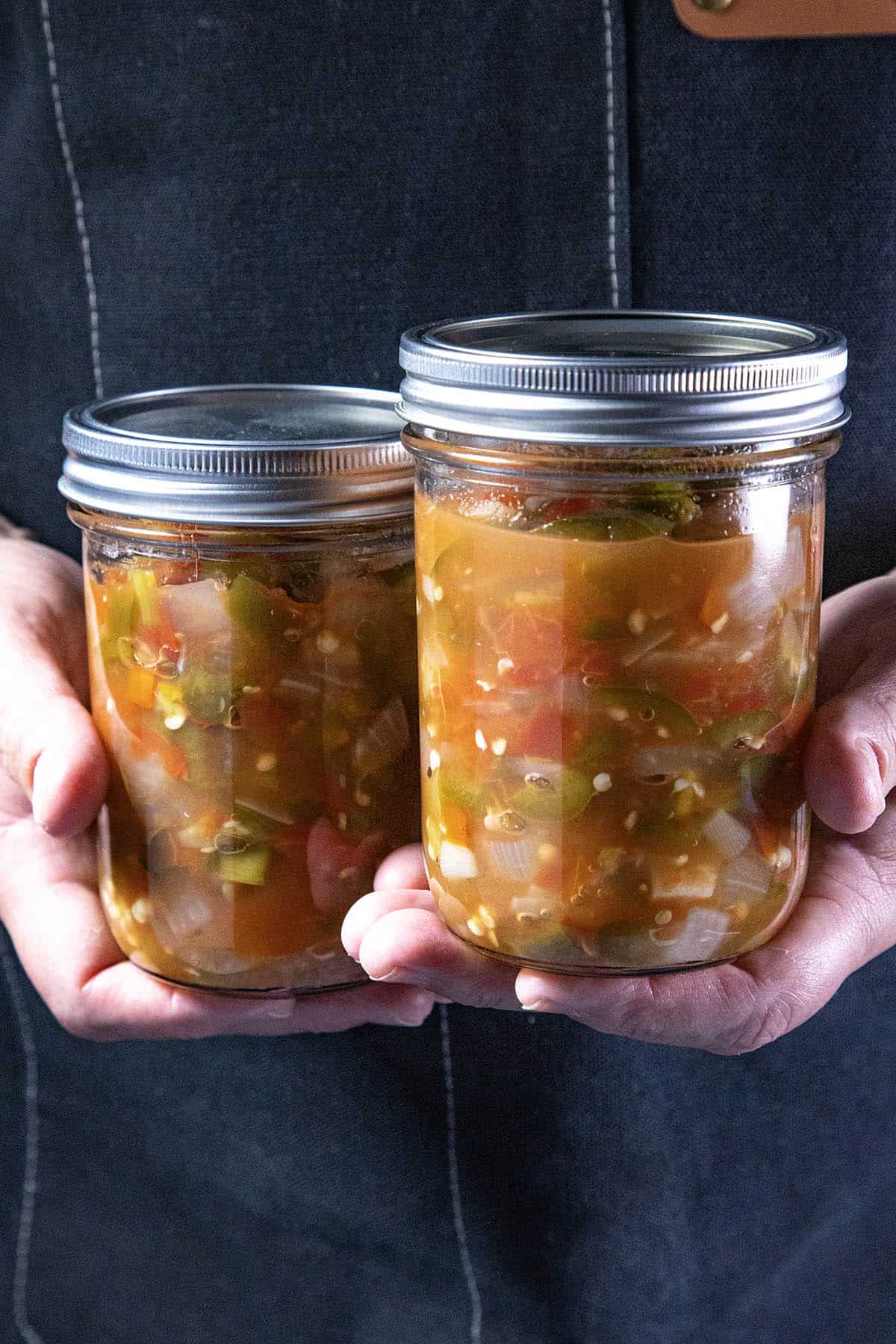
I get this question all the time. "Mike, can I can your salsa recipe?"
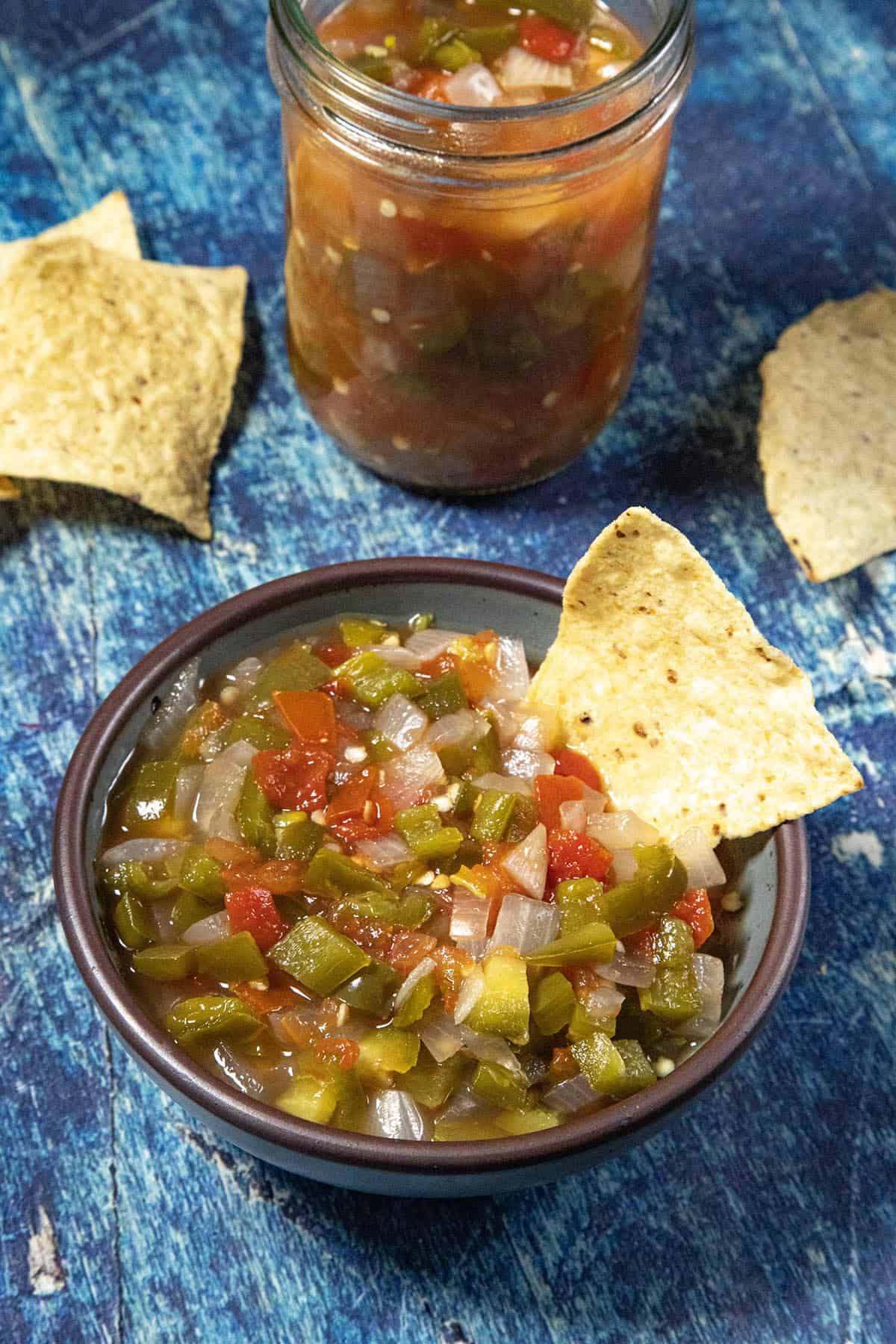
To can salsa safely, you need a recipe that someone tested in a lab, as the acid level and the processing time must match that exact formulation. I've included this below, a tested, shelf-stable salsa recipe.
It isn't safe to eyeball a recipe, and even pH meters aren't reliable. However, we can choose whatever chilies we want and make our salsa and mild or spicy as we want it. I've included a heat chart to help you make this decision.
Let's get into it.
Why You Can't Just Can Your Favorite Salsa
Salsa is generally a mix of acidic tomatoes and non-acidic onions, garlic, and chilies. When you blend them together, the mixture usually isn't acidic enough on its own to stop Clostridium botulinum, the bacterium behind botulism, from growing inside a sealed jar. That's why every tested canning salsa recipe adds bottled lemon juice, lime juice or vinegar. The acid isn't for flavor, but for safety.
For true tested canning recipes, the amount of acid is calculated against the exact amount of low-acid vegetables. If you make changes, like adding another cup of onions, throwing in some corn, or doubling the garlic, you've diluted the acid, which leaves it vulnerable to contamination, and you can't tell just by looking at the sealed and processed jar.
This is a common issue with canning. Researchers at the University of Maine went through 56 canned salsa recipes from 43 food blogs and checked them against USDA guidelines. 91% of them didn't have enough acid for the vegetables they contained. On average they had less than half of what they needed.
This is a tested recipe. It comes from the National Center for Home Food Preservation, it was developed and tested at the University of Georgia, and it's the same recipe those Maine researchers used when they graded everybody else.
This recipe was made for people like us.
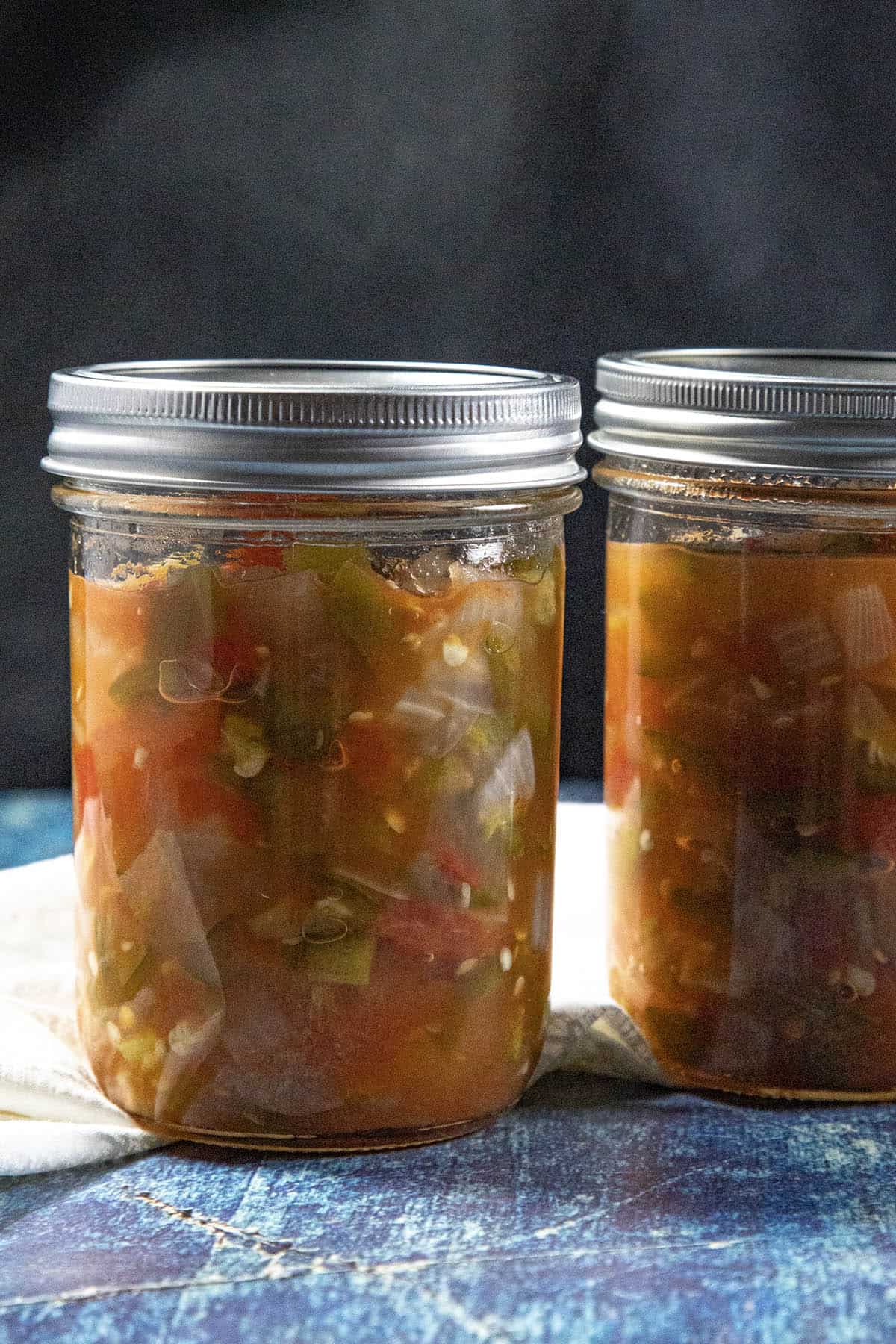
Canning Salsa Ingredients
You'll find exact measurements in the recipe card at the bottom of the post.
- Tomatoes. Ripe ones, peeled, cored and seeded. Paste tomatoes like Romas give you a thicker salsa. Big slicers work too, but will give you looser salsa. Skip overripe or bruised tomatoes, or ones starting to turn.
- Onions and peppers. 9 cups, and it's fun to play with the ratios and types. Use any onion, any pepper, sweet or hot, in any mix you like. See my heat chart below to help you.
- Bottled lime juice or bottled lemon juice. I like lime, since it plays a little better against the chilies, but lemon is equally safe and flavorful. Use bottled only, not fresh. This is the acid that makes the recipe safe to can, and bottled juice has a consistent, tested acidity. Don't use bottled key lime juice.
- Canning or pickling salt. Pure salt without the anti-caking agents in table salt, so your salsa stays clear.
- Dried seasonings. Optional, and this is where you make it yours. Cumin, Mexican oregano, granulated garlic, smoked paprika, whatever you like. I recommend a tablespoon for flavor balance.
Canning Equipment You'll Need
- A boiling water canner with a rack, or a tall stockpot with a rack and a lid that holds enough water to cover your jars by an inch
- Pint or half-pint canning jars with new lids and bands
- A jar lifter
- A canning funnel and a bubble remover or headspace tool
- A large stainless steel pot for cooking the salsa
- Dry measuring cups, for measuring your onions and peppers level
- Gloves for handling hot chilies
The Heat Level Chart
The recipe calls for 9 cups of onions and chilies total. You cannot change the total, but you can change the ratio, and this is where the fun begins.
The people at Georgia tested this recipe across a wide range of tomatoes, onions and peppers.
| Heat level | Onion | Peppers | What goes in |
|---|---|---|---|
| Mild | 2 cups | 7 cups | 6 cups bell, 1 cup poblano or Anaheim |
| Medium | 2 cups | 7 cups | 4 cups bell, 3 cups jalapeño, seeded |
| Hot | 2 cups | 7 cups | 2 cups bell, 5 cups jalapeño and serrano, seeds in |
| Very hot | 2 cups | 7 cups | 4 cups jalapeño, 3 cups habanero |
Want zero heat? Go all bell pepper, mixed colors. Still a great salsa, and your mother-in-law can eat it.
Want extra hot? Swap 1 cup of the jalapeños for ghost, reaper or scorpion. That's 1 cup out of 9, and it will give you a serious heat blast. For diehard chiliheads only.
Want more onion and less pepper? Go for it. Want to skip the onion almost entirely and go nearly all chilies? No problem. The mix is yours. The 9 cups is not.
And yes, you can leave the seeds and membranes in your hot chilies or core them out, depending on how much heat you love. It does not affect the safety.
Yes, You Can Roast the Peppers
I checked with NC State Extension on this one specifically, because roasted peppers taste incredible in salsa, and the answer is YES.
You can use roasted peppers with this canning recipe, but there are two important rules:
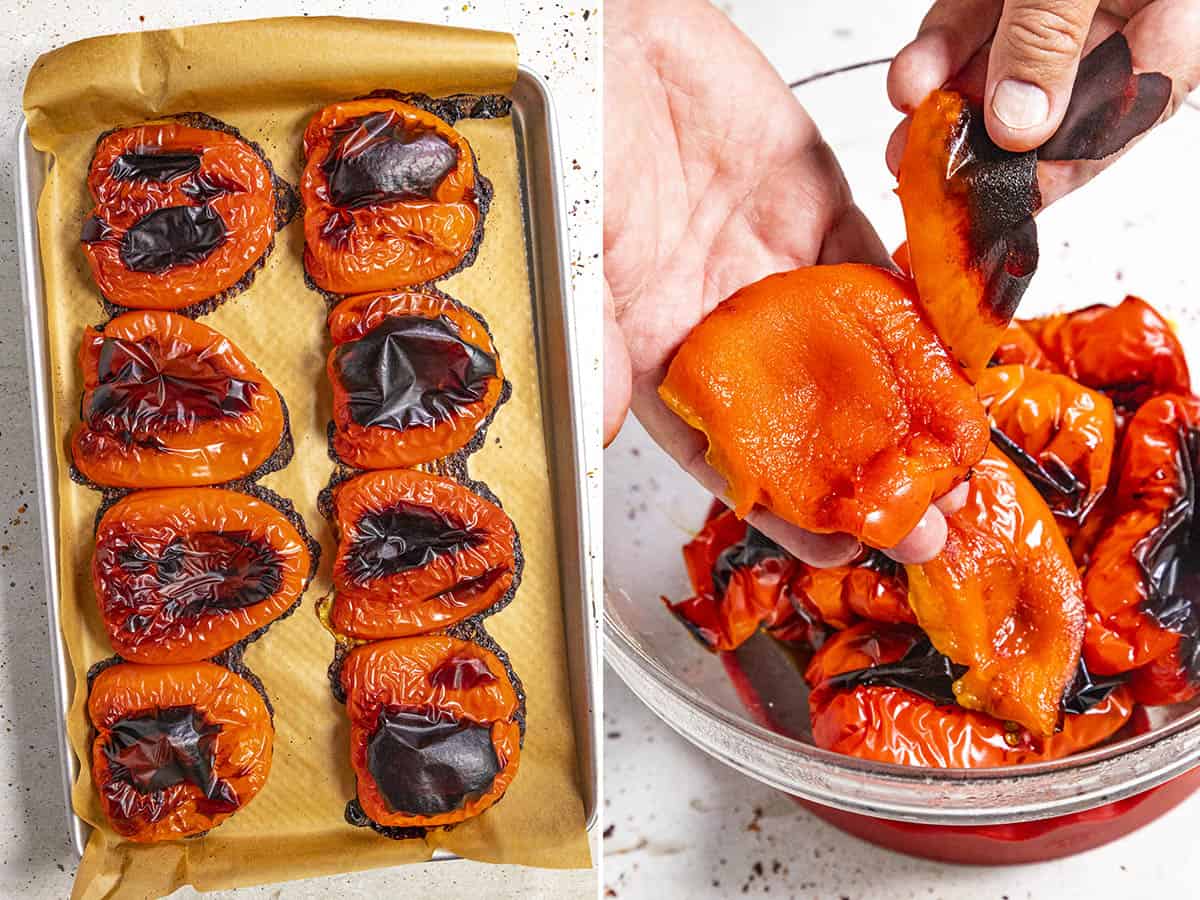
- Peel off every bit of charred skin before you dice. Charred skin can affect how heat moves through the jar during processing. Blister the peppers, steam them under a damp towel for a few minutes, then peel the skins off and discard them.
- Measure your 9 cups after roasting, peeling, coring and dicing. Not before. Roasted peppers shrink quite a bit, so if you measure raw, it will throw off your ratios. Roast first, clean them up, dice, then measure.
To roast: place the peppers under the broiler or in a 400 degree oven for 6 to 8 minutes until the skins blister, or char them right on a gas burner. Cover them with a damp cloth for a few minutes to loosen the skins, then peel, seed and dice. See my post on how to roast peppers with 4 methods to choose from.
One thing I'd leave alone for now is the tomatoes. The guidance I got covers roasting peppers, not tomatoes. Roasting tomatoes changes their moisture quite a bit, and I don't have an answer on that one, so stick with the blanch and peel method for those.
What You Can Change and What You Can't
This recipe isn't as restrictive as it may seem. You can use just about any chili pepper you like, and you can adjust the onion-to-pepper ratio any way you like, which gives you a lot of room to experiment.
You just can't add more stuff. That's basically it.
Yes, go ahead
| Change | Why it's fine |
|---|---|
| Swap chili varieties, same total volume | Variety doesn't affect acidity. Total volume does. |
| Change the onion-to-pepper mix, same 9 cup total | The recipe was tested for any combination |
| Swap red, white or yellow onions | Interchangeable, cup for cup |
| Add dried herbs and spices | Dried seasonings don't shift the acidity. Keep it to about a tablespoon for flavor's sake. |
| Adjust the salt | Salt is flavor here, not preservation |
| Roast the peppers first | Fine, as long as you peel off the charred skin and still measure 9 cups after dicing |
| Use bottled lemon instead of bottled lime | Both are standardized and both work in this recipe |
| Halve the recipe | Cut every ingredient by the same amount and keep the processing time the same |
| Leave seeds/innards in or take them out | Flavor and heat, not safety |
No, don't
| Change | Why not |
|---|---|
| Double the recipe | A double batch cooks unevenly and leaves jars sitting too long before they go in the canner, which risks underprocessing. Make two batches instead. |
| Add or increase fresh garlic, cilantro or fresh herbs | Fresh low-acid additions pull your acidity down |
| Increase the total onions or chilies past 9 cups | This is a classic mistake. More vegetables, same acid. |
| Add corn, beans, carrots or any other vegetable | Never tested for acidity or heat penetration |
| Use vinegar instead of the citrus | Less acidic than what this recipe was tested with |
| Use fresh squeezed lemon or lime | Not standardized. Acidity swings fruit to fruit. |
| Cut back on the juice | The acid is what makes this safe to can |
| Use quart jars | No tested salsa recipe exists above pint size |
| Thicken it with paste, flour or cornstarch | Changes how heat moves through the jar |
If your favorite salsa is on the "don't" list, don't worry. I have a solution for you further down.
How to Can Salsa, Step by Step
Get your jars going first. Wash them, then hold them hot until you're ready to fill. Cold jars plus hot salsa equals cracked glass. Have your lids and bands clean and ready.
Peel your tomatoes. Carefully drop them in boiling water for 30 to 60 seconds and watch for the skins to split. Move them straight into cold water, and the skins peel off very easily. Core them, squeeze out the seed pockets, then chop to about ½ inch. You want 6 cups total.
Dice and measure your onions and chilies. Dice everything to about ¼ inch and measure it level in a dry measuring cup. Stop at 9 cups total. Use gloves for handling hot chilies.
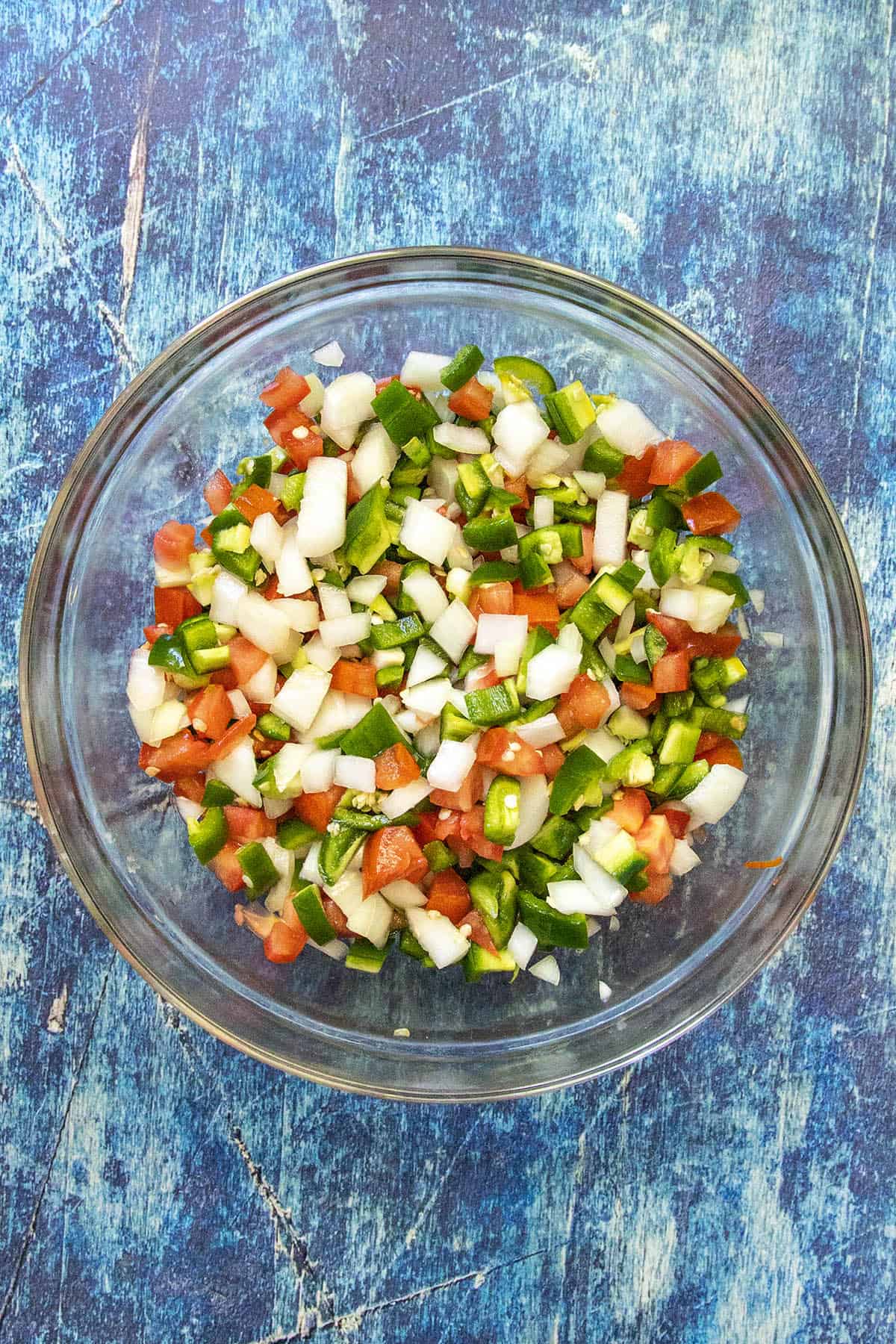
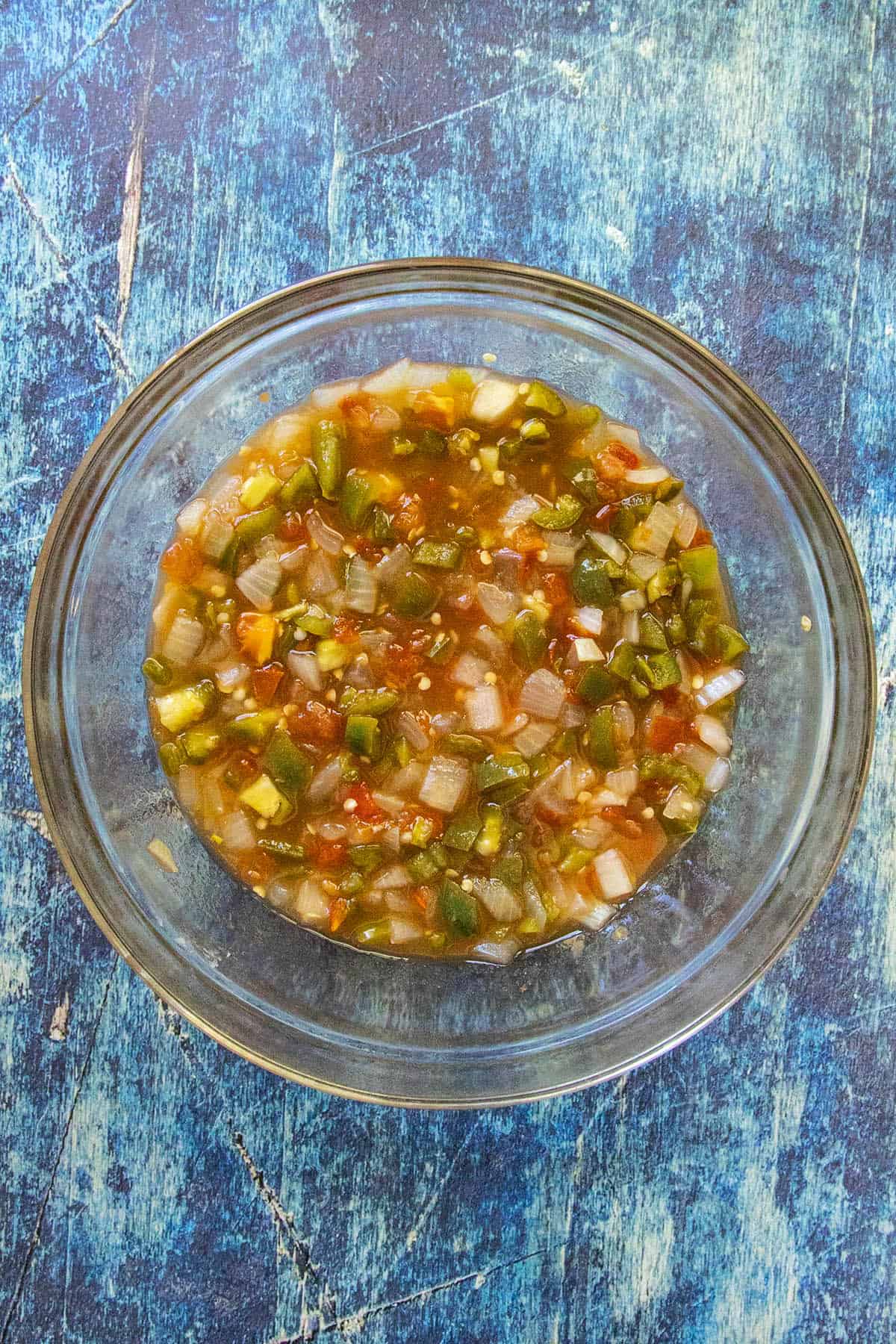
Cook it down. Add everything to a big pot with the juice and salt. Bring to a boil over medium heat, stirring as you go. Drop the heat and simmer 3 minutes. The short cook keeps the salsa bright and a little chunky.
Fill your jars. Ladle the hot salsa in and leave ½ inch of headspace. Run a bubble remover or a plastic knife around the inside to release trapped air, then check your headspace again and top up if it dropped. Wipe the rims with a damp paper towel, because a speck of salsa on the rim will cost you the seal. Lids on, bands fingertip tight.
Process. Into the canner, water at least an inch over the tops. Lid on, bring it to a full rolling boil, and only then start your timer. 15 minutes at sea level, longer if you're up high. If the boil stops at any point, you start the timing over.
Cool and check. Heat off, lid off, let the jars sit 5 minutes in the water. Lift them out onto a towel, an inch apart, and then leave them alone. No poking, no tightening. After 12 to 24 hours press the center of each lid. If it's curved down and doesn't move, you're sealed.
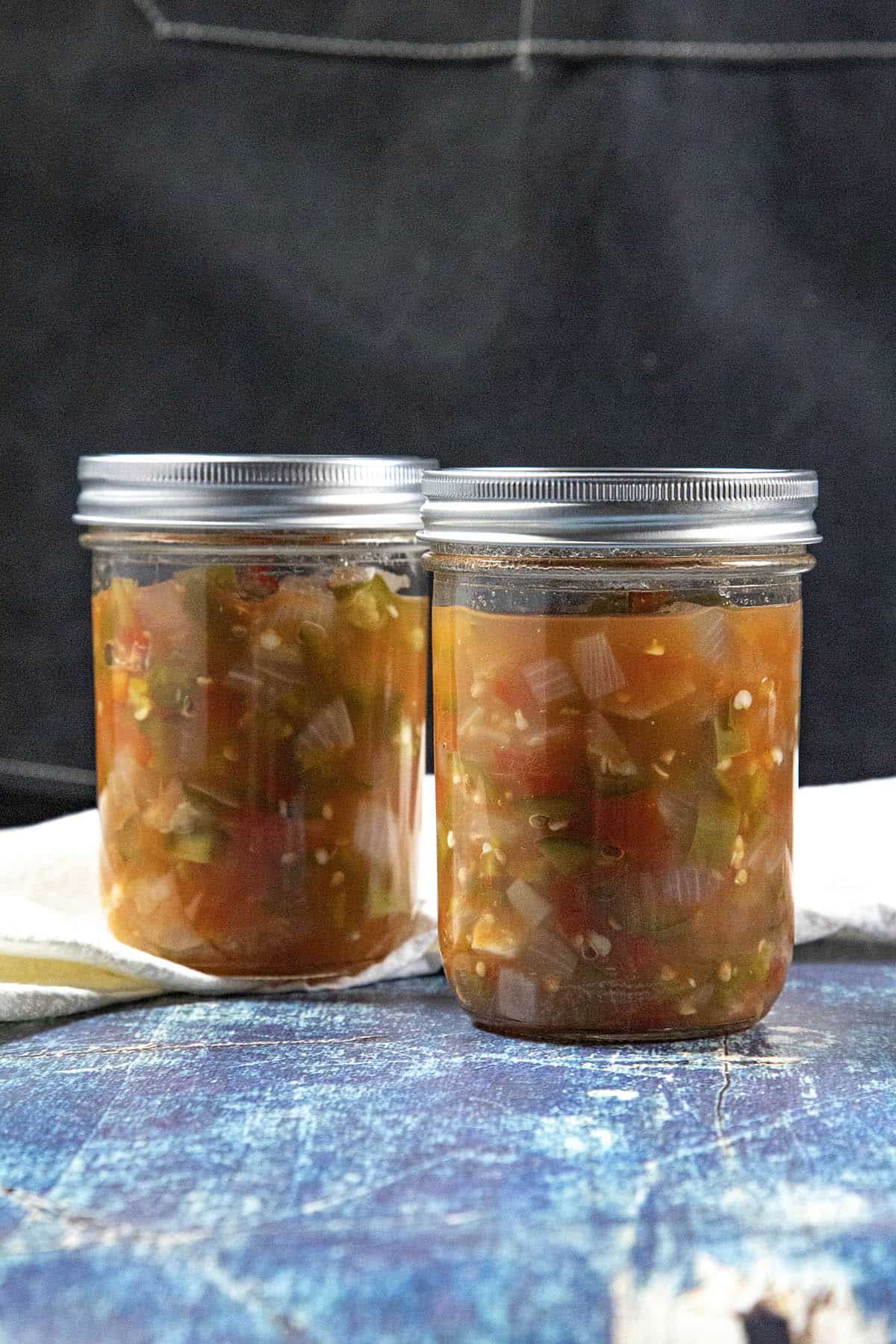
Anything that didn't seal goes in the fridge and gets eaten within a few days, or reprocess it within 24 hours with a fresh lid.
Storage and Shelf Life
Take the bands off before you store them. Leaving bands on can hide a failed seal and trap moisture under the ring, which rusts the lid.
Wipe the jars down, label and date them, and keep them somewhere cool, dark and dry. Use them within a year for best quality. They are still safe at 366 days, but the color and flavor tend to fade.
Once you open a jar, keep it in the fridge like anything else.
Throw a jar out without tasting it if the lid is bulging, the seal has failed, it spurts when you open it, you see mold, or it smells off. Do not taste to check.
Can You Just Test Your Salsa With a pH Meter?
The National Center for Home Food Preservation now says it clearly: a home pH meter can't tell you whether a salsa is safe to can. Consumer meters aren't accurate enough, and a probe dipped in the liquid doesn't measure the chunks in the salsa. Even a perfect reading wouldn't give you a processing time, because that number comes from lab studies measuring how long heat takes to reach the center of a jar of one specific recipe.
So use a meter to watch acidity in fresh or refrigerated sauces. For shelf canning, use a tested recipe and follow it.
If You Want to Break the Rules
So you read the "don't" list and want to make changes anyway. You want the corn in your salsa. You want a fistful of fresh cilantro and six cloves of raw garlic and you want it thick.
Good news. Make it exactly the way you love it, then freeze it.
Any salsa on this site can be frozen - no need for canning. Ladle your salsa into freezer containers, leave some headroom for expansion, and you're done. It'll keep about six months before the quality starts to fade.
The texture does change. Chunky salsas come out softer and a little watery after thawing, so give it a stir and drain off any excess liquid. It's still great, and it's fantastic stirred into soups, chili, braises and slow cooker meals where texture doesn't matter anyway.
Or just refrigerate it and eat it within a week.
Here are some to start with:
Closing
That's canning salsa, my friends. I got your tested recipe right here with all the chilies you want and how you can change it up (or not) if you desire.
Best of luck with your gardens! Be sure to bookmark this page for when your harvest is going crazy in such a good way.
Got any questions? Ask away! I'm happy to help. If you enjoy this recipe, I hope you'll leave a comment with some STARS. Also, please share it on social media. Don't forget to tag us at #ChiliPepperMadness. I'll be sure to share! Thanks! -- Mike H.
Sources
This information is based on research-tested guidance from the following sources:
- Choice Salsa, National Center for Home Food Preservation, University of Georgia. The tested recipe this post is built on.
- Why Experts Say "No" to pH Meters in Home Canning, NCHFP.
- Can I Double the Recipe?, NCHFP.
- Salsa 101, Michigan State University Extension. On swapping peppers by volume rather than by count.
- Small-Batch Canning for the Rest of Us, UC Master Food Preserver Program. On safely reducing a batch.
- Adherence of Food Blog Salsa Recipes to Home Canning Guidelines, Savoie and Perry, Food Protection Trends, 2019.
- Home Food Preservation, NC State Extension.
If you're canning anything beyond salsa, the NCHFP site is a fantastic resource, and your county Extension office will answer questions by email. Mine did.
More Preserving Recipes
Canning Salsa
Equipment
- Boiling water canner with rack
- 6 pint jars with new lids and bands
- Jar lifter
- Canning funnel
- Bubble remover or headspace tool
- Large stainless steel pot
- Dry measuring cups
Ingredients
- 6 cups peeled cored, seeded and chopped ripe tomatoes, ¼ to ½ inch pieces
- 9 cups diced onions and peppers any combination of sweet and hot, ¼ inch pieces (see Notes for heat levels)
- 1½ cups bottled lemon juice or bottled lime juice
- 3 teaspoons canning or pickling salt
- 1 tablespoon dried seasonings, total (optional; cumin, Mexican oregano, granulated garlic, smoked paprika or your own blend)
Instructions
- Prep the jars. Wash your pint or half-pint jars and keep them hot until you fill them. Prepare your lids and bands according to the manufacturer's directions. Fill your canner and start heating the water.
- Peel the tomatoes. Dip washed tomatoes in boiling water for 30 to 60 seconds, until the skins split. Move them straight into cold water, then slip off the skins. Core them, remove the seeds, and chop into ¼ to ½ inch pieces. Measure 6 cups.
- Prep the onions and peppers. Peel and dice the onions. Remove seeds and membranes from bell peppers. For hot chilies, remove the stems and keep or remove as many seeds and membranes as you like for heat. Dice everything into ¼ inch pieces and measure level in dry measuring cups for exactly 9 cups total. Wear gloves for the hot chilies.
- Cook the salsa. Combine the tomatoes, onions and peppers, bottled juice, salt and any dried seasonings in a large pot. Bring to a boil over medium heat, stirring. Reduce the heat and simmer 3 minutes, stirring to keep it from scorching.
- Fill the jars. Ladle the hot salsa into the hot jars, leaving ½ inch headspace. Remove air bubbles and adjust the headspace back to ½ inch if needed. Wipe the rims with a clean damp paper towel. Apply lids and bands, fingertip tight.
- Process. Set the jars in the canner with water covering them by at least 1 inch. Bring to a full rolling boil, then start your timer. Process half-pints or pints for 15 minutes at 0 to 1,000 feet elevation, 20 minutes at 1,001 to 6,000 feet, or 25 minutes above 6,000 feet.
- Cool and check seals. Turn off the heat, remove the canner lid, and let the jars rest 5 minutes. Lift the jars onto a towel, 1 inch apart, and let them cool undisturbed for 12 to 24 hours. Check that each lid is sealed and curves down in the center.
Notes
- No heat: 7 cups bell pepper
- Mild: 6 cups bell, 1 cup poblano or Anaheim
- Medium: 4 cups bell, 3 cups jalapeño, seeded
- Hot: 2 cups bell, 5 cups jalapeño and serrano, seeds in
- Very hot: 4 cups jalapeño, 3 cups habanero
- Wild: 6 cups jalapeño, 1 cup ghost, reaper or scorpion
Nutrition Information
Canning Salsa FAQ
Can I can my regular salsa recipe?
Not safely, unless somebody tested it for canning. Most salsa recipes are written to be enjoyed fresh, not with a specific acidity in mind, so there's no way to know whether they'd be safe in a sealed jar on your shelf. Use this recipe when you want jars. Freeze your favorite when you want your favorite.
Can I add more chilies to make it hotter?
No, but you don't need to. Swap hotter chilies in instead. Trade some of your bell peppers for habaneros and keep the total at 9 cups. You'll get all the heat you want without touching the part that matters.
Can I use vinegar instead of lemon juice?
No. Vinegar is less acidic than bottled citrus, so that swap makes your salsa less safe. Use bottled lemon or lime juice for this recipe.
Why bottled juice instead of fresh squeezed?
Bottled juice is standardized to a consistent acidity. Fresh lemons and limes vary a lot depending on variety, ripeness and how age. The recipe's safety math assumes a known acid level, and only bottled juice gives you that.
Can I add corn, black beans or extra garlic?
No. Every one of those is a low-acid ingredient, and adding them dilutes the acid that's keeping the jar safe. Add them after you open the jar, or make a freezer batch instead.
Can I use quart jars?
No. There's no tested salsa recipe for jars larger than a pint. A quart jar takes longer for heat to reach the center, and nobody has run those numbers for salsa.
Do I need a pressure canner?
No. This is an acidified recipe, so a boiling water canner is what you want. A tall stockpot with a rack and a lid works fine if the water covers your jars by an inch.
How long does canned salsa last?
Best quality within a year. Store it cool, dark and dry with the bands off. Once you open a jar, refrigerate it.
Can I make it with fewer chilies?
Keep the onion and pepper total at 9 cups. If you want less heat, swap hot chilies out for bell peppers cup for cup rather than leaving them out. That way you get a milder salsa without changing the recipe.
Can I double the batch?
Do one canner load at a time. If you want more jars, run a second batch. A huge pot of salsa behaves differently and canning guidance is consistent here.
Can I roast the chilies first?
Yes. I checked with NC State Extension on this question. Follow these two things: peel off all the charred skin before you dice, because char can affect heat transfer during processing, and measure your 9 cups after roasting and dicing rather than before. Roasted peppers shrink, so measuring raw puts more pepper in the jar than the recipe accounts for. I'd leave the tomatoes raw, since the guidance I have covers peppers.
Can I add spices like cumin or oregano?
Yes, dried ones only. Dried seasonings don't affect the acidity, so season it how you like. NC State suggests keeping the total to about a tablespoon so it doesn't overwhelm the batch, which is good advice. Fresh herbs are a different story, and cannot be used.
Leave a Reply