



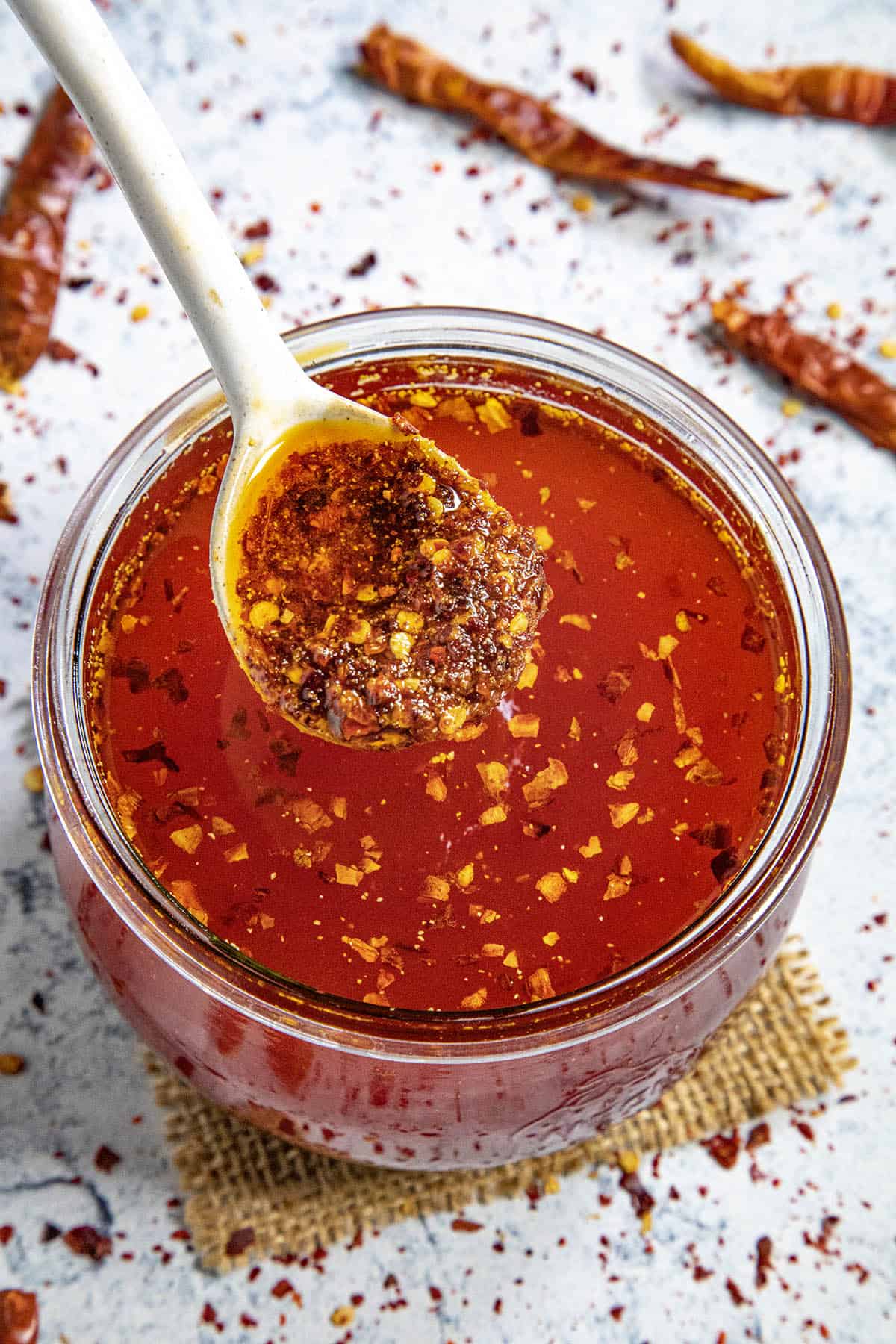
Learn how to make a simple chili oil at home with this quick and easy recipe. You only need oil and chili flakes, done in 5 minutes. I'll also show you how to make it with fresh chilies or chili powder. Homemade chili oil is great for drizzling over foods for extra spice and flavor, for mixing into sauces and vinaigrettes, as well as for cooking many meals. You'll also love my homemade chili crisp recipe.
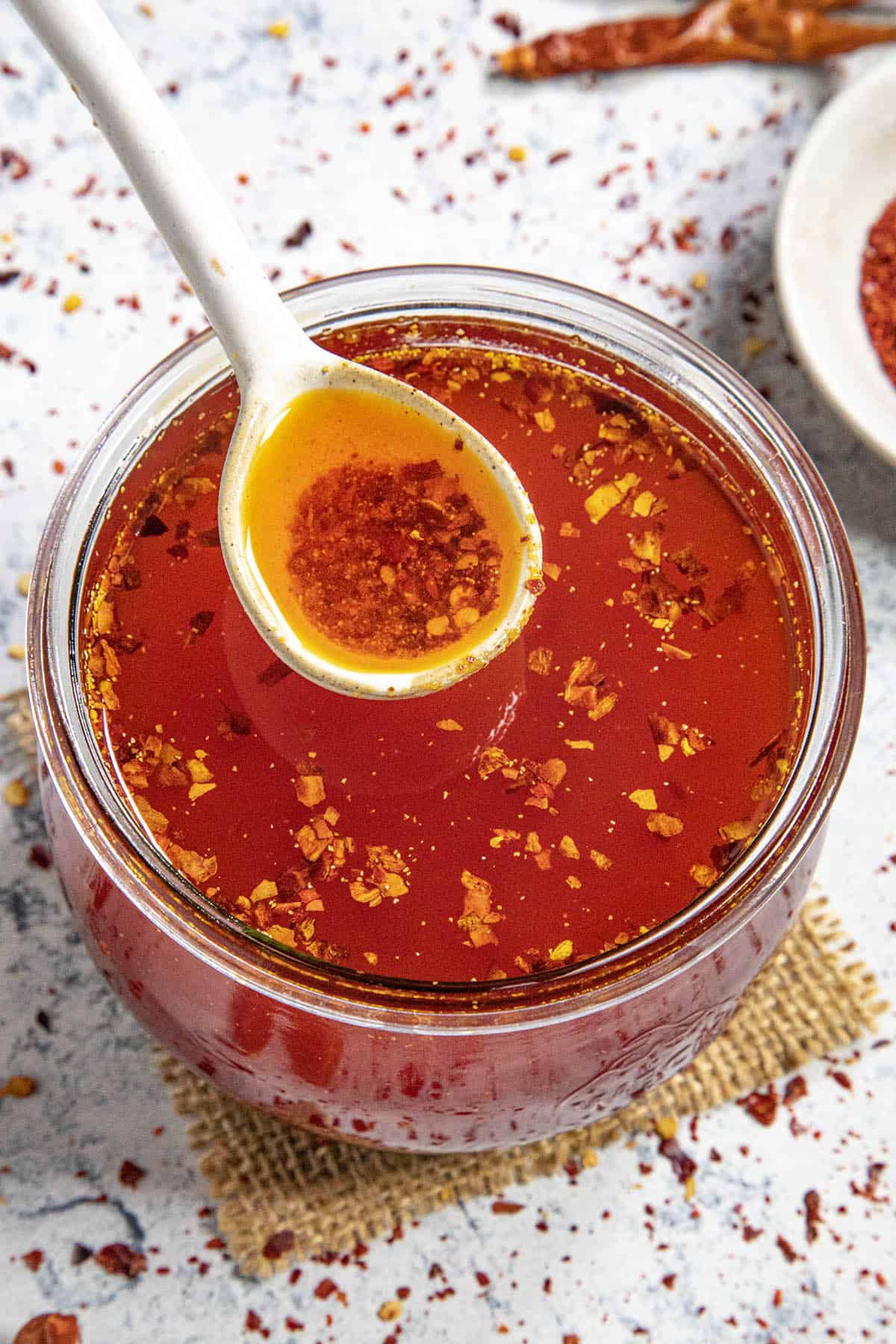
Homemade Chili Oil Recipe
I use chili oils for all sorts of recipes. They're pretty standard in certain parts of the world. They figure prominently in Chinese and Japanese cooking, and in many parts of Asia, although the Italians enjoy their own version as well.
There are many great brands on the market, but I find it best to make my own when I need a small batch, or even to give as a gift, and to really customize what I'm looking for.
Making chili oil from scratch is incredibly easy, and it's also fun to make your own variations with flavors you'll never find anywhere else. All you need are 3 ingredients (oil, chili flakes, and a pinch of salt if want), and it’s ready in about 5 minutes. I’ll also show you how to make it with fresh chilies or chili powder.
What is Chili Oil?
Chili oil is made from vegetable oil that has been infused with chili peppers of choice. You can use any type of chili pepper, from mild to superhot peppers. Other ingredients are sometimes included.
You can use most types of vegetable oil, though a neutral oil is ideal for highlighting the chili pepper flavor.
Let's discuss how to make chili oil, shall we?
Homemade Chili Oil Ingredients
You only need two ingredients to make chili oil:
- Oil.
- Chili Flakes or Crushed Dried Chilies. You can also make it with fresh chilies. See my homemade chili flakes recipe.
I like to include a pinch of salt with mine, so you can say 3 ingredient chili oil, as well as a small amount of other preferred dried seasonings. More on that below.
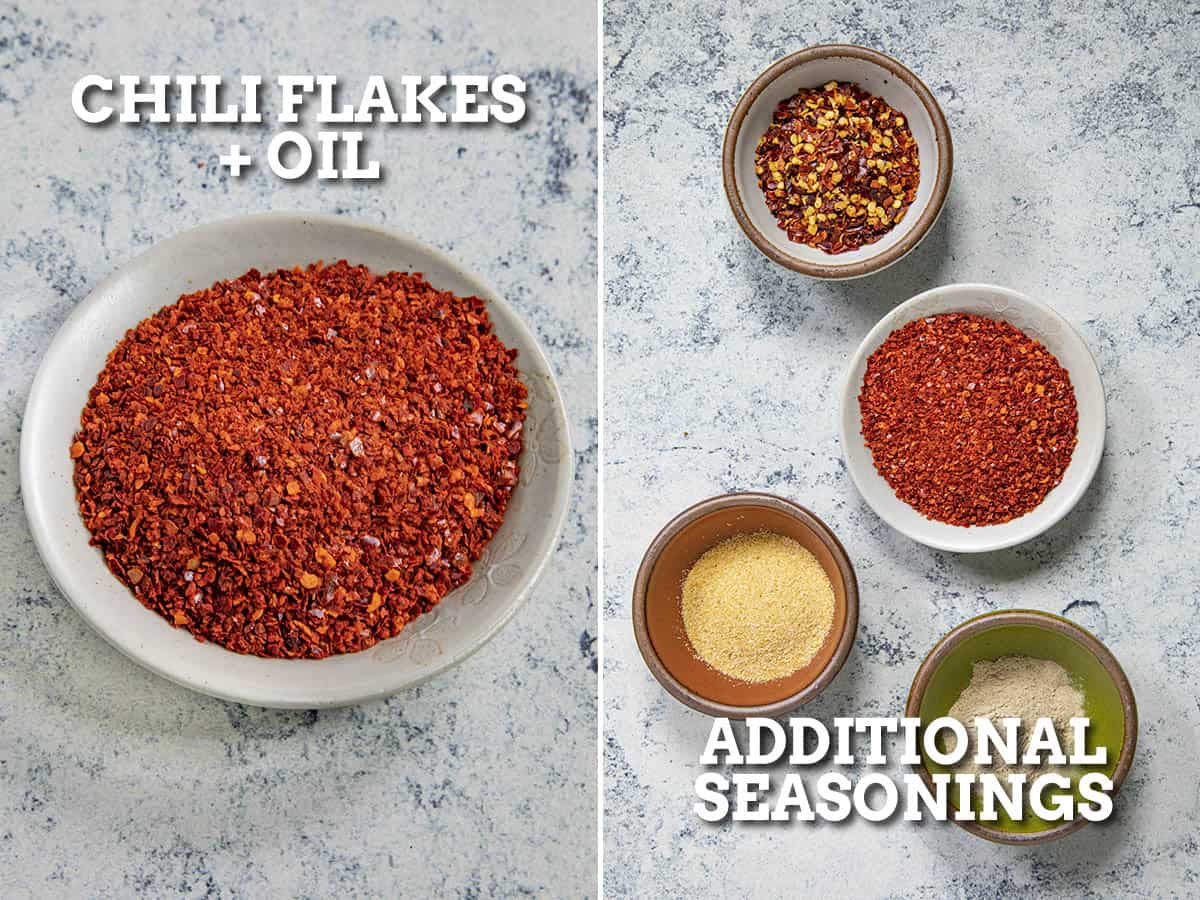
Best Oil for Making Chili Oil
Any neutral oil is best for making homemade chili oil. Peanut oil, canola oil, corn oil, avocado oil, or a simple vegetable oil make the best chili oil with real chili flavor. I do not recommend oils with stronger flavors, such as olive oil, sesame oil, or coconut oil, as they can affect the flavor of your final oil.
They can be used, however, depending on your final flavor preferences and preferred application.
How to Make Chili Oil - the Recipe Method
First, gather up the following ingredients:
- 1 cup canola oil – or any neutral oil such as peanut oil
- 3 tablespoons crushed dried peppers
- Dash of salt if desired
Prepare Your Chili Flakes & Spices. Add the chili flakes and your additional spices to a heat proof bowl. Mix well.
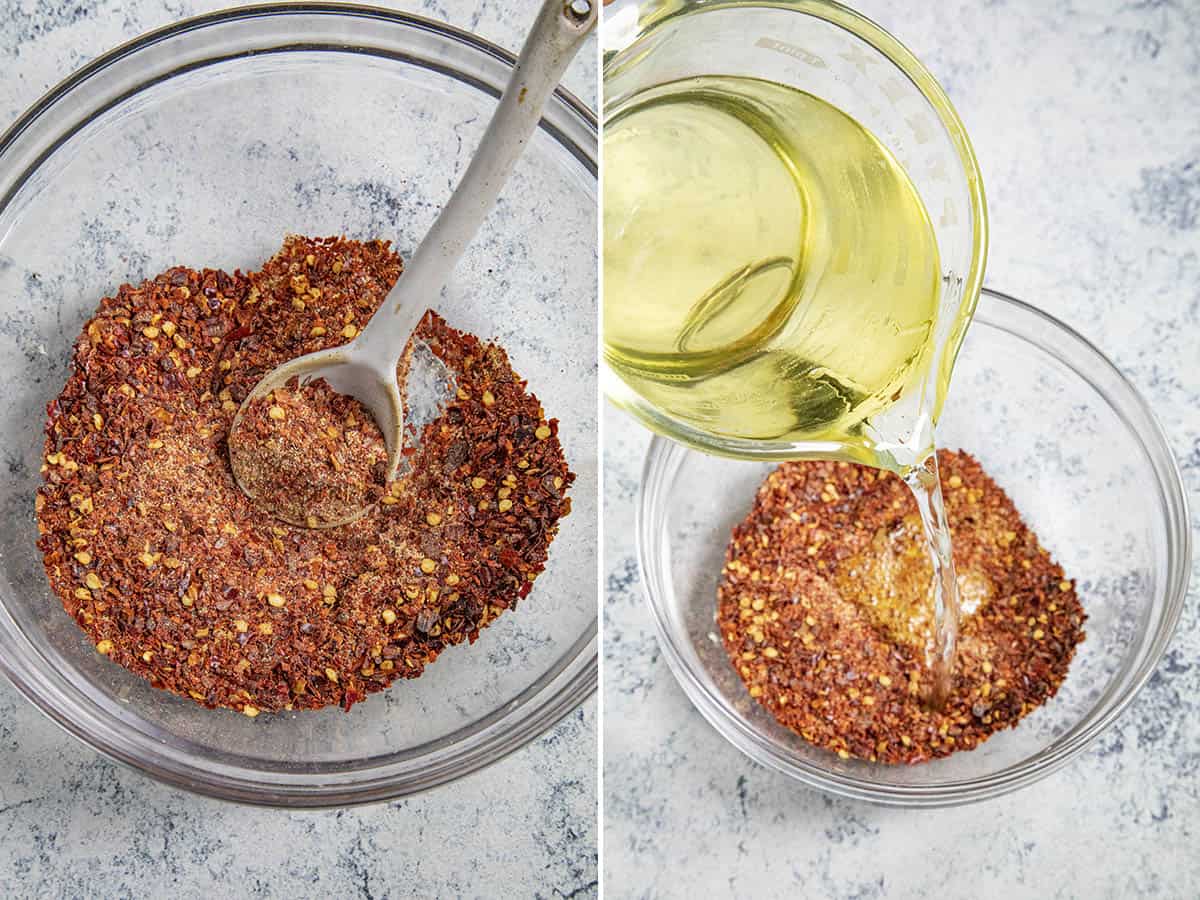
Heat the Oil. Heat the oil over medium high heat in a small pot. Do not allow the oil to smoke. If it smokes, remove it from the heat to reduce the temperature.
Mix the Hot Oil & Chili Flakes + Spices. Pour the hot oil carefully over the chili flakes. It will sizzle up nicely. Mix well. Cool and strain if desired.
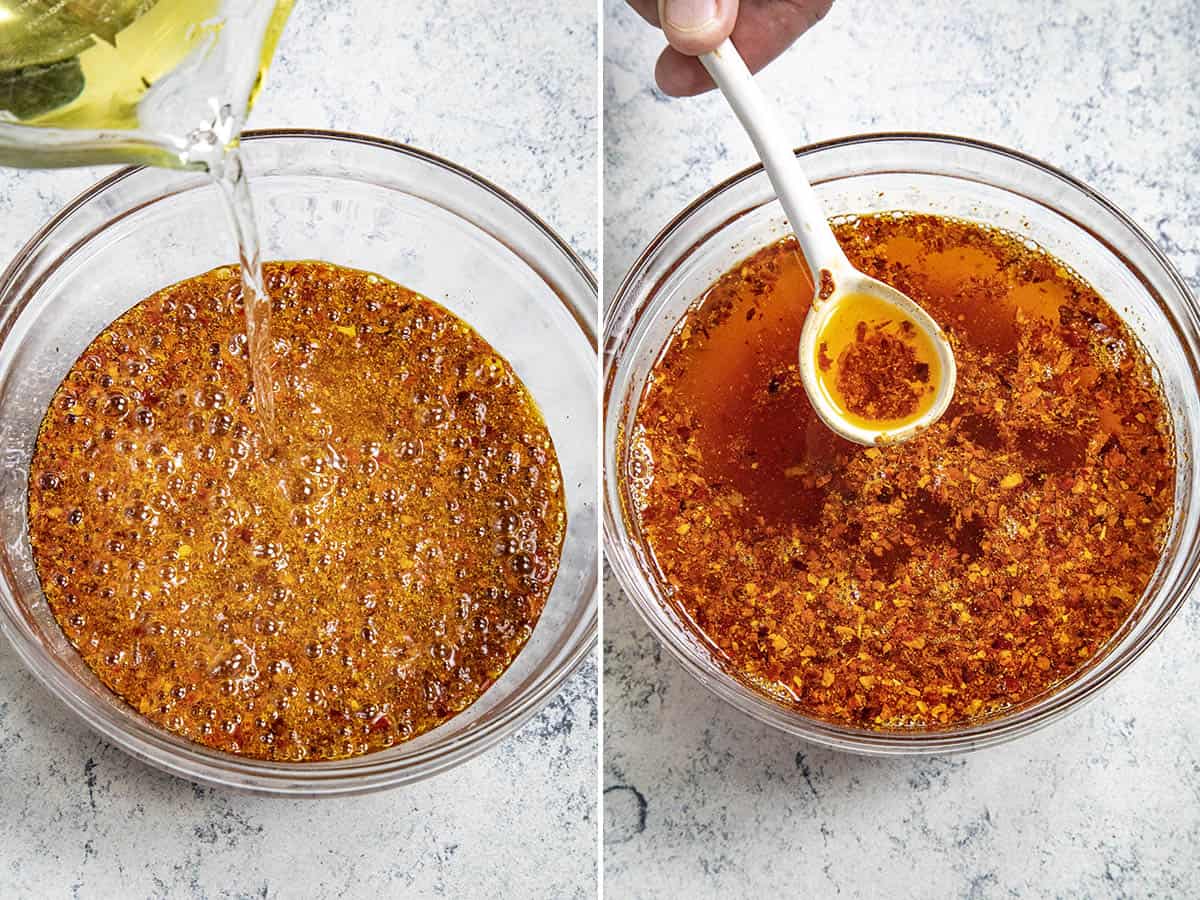
Transfer to a glass container. Use immediately or store.
BOOM! Done! Super easy, isn't it? Soon you'll be making chili oils of your own and drizzling it over anything and everything.
Recipe Tips & Notes
Oil Temperature. Heat your oil to 180 degrees F minimum, or to 350 degrees F maximum for a darker oil. Do not let your oil smoke or get any hotter, or it can burn your chili flakes and spices, resulting in a bitter flavor.
If you do not have a temperature gauge, you can test it by adding a tiny pinch of chili flakes to the hot oil. It is ready when the flakes sizzle.
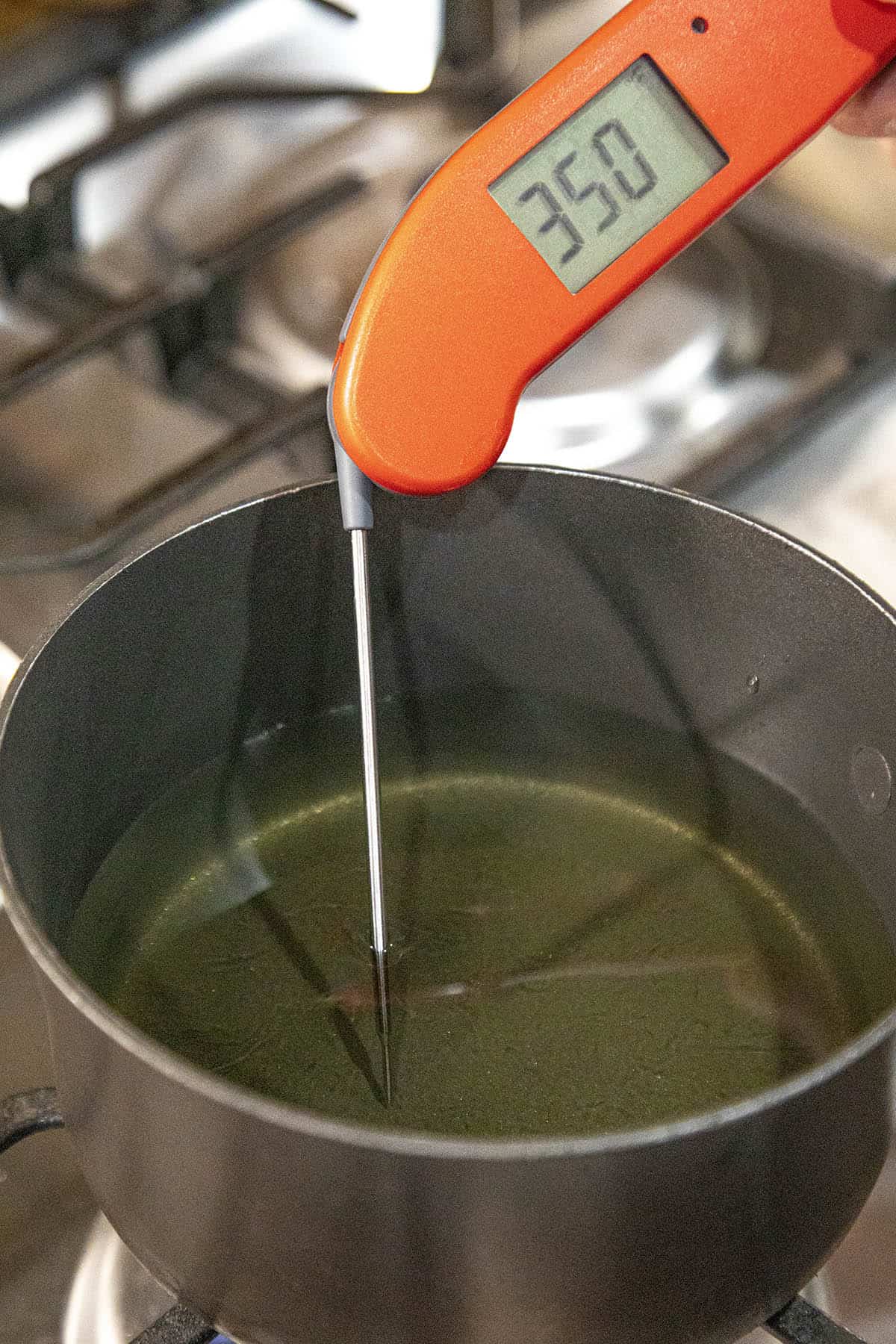
I recommend the Thermoworks Thermapen ONE thermometer (affiliate link, my friends!). It works GREAT for meats and making oils.
You can strain your oil through a thin sieve or cheese cloth to remove the peppers/sediment, depending on how finely you chop/crush the peppers.
You can also include whole dried chili peppers into the oil, which can be decorative.
What Other Ingredients Can Be Used to Make Chili Oil?
Other ingredients might include granulated garlic, white pepper, salt or msg, cayenne pepper, paprika or other chili powders, cinnamon, shallots, peppercorns, Sichuan peppercorns (for a Sichuan style or Chinese chili oil), ginger, soy sauce, sesame seed, bay leaves, star anise, crushed red pepper flakes, and so much more.
You can essentially infuse your oil with any number of ingredients and creative combinations. Feel free to dream up your own personal creation.
Different Types of Chili Oil
You can make many different types of chili oil, depending on the ingredients used to infuse the oil. Possibilities include:
- Chinese Chili Oil. Use Chinese chili peppers or Sichuan chili flakes, along with Sichuan peppercorns, star anise, cinnamon stick, and Chinese vinegar or black vinegar.
- Japanese Chili Oil. Use gochugaru and shichimi togarashi to make Rayu (Japanese Chili Oil).
- Calabrian Chili. Use Calabrian chili peppers to infuse the oil.
- Garlic Chili. Use garlic and spicy chili flakes.
- Nashville Hot Sauce. Nashville hot sauce is essentially a hot oil infused with cayenne and other spices.
There are many, many possibilities to explore your creativity.
How to Make Chili Oil with Fresh Chilies
You can absolutely make chili oil with fresh chilies, but the method is a bit different. Fresh peppers are full of water, and water and hot oil don’t play nice. So instead of pouring hot oil over them, you gently cook the chilies in the oil to drive off that moisture and infuse it.
What you’ll need:
- 1 cup neutral oil (canola, peanut, vegetable)
- 4-6 fresh red chilies, finely chopped (about ½ cup). Fresnos, red jalapeños, cayennes, or Thai chilies for more heat.
- Optional: 2 cloves minced garlic, a pinch of salt
How to make it:
- Pat the chopped chilies as dry as you can with paper towels.
- Add the oil and chilies to a small pot and heat over medium-low. You’ll see lots of small bubbles. That’s the water cooking out.
- Let it gently simmer for 10-15 minutes, stirring now and then, until the bubbling slows way down and the chilies soften and darken a bit. If you’re using garlic, add it for the last few minutes so it doesn’t burn.
- Remove from heat and cool completely. Strain it if you want a clear oil, or leave the chili bits in.
Important: Chili oil made with fresh chilies (or fresh garlic, shallots, or ginger) must be refrigerated. Use it within 4 days, or freeze it for longer storage. Ice cube trays work great for this. It doesn’t keep like the dried flake version, so make small batches.
Want more crunch? My Chili Crisp uses fresh ingredients fried until crispy.
Can You Make Chili Oil with Chili Powder?
Yes! Chili powder makes a deeply red, flavorful oil, but it’s finer than flakes, so it burns faster and can turn the oil cloudy. A few tips:
- Use cooler oil. Aim for the low end, around 180-250°F (82-121°C). Hot oil that works for flakes can scorch powder and make it bitter.
- Make a paste first. Stir the powder with a tablespoon or two of room-temperature oil, then pour in the warm oil. This prevents clumping.
- Let it settle, then strain. The powder sinks to the bottom after a few hours. Pour off the clear oil, or strain it through a coffee filter.
Use about 2 tablespoons of chili powder per cup of oil. Cayenne, paprika, gochugaru, or any single-chili powder works. Avoid American “chili powder” blends with cumin and oregano unless you want that flavor.
Chili Oil with Crispy Bits
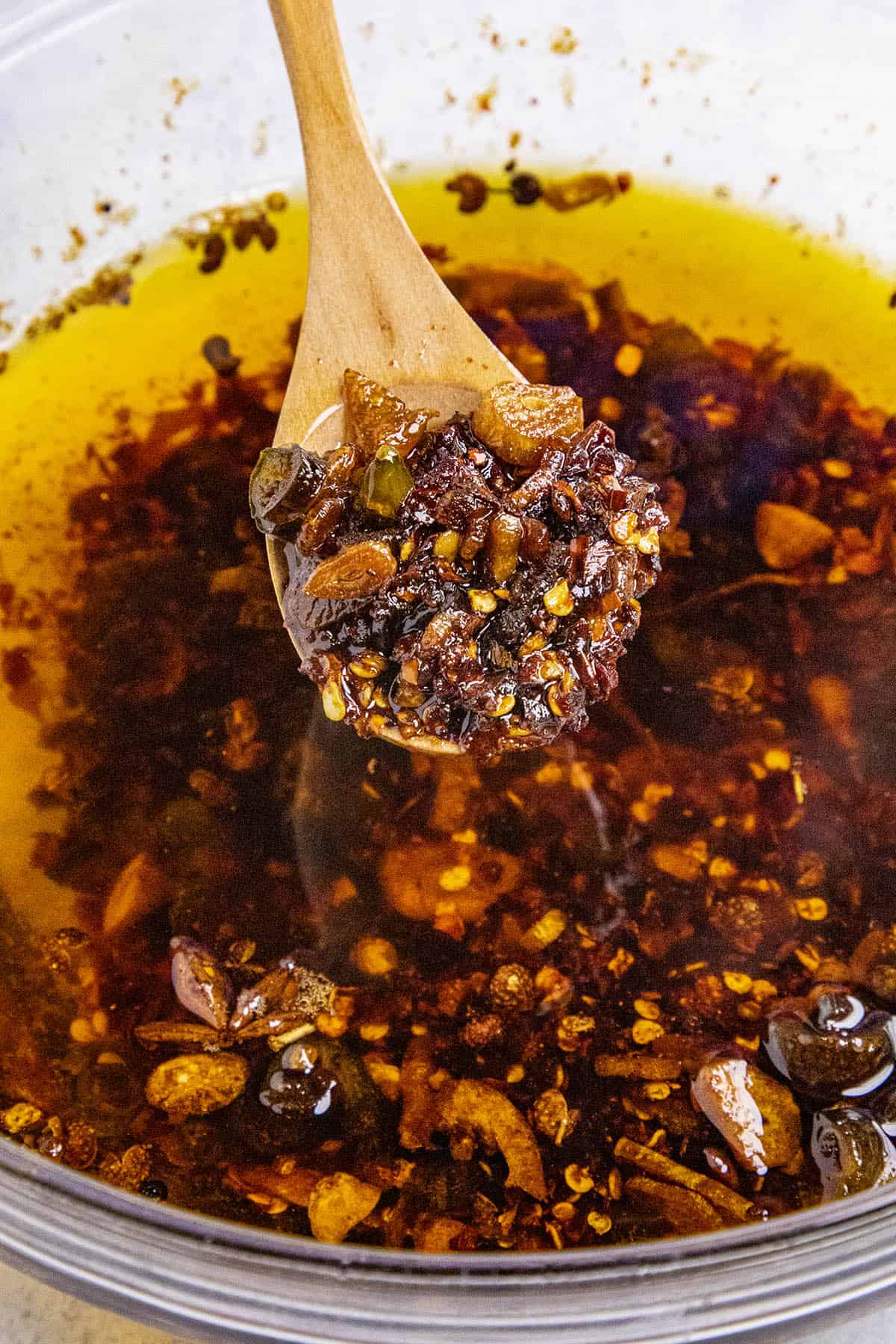
You can also use fresh ingredients, such as minced garlic, ginger root, minced shallot, and minced hot chili peppers to make chili oil with crispy bits, which is very popular today.
See my Chili Crisp Recipe (Hot Chili Oil with Crispy Bits) to learn how to make it.
Serving Suggestions for Chili Oil
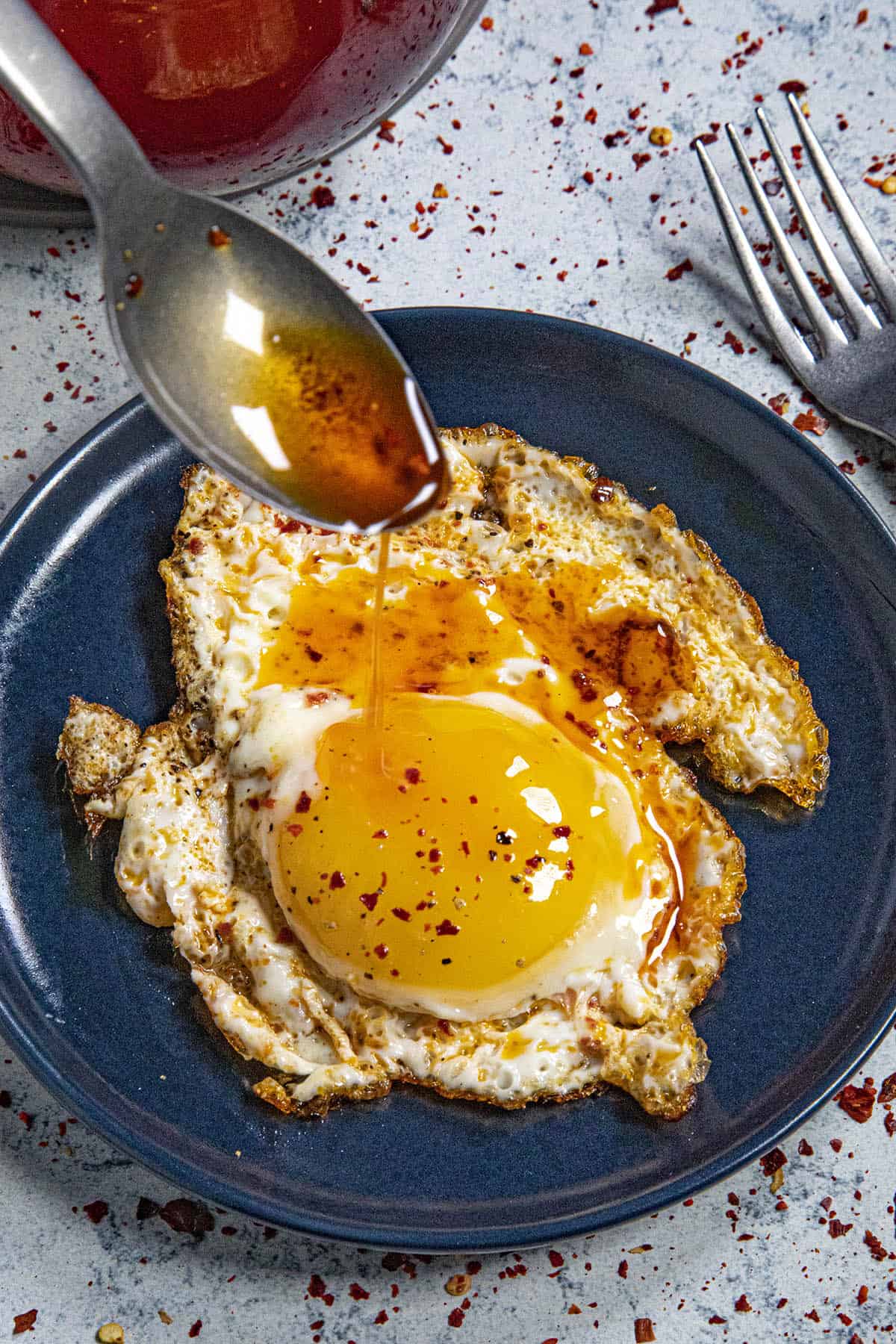
You can serve the resulting oil as a condiment or stir it into a variety of dishes, like stir fries, chili oil noodles, dressings, drizzles, gyoza sauce, and more. I personally love it for spicing up ramen noodles or drizzling over fried eggs.
You can keep the chili flakes and spices in the oil and serve it that way, or strain and serve only the oil.
The dried peppers that eventually sink to the bottom of the oil are called the “sludge,” and can be served on their own in a variety of applications.
Storage Information
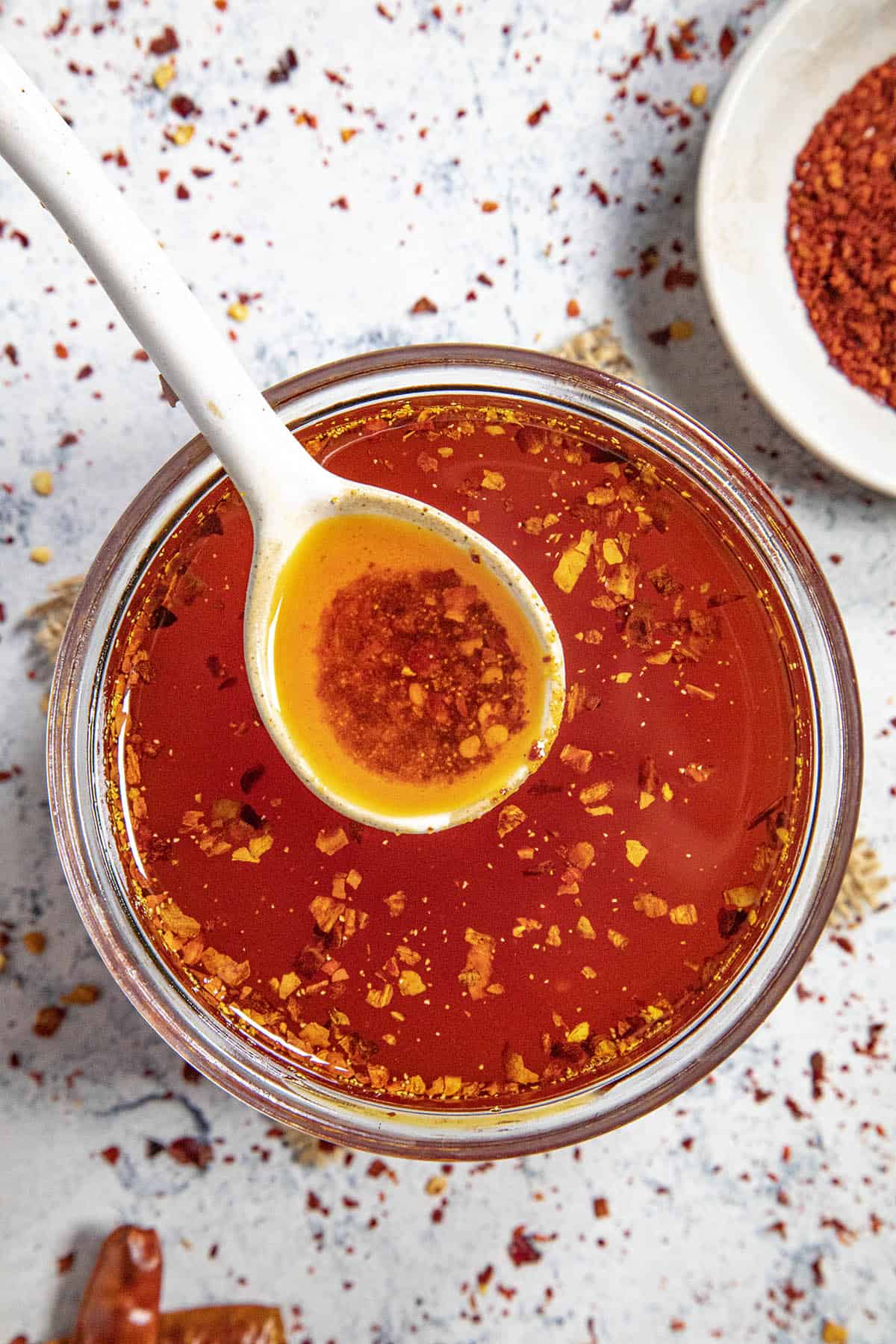
Chili oil made with dried chilies and dried spices keeps best in an airtight glass container. I keep mine in a cool, dark place and use it within a few weeks. For longer keeping, refrigerate it for up to 3 months. The oil may turn cloudy or solidify a bit in the fridge, which is normal. Let it sit at room temperature for a few minutes before using.
Chili oil made with any fresh ingredients (fresh chilies, garlic, shallots, ginger) must be refrigerated and used within 4 days, or frozen. Fresh ingredients in oil can create the low-oxygen conditions where botulism bacteria thrive, so don’t store these at room temperature.
Always use a clean, dry spoon, and toss the oil if it smells off or rancid.
Try Some of my Other Infusion Recipes
If you enjoy this recipe, I hope you'll leave a comment with some STARS. Also, please share it on social media. Don't forget to tag us at #ChiliPepperMadness. I'll be sure to share! Thanks! -- Mike H.
5-Minute Chili Oil Recipe (How to Make Chili Oil)
Ingredients
- 1 cup canola oil (or any neutral oil such as peanut oil)
- 3 tablespoons chili flakes or crushed dried chili peppers
- Dash of salt if desired
Optional Extras
- 1 tablespoon granulated garlic
- 1 teaspoon white pepper
- See Recipe Notes
Instructions
- Add the chili flakes and your additional spices to a heat proof bowl. Mix well.
- Heat the oil over medium heat in a small pot. Do not allow the oil to smoke. If it smokes, remove it from the heat to reduce the temperature. (**)
- Pour the hot oil carefully over the chili flakes. It will sizzle up nicely. Mix well. Cool and strain if desired.
- Transfer to a glass container. Use immediately. Lasts 3 months or longer in the refrigerator.
Notes
Nutrition Information
FAQs
Can you make chili oil with fresh chilies?
Yes. Gently cook chopped fresh chilies in the oil over medium-low heat for 10-15 minutes to drive off their moisture, then cool and strain if you like. Refrigerate fresh chili oil and use it within 4 days, or freeze it. See the full method above.
Can you make chili oil with chili powder?
Yes. Use cooler oil (180-250°F), mix the powder into a little oil first so it doesn’t clump, and let it settle before straining. Powder burns faster than flakes, so watch the temperature.
How long does homemade chili oil last?
Chili oil made with only dried ingredients keeps for up to 3 months in the refrigerator. If it contains any fresh ingredients like garlic, shallots, or fresh chilies, refrigerate it and use it within 4 days, or freeze it.
Does chili oil need to be refrigerated?
Any chili oil with fresh ingredients must be refrigerated. Dried-ingredient chili oil lasts longest in the refrigerator, too. See the Storage section for details.
How many calories are in chili oil?
Chili oil is almost all oil, so it’s about 120 calories per tablespoon, nearly all from fat. A little goes a long way, though. Most people use a teaspoon or two at a time.
Can I add more oil to my chili oil?
Yes. When your oil runs low, heat fresh oil to the same temperature and pour it over the remaining flakes. They’ll have given up some flavor and heat already, so stir in another tablespoon of fresh chili flakes for a stronger second batch.
Why does my chili oil taste bitter?
The oil was too hot and the chili flakes burned. Keep the oil under 350°F (177°C) and never let it smoke. If you don’t have a thermometer, test with a pinch of flakes: they should sizzle, not blacken.
What’s the difference between chili oil and chili crisp?
Chili oil is mainly the infused oil, with or without some chili flakes. Chili crisp is heavy on the crunchy bits (fried garlic, shallots, and chilies), and the oil is more of a carrier. Here’s my Chili Crisp recipe.
NOTE: TThis post was originally published on 12/15/15. It was updated on 2/22/23 with new photos and information, and again on 10/12/26 with a fresh chili method, chili powder tips, storage info, and an FAQ.
Terry says
I've been making this for a while now, adding a dash of Szechuan pepper to the mix. Thanks Mike.
Mike Hultquist says
Very nice! I love it. Thanks, Terry!
Greg Thow says
Okay, I'm going to make about 5 versions of chili oil/chili crunch this month.. first up was your strained oil. I let it cool and then drizzled on some leftover pasta. Just super delicious. I used Chinese chili peppers and I'll try next batch with just standard red chili pepper flakes. Do you strain yours or do you (as pictured here) leave the flakes in for drizzling?
Making your Conchita Pibil recipe tomorrow night.. even with the banana leaves! Thanks for all you do.
Greg
Mike Hultquist says
Nice. I hope you love it, Greg. I usually leave the bits/flakes in as I like the crunchy bits for texture, but they tend to settle to the bottom so it's easy to grab a bit of oil if needed. Enjoy!!
Klumsy K says
Solid lowdown. Thanks a bunch.
Mike Hultquist says
Thanks, Klumsy!!
Radhika says
Mike, I love your love for peppers! I am going to try hot sauce once red peppers are in season in india.
will you help me please please please with one more thing? I need to know what equipment you take pictures? your pictures are so bright! also how do you edit them?
I want to make Indian food blog, I asked many bloggers but all in vain. please do help if possible.
Mike Hultquist says
Radhika, we have a couple of Canon cameras, and I use Photoshop for editing. Good luck!!!
Miranda says
I really liked the 2015 recipe. Any chance you could post it here as well. Was it 3-5 min on heat and then take it off and put it in glass container?
Mike Hultquist says
Miranda, it's the same recipe. You really just heat the oil then pour it over chili flakes, then transfer to a container. Or really you can just add the chili flakes or fresh hot chilies to the pot of hot oil, or even just simmer them a while to infuse.
Peg says
My silly hubby who never cooks thinks he can just add cold oil to the chilli flakes. I said it not going to infuse . he is a numnut!
Mike Hultquist says
Haha, you're right, Peg. This is the best way to do it. =) Cheers!
gene says
funny. I haven't heard that name used in a while 🙂
Mike, I am enjoying your spice mixes and your creativity. Life is too short to be eating boring/plain food. Keep up the good work.
Mike Hultquist says
Thanks so much, Gene. I appreciate it.
Larry Matthews says
I recently ordered over 2#'s of African Bird's Eye pepper in both a dried power and a dried pod form. I combine the seed pod chili pepper with olive oil, after crushing with mortar and pestle the following...cinnamon stick, peppercorns, fennel seed, star of anise, coriander seed, and bayleaf. I use the recipe from Chillichump on YouTube. I have tried various oils thus far. I mix small batches that produce about 200 ml after mixing in 250 ml of oil. The ABE pepper is very hot but has a tremendous flavor. Normally about 10-20 seed pods is enough heat for me. I love it on toasted breads or naan. My sister recently drizzled some of the chili oil on popcorn and loved it. To infuse the oils and the spices, I used a mason jar and place it into a sous vide heater at about 180 degrees F. It makes the process very easy and I can experiment with 2 or 3 different jars each time I use it.
Mike Hultquist says
Sounds very much like my Chili Crisp Recipe here: https://www.chilipeppermadness.com/recipes/chili-crisp/
Duke says
I make a fair amount of fermented chile sauce, much of it with smoked peppers. I was just dumping the brine and the mash left over from straining the fermented peppers. One day I saved both and now use both the left over brines and the chile " paste" for lack of a better term.
Reading your chile oil recipe I am inspired to use some of my fermented smoked paste to make a chile oil.
Thanks Mike.
Mike Hultquist says
Sounds great! Enjoy, Duke! Thanks!
Paul says
That fried egg looks tempting…
Mike Hultquist says
Haha, do it!
Nadine says
Hi! Can I use fresh Chillis for this recipe? I have loads leftover
Mike Hultquist says
Absolutely, Nadine. Check out my Chili Crisp Recipe: https://www.chilipeppermadness.com/recipes/chili-crisp/
oscar martinez gutierrez says
RIQUISIMAS RECETAS FELICIDADES
Mike Hultquist says
Gracias!
Jay Verge says
i tried the chilli sauce in a Chinese restaurant and love it
Robert Brenneck says
Are the chili pepper seeds removed before, after or at any time for this recipe?
Thank you,
BB
Mike Hultquist says
It's your choice, Robert. They are edible, though some people don't like them floating around. I usually leave them in.