


Learn how to ferment peppers to make pepper mash at home so you can make your own homemade hot sauces and help preserve your abundant chili pepper harvest. Fermenting chili peppers is a fun, great way to preserve them, and essential for making hot sauces.
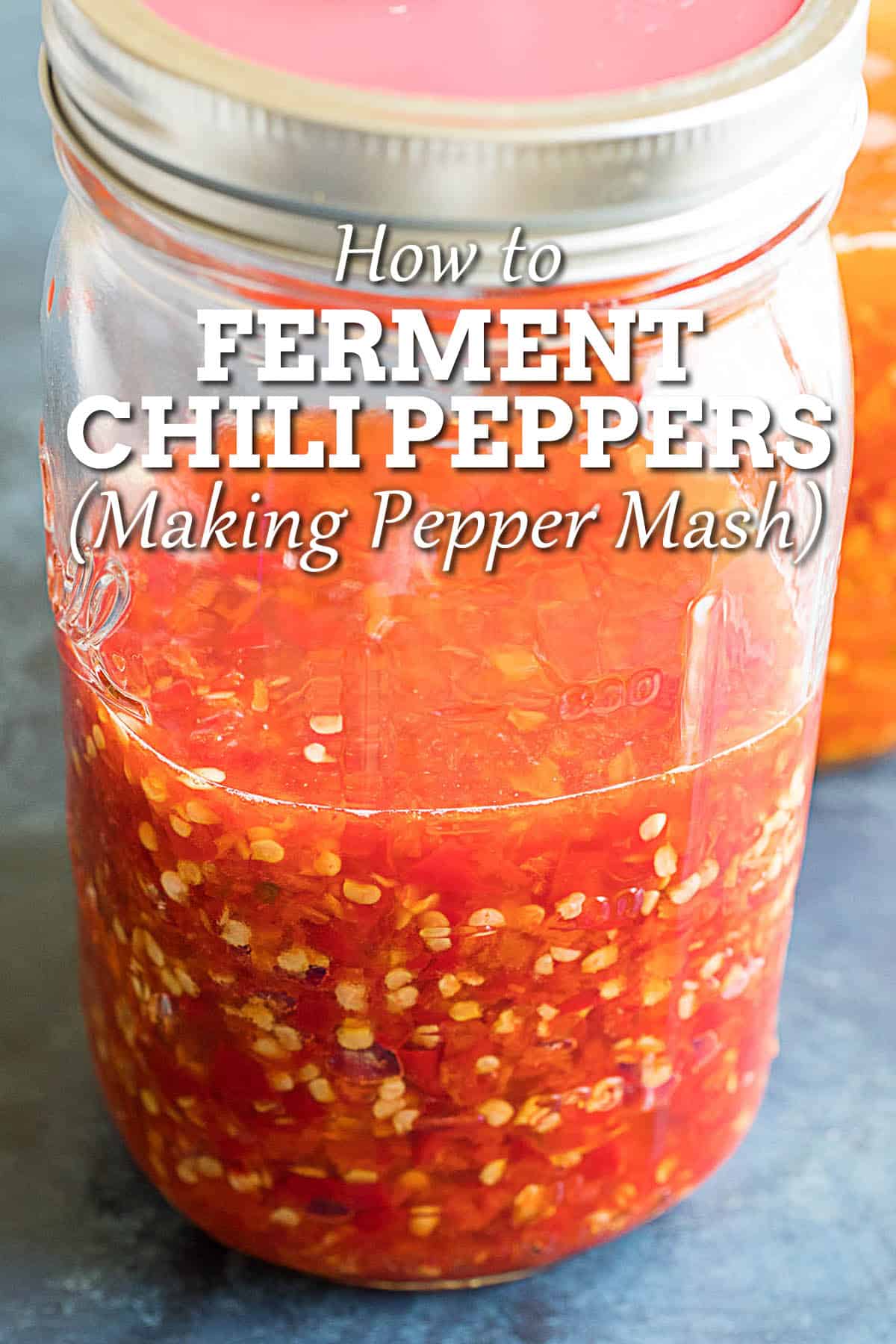
How to Ferment Peppers (Make Pepper Mash)
There are many ways to make hot sauce, and as you can tell by our Hot Sauce Recipes section of the web site, I’ve made a lot of them. However, one way we have yet to explore is making them with fermented chili peppers.
If you’ve ever enjoyed Tabasco sauce, you’ve tasted fermented chili peppers. Tabasco starts with tabasco peppers which they crush, mix with salt, and ferment in oak barrels for up to 3 years. The original Tabasco sauce only uses 3 ingredients – tabasco peppers, salt, and distilled vinegar.
A number of hot sauce makers use fermented peppers in the form of pepper mash to make their products, and a good pepper mash makes a difference in the resulting flavors. If you’re interested in making sauces from pepper mash, good news. It’s easy to make at home and you don’t need to wait 3 years for it to be ready.
But first…
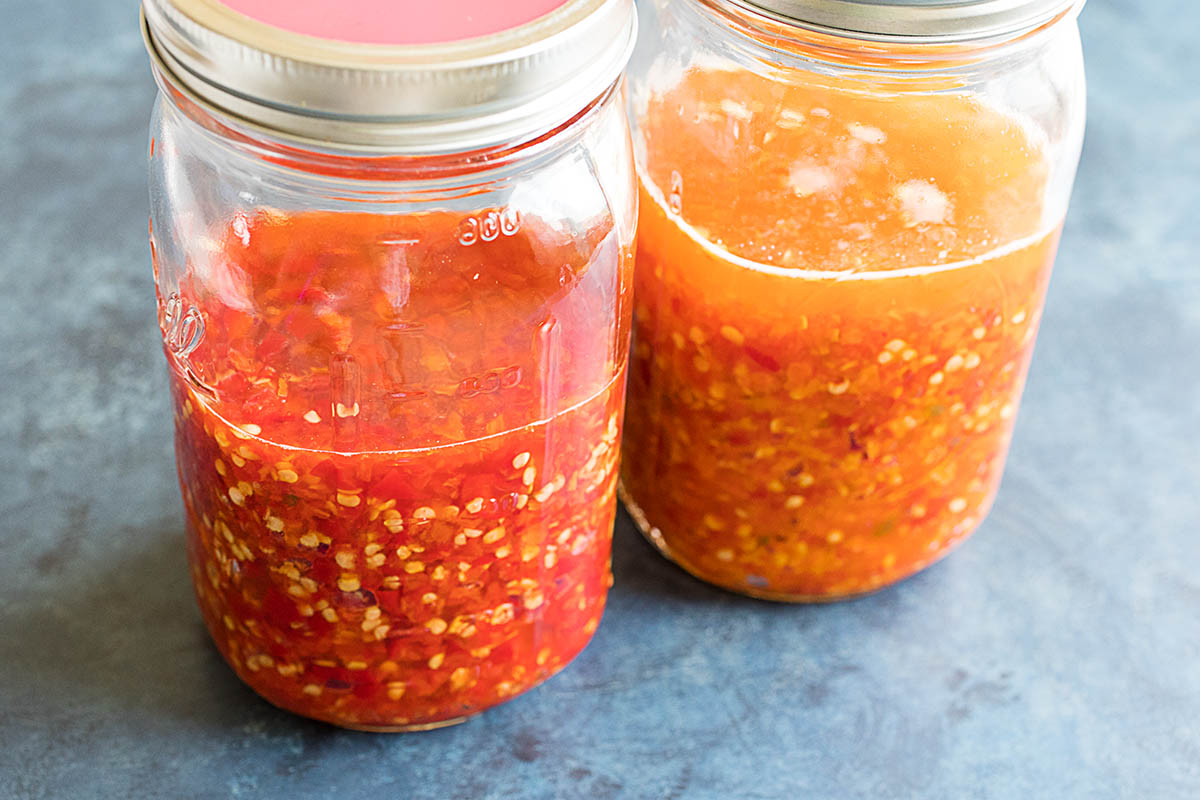
What is Fermented Pepper Mash?
Pepper mash is a collection of chili peppers that have been mashed together with salt then aged until they break down chemically. Fermentation is one our oldest methods of food preservation. Humans have preserved many foods this way, from cheeses to wine to a slew of other vegetables.
Fermentation, basically, is the decomposition of foods by micro-organisms (Lactic Acid Bacteria) or enzymes. We create an anaerobic (no oxygen) environment for the peppers so the natural Lactic Acid Bacteria can thrive, and other undesirable bacteria cannot.
Bad bacteria or rotting molds, cannot survive in an anaerobic environment, which we create with salt and brine, therefore protecting the peppers while the good bacteria do their work. The salt is not actually the preservative. It is the acid produced by the fermentation process that does the preserving.
Lactic acid bacteria consumes carbohydrates in the peppers and converts them to acid. After fermenting, the carbohydrates have been predigested, leaving them with more vitamins and flavor than fresh peppers.
It is akin to a controlled decay process, and there are numerous benefits to fermentation, including more digestible foods and more desirable flavors. With peppers, you’ll notice a mellowing of flavors, changes in color, and in the pleasant smell of the resulting mash.
How Safe is Fermenting Peppers?
Fermenting peppers is very safe! Before I began my exploration into fermentation, I succumbed to the common misconception that fermenting could easily lead to rotten or even dangerous foods, but in truth, fermentation is very simple and hard to mess up.
The key is to ferment properly. You’ll know if you’ve made a mistake by the smell of a ferment. It will smell “off” or “rotten”.
The fact is, we’re fermenting in a controlled environment, so just be sure to follow the proper procedures.
Making Basic Pepper Mash
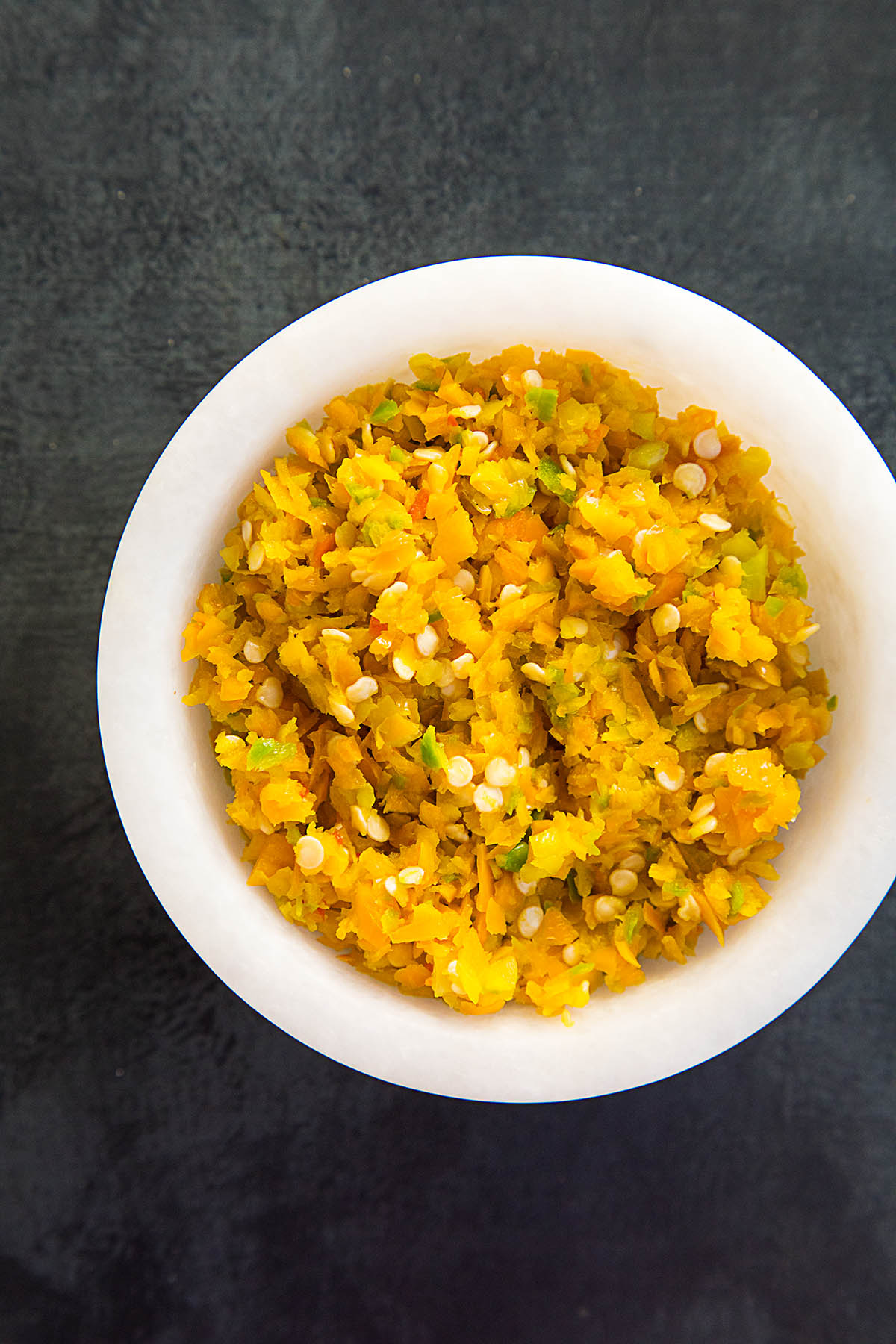
You can make fermented pepper mash from any type of chili pepper, even dried peppers. Your only consideration is the thickness of the pepper walls. Thicker walled peppers may need to be strained after the fermentation period, to remove the coarser skin, so you don’t need to seed them if you don’t want to.
Thinner walled peppers won’t need straining, so you may want to seed them first if you prefer a smoother result when you process the mash later on.
To make pepper mash, first process your fresh peppers in a food processor. If you don’t have a processor, use a mortar and pestle or simply finely chop them.
Next, mix in salt. Use 2-3% salt by weight of your chilies. For 1 pound (454 g) of chilies, that's 9-14 grams of salt, roughly 1½ to 2½ teaspoons of fine sea salt, though this varies quite a bit by salt type. Coarse kosher salt can weigh half as much per spoonful as fine sea salt, so a kitchen scale is the most reliable way to do this.
Note that mash and brine ferments calculate salt differently. With a mash there's no added water, so the salt percentage is based on the weight of the chilies. With a brine, the percentage is based on the weight of the water. That's why the brine method calls for tablespoons while the mash calls for teaspoons.
Resources vary in their salt recommendations. Most recommend 2-5% by weight and up to 10%, with 2-3% being ideal.
The peppers will begin to release their moisture right away. A note about salt: most salts are fine to use, but avoid using salts with additives, such as table salt.
Place your mash into a jar and press it down to remove any air pockets. Leave at least 1 inch (2.54 cm) of headspace. The peppers may rise a bit when fermenting. The brine will rise up and cover the peppers. It is important to keep the peppers covered with brine to avoid spoilage. Check this daily.
Screw on the lid and set the jar away from direct sunlight to ferment for at least 1 week. Ideal temperatures are between 55-75 degrees F (12.78-23.89 C). The most active fermentation period is between 1-2 weeks, so be sure to monitor it during this time. “Burp” the jars often by unscrewing the lid a bit to let out some of the accumulating gases. Or, use an airlock or membrane for easier fermenting. See below for what I like to use.
After 1-2 weeks, the fermenting activity will diminish. Move it to a pantry where you can let it ferment longer if you’d like, or use it right away. You can ferment for months or even longer to allow the flavors to more fully develop.
Once it is ready, store it in the refrigerator where it will last for a year or longer.
Making Brine Pepper Mash
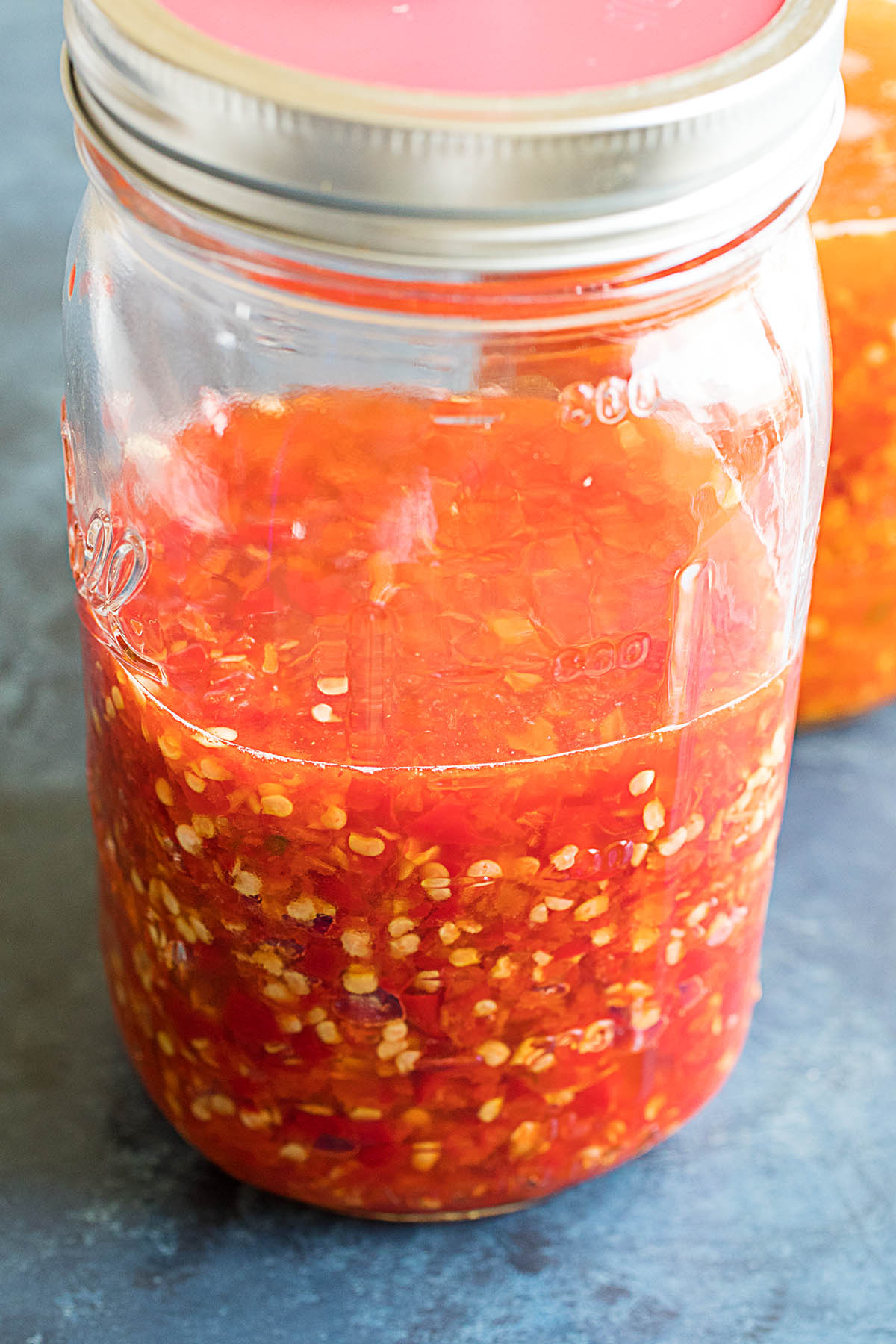
An alternate method to the basic pepper mash is using a brine, which is a salt water solution. The primary difference is that we’re adding water rather than using the natural juices from the peppers. This method ensures the peppers stay beneath the brine, and is more ideal for thinner walled peppers.
To make a brine pepper mash, first chop your fresh peppers. You can process in a food processor or use a mortar and pestle or simply finely chop them. Pack them into a jar, leaving at least 1 inch of head space. The peppers may rise a bit when fermenting.
Next, mix 1 quart (.95 liter, about 946 g) unchlorinated water with 28 g salt for a 3% brine, or up to 54 g for a 6% brine. That works out to roughly 1.5 to 3 tablespoons of fine sea salt. Pour just enough brine over the peppers to cover them, pressing them down a bit as you go. It is important to keep the peppers covered with brine to avoid spoilage. Check this daily.
Screw on the lid and set the jar away from direct sunlight to ferment for at least 1 week. Ideal temperatures are between 55-75 degrees F (12.78-23.89 C). The most active fermentation period is between 1-2 weeks, so be sure to monitor it during this time. “Burp” the jars often by unscrewing the lid a bit to let out some of the accumulating gases. Or, use an airlock or membrane for easier fermenting. See below for what I like to use.
After 1-2 weeks, the fermenting activity will diminish and the brine will turn cloudy and taste acidic. Move it to a pantry where you can let it ferment longer if you’d like, or use it right away. You can ferment for months or even longer to allow the flavors to more fully develop.
Once it is ready, process it with a food processor. You can use it right away to make hot sauce or store it in the refrigerator where it will last for a year or longer.
I personally like to add a bit of vinegar at this stage before storage.
Good luck, and happy fermenting! Let me know what you make with your pepper mash.
Frequently Asked Questions about Fermenting Peppers and Making Pepper Mash
Best Salt for Fermenting Peppers
When fermenting chilies, it is important to use salt that does not contain anti-caking agents or iodine, as these can inhibit the natural fermentation process. Here are some types of salt that are commonly used for fermenting chili peppers:
- Non-iodized Sea Salt. Sea salt is a popular choice for fermenting chili peppers, as it is minimally processed and typically does not contain anti-caking agents or iodine. Look for non-iodized sea salt, which is readily available in most grocery stores.
- Kosher Salt. Kosher salt is a coarse-grained salt that dissolves easily in water, making it suitable for fermenting. Like sea salt, kosher salt does not usually contain anti-caking agents or iodine, but it's important to check the packaging to make sure.
- Pickling Salt. Pickling salt is specifically formulated for preserving and fermenting vegetables, making it a good choice for fermenting chili peppers. It is fine-grained and dissolves easily in water, ensuring even distribution of salt in the fermentation brine.
- Himalayan Pink Salt. Himalayan pink salt is a natural salt that is often used in fermenting and has gained popularity for its trace mineral content and unique flavor. It is typically non-iodized and does not contain anti-caking agents, making it suitable for fermenting chili peppers.
When fermenting chili peppers, it's important to use the right amount of salt according to your recipe or fermentation process. Too little salt can lead to spoilage or mold growth, while too much salt can inhibit fermentation.
Why Does My Pepper Mash Taste Bitter?
I sometimes get some bitterness with my fermented pepper batches. I've seen a lot of discussion on it, whether it is from kahm yeast or from the starting peppers themselves, where the slight bitterness is amplified in the fermentation process. The best way to counter it is through the addition of other ingredients.
Also, some people report a bitterness from the pepper seeds, so try removing the seeds before fermentation and see if that affects your resulting flavor.
To counterbalance the bitterness, try adding an acid like vinegar or lime juice, which can help balance it out, then a sweetener like sugar or honey. Certain roasted vegetables can help, too, like carrots or other flavors. Garlic is good. They can all help balance out the bitterness. Give the final sauce time to rest and let the flavors meld in the refrigerator.
What is Kahm Yeast?
Kahm yeast is a whitish film that can sometimes appear on top of your ferment. It can form when all of the sugar in your ferment is consumed. The PH drops because of lactic acid buildup, allowing kahm yeast to form. It is not a mold, and can be scraped away from your ferment.
Sweeter vegetables, particular peppers, are more prone to kahm yeast.
How do I tell if peppers are fermenting?
You will often see bubbling activity in the jar as the fermentation process takes place, but not always. Sometimes you may have what is called a "quiet ferment", where it seems little activity it taking place. Fermenting peppers give off a slightly sour, pleasent smell, so trust your nose to know fermentation is taking place.
How Do You Know if the Fermentation is Bad?
You can usually tell if a fermentation is bad by sight or smell. If you see signs of fuzzy or pinkish colored mold, the ferment is infected. If the peppers are very mushy, something has gone wrong.
If the ferment smells rotten or disgusting to you, it has gone bad. Trust your nose to know if something is bad. A good ferment will have a slightly sour smell, but will smell pleasant.
Hot Sauce Recipes with Fermented Peppers
Here are some of my own recipes that use fermented chili peppers.
- Fermented Hot Sauce Recipe
- Homemade Sriracha Hot Sauce
- Fermented Aji-Garlic Hot Sauce
- Homemade Louisiana Hot Sauce
- Spicy Serrano Hot Sauce
Check out more Hot Sauce Recipes or learn more about How to Make Hot Sauce. Also see my post on Homemade Kimchi (How to Make Kimchi).
The best ph meters that I recommend are from Thermoworks. Get yourself a ph meter from Thermoworks today. I am a happy affiliate.
Got any questions? Please contact me anytime and I will do my best to help. Good luck with your pepper fermentation!
How to Ferment Chili Peppers (Pepper Mash Recipe)
Ingredients
FOR BASIC PEPPER MASH
- 1 pound chili peppers stemmed and roughly chopped (cored and seeded, if desired)
- 11 grams salt (about 2 teaspoons fine sea salt - 2.5% by weight of the chilies; use 9 g for 2%, 14 g for 3%)
FOR BRINE PEPPER MASH
- 1 pound chili peppers stemmed and roughly chopped (cored and seeded, if desired)
- 28-54 grams salt (about 1.5 tablespoons fine sea salt) for a 3% brine, up to 54 g (3 tablespoons) for 6%
- 1 quart unchlorinated water
Instructions
FOR MAKING BASIC PEPPER MASH
- Finely chop your peppers. You can blend them to fit more into jars, but this can make it harder to keep below the brine.
- Next, mix in salt. Use 2-3% salt by weight of your chilies. For 1 pound (454 g) of chilies, that's 9-14 grams of salt, roughly 1½ to 2½ teaspoons of fine sea salt
- The peppers will begin to release their moisture right away.
- Place your mash into a jar and press it down to remove any air pockets. Leave at least 1 inch (2.54 cm) of headspace. The peppers may rise a bit when fermenting. The brine will rise up and cover the peppers. It is important to keep the peppers covered with brine to avoid spoilage. Check this daily.
- Screw on the lid and set the jar away from direct sunlight to ferment for at least 1 week. Ideal temperatures are between 55-75 degrees F (12.78-23.89 C). The most active fermentation period is between 1-2 weeks, so be sure to monitor it during this time. “Burp” the jars often by unscrewing the lid a bit to let out some of the accumulating gases. Or, use an airlock or membrane for easier fermenting. See below for what I like to use.
- After 1-2 weeks, the fermenting activity will diminish. Move it to a pantry where you can let it ferment longer if you’d like, or use it right away. You can ferment for months or even longer to allow the flavors to more fully develop.
- Once it is ready, store it in the refrigerator where it will last for a year or longer.
FOR MAKING BRINE PEPPER MASH
- Finely chop your fresh peppers. You can blend them to fit more into jars, but this can make it harder to keep below the brine. Pack them into a jar, leaving at least 1 inch of head space. The peppers may rise a bit when fermenting.
- Next, mix 1 quart (.95 liter) unchlorinated water with sea salt. Pour just enough brine over the peppers to cover them, pressing them down a bit as you go. It is important to keep the peppers covered with brine to avoid spoilage. Use a glass weight or a baggie filled with water on top if needed to press the peppers down below the brine. Check this daily.
- Screw on the lid and set the jar away from direct sunlight to ferment for at least 1 week. Ideal temperatures are between 55-75 degrees F (12.78-23.89 C). The most active fermentation period is between 1-2 weeks, so be sure to monitor it during this time. “Burp” the jars often by unscrewing the lid a bit to let out some of the accumulating gases. Or, use an airlock or membrane for easier fermenting.
- After 1-2 weeks, the fermenting activity will diminish and the brine will turn cloudy and taste acidic. Move it to a pantry where you can let it ferment longer if you’d like, or use it right away. You can ferment for months or even longer to allow the flavors to more fully develop.
- Once it is ready, process it with a food processor. You can use it right away to make hot sauce or store it in the refrigerator where it will last for a year or longer.
- I personally like to add a bit of vinegar at this stage before storage.
Notes
Nutrition Information
FAQs
How Much Salt Do You Use to Ferment Peppers?
Mash and brine ferments measure salt differently.
For a basic mash, use 2-3% salt by weight of your chilies. For the brine ferment used here, use 3% salt by weight of your water.
| Method | Salt amount | For a standard batch |
|---|---|---|
| Basic mash | 2-3% of the chili weight | 9-14 g per pound (454 g) of chilies |
| Brine | 3% of the water weight | 28 g per quart (946 g) of water |
The amounts are different because you're salting a pound of chilies in one method and nearly two pounds of water in the other.
Weigh your salt if you can. A tablespoon of fine sea salt runs about 18 grams, while the same spoonful of coarse kosher salt can be as little as 9. A cheap kitchen scale is very helpful.
NOTE: This page was updated on 8/22/26 to include clarified measurements by percentages and weights, along with FAQ addition.
Richard says
I think i messed up. I wanted to use this method to make wing sauce. I made a mash using various peppers from my garden (Reapers, Scorpions, Ghost, Jalepenos). Once it was all mashed it was about 3/4 gallon in peppers. I was paranoid about mold so i added the brine solution and left it for 3 weeks. After this period, all the signs were good and so i strained of the excess water and added distilled vinegar. My plan was to mix this up with some garlic powder and after a few days, push it through a sieve to produce my sauce. The thing that worries me is that, in a moment of madness, i threw the used brine water away and i am worried that most of my chili flavour may have gone with it. Am i worried about nothing?
Michael Hultquist - Chili Pepper Madness says
Richard, no, you can still make a new brine if you'd like, or just process your peppers as described. You may have lost a bit of flavor, but that mash still has loads of flavor. You should be able to do a lot with what you have. Let me know how it turns out for you.
Richard says
Michael-You were right. When i got home last night, i used a hand blender on the mixture and then tasted it. There is still plenty of chilli flavour and of course heat!
I am not getting that classic buffalo flavour yet but i will work on that. So far the mixture contains:
Chillies
Distilled white Vinegar
Onion Powder
Garlic Powder
I will try to add some additional things from your buffalo recipe, basically smoked paprika and worcestershire sauce but i am guessing that if i want to keep it shelf stable, i will not be able to add any butter which i guess is when the true buffalo flavour will be made. I can add this when i am cooking up the sauce to put on my wings.
Will let you know how it goes.
Michael Hultquist - Chili Pepper Madness says
Sounds great. Yes, the butter is what will really bring that Buffalo flavor, mixed with the finished sauce. Definitely let me know how it goes. Good luck!
Richard says
My buffalo sauce turned out great once i added butter. The only slight grumble that i have (and this is entirely my fault)-its nuclear hot! I think i will make a new batch with mild chillis and mix them together to get a happy medium. Do you think i should ferment them or merely soak them in vinegar and mash them in the food processor?
Michael Hultquist - Chili Pepper Madness says
Sorry to hear it's too hot, Richard! If you're going to make a milder version, you can do it either way, with or without fermenting. Fermenting will mellow the overall flavors a bit, but it's really up to personal preference. If you don't feel like waiting, skip the fermenting. Let me know how it turns out for you.
Jason says
Is it safe to add more processed peppers as they ripen as long as I keep the salt to weight ratio? Or would it be better to freeze my peppers until they are all ripe and process them all together?
Michael Hultquist - Chili Pepper Madness says
Jason, to be honest, I've never added more peppers to an already fermenting batch. I try not to open the lid once it is on to avoid contamination, though sometimes you have to if you need to submerge any peppers that have floated above the brine. The brine is reusable, so I don't really see why you couldn't add more as you go along, provided you're careful to avoid contaminating the current batch. You can always just get several going at any given time, or freezing is a good option, though in that case you may need a starter of some sort to get the ferment going. Let me know how it goes for you.
Jason says
Hi Michael, thanks for the reply, that makes perfect sense.
On another topic, what is your wisdom regarding fermenting pepper "juice" versus mash? Bear with me here...
I find the seeds of some peppers to be bitter in my sauces, so to save time when I make big batches, I usually run my peppers through a cold-press juice extractor. This gets rid of the seeds and also the skins of some thicker walled peppers that don't process well, leaving me with a nice spicy pepper juice.
Would this juice make for a good ferment, or do you really need more "mass" when you ferment?
thanks for all your tips and your dedication to this site!
Michael Hultquist - Chili Pepper Madness says
You should be able to ferment the juice, Jason. If your end goal is more of a liquid, this is a good way to do it, though you can always scoop out the seeds/membranes before the ferment. Fermenting with more of a juice would be similar to making beer or kombucha.
Chilli Lovers says
Hi, i have some questions. Please help me.
1. Do i need to wash my peppers and let it dry before making a mash?
2. Is it ok if i boil my peppers and then let them cool down and Then i make a mash?
3. 1-2 weeks fermentation is slow down or just stop producing gas?
4. No more gas build up or bubbling, it means the pepper mash is finish fermenting? And i can process it for bottling?
5. How long fermentation stop or ready to bottling if i ferment 70kg or 1 drum?
6. I ask these questions because my hot sauce explode in room temperature. Please help me.
Michael Hultquist - Chili Pepper Madness says
Chilli Lovers, to answer your questions:
1. You should wash and dry your peppers after picking them, yes.
2. Yes, it is OK to do so. You don't have to, but you can ferment them either way.
3. 2 weeks is usually sufficient for a quick ferment, though you may still see activity. You can realistically ferment as long as you'd like, as long as oxygen doesn't get in. It really depends on your overall fermentation goals. I usually like to go 4-6 weeks to get a flavor change and some fizz.
4. See my response above. You may still have a "quiet ferment" and not see bubbling, but there can still be fermentation. But yes, you can process and bottle when ready.
5. I'm not sure exactly, but again, I usually go 4-6 weeks, though sometimes 3 months or longer.
6. Sorry to hear!
Let me know if this helps. Happy to help more as needed. Good luck!
John says
6. Did the hot sauce explode during fermentation or after when you processed the sauce? If it was during the fermentation, i'd suggest "Burping" the jars to release excess gas. I'd recommend using an airlock lid that you can get that fits mason jars. It sounds like you're making a very large batch, you can get 6 gallon bottles and airlocks from winemaking stores which will help. If the explosion happened after bottling the final sauce, i'd suggest using a hot water bath on your hot sauce jars to kill off any fermentation that may still be taking place.
Diane says
Hello. I am new to making hot sauce. I want to use cayenne peppers and red bell peppers. Do you consider these pepper thin or thick skinned peppers.
Thanks. Diane
Michael Hultquist - Chili Pepper Madness says
Hi, Diane. Bell peppers are pretty thick walled. Cayenne peppers are thinner walled, depending on the variety, so plan accordingly.
Mike Skinner says
Hello Mike! Well after a couple of tries, I had some success with getting a good fermentation.
Can you suggest a food processor brand/model that will better liquify my brew? I have good flavor, but the consistency isn't, well, consistent. There's too much pulp. I'm going more for a Louisiana or Crystal-style hot sauce.
I'm using a bullet presently, which just isn't liquifying the material sufficiently. I have a small food processor - but it doesn't do well AT ALL with liquid.
I would prefer to stay under $100 if you can suggest something that would do a good job.
Thanks in advance,
Mike
Michael Hultquist - Chili Pepper Madness says
Congratulations, Mike. Great job. For a blender, I use a Kitchenaid and a Magic Bullet, but have also heard great things about Blendtech.
Philip Polk Palmer says
Mike, if you want a thin, Louisiana sauce style consistency, you're going to want to strain the seeds and pulp from your mash after fermenting. You can do this with cheese cloth and rubber gloves, or by using a high quality strainer, such as a Victorio strainer. Even the best food blenders will not give you that consistency, you have to strain it.
Philip
Michael Hultquist - Chili Pepper Madness says
Yes, straining will give you a much thinner consistency.
James says
Do yourself a favor and pick up an immersion blender. Even the inexpensive $16 one from Walmart works great. No blender to clean up. Blend it right in the pot you are using to cook/prepare the sauce in. Does a good job turning everything in the pot into a homogenous well blended mixture, perfect for hot sauce.
Flyn says
I made up 650g of salted Habanero mash but 3 hours later there is hardly any visible liquid. Looks like I need to add liquid. What do you think?
Michael Hultquist - Chili Pepper Madness says
Flyn, it takes time for the liquid to appear, but if you need to, you can always add in a brine.
Mike Skinner says
Hi Michael: quick question for you. Hey was moving the jars gently and I I noticed a ton of bubbles coming up. I started to daily tilt the jar and twirl them a bit to release these bubbles that build up quite a bit every day. This turned out to not be a great idea since a couple of pieces of garlic escaped the glass weight and came to the top (which I plucked out).
Is this air build up normal? I’m using the gel “auto burp” gizmo. Will these bubbles clear themselves without me tilting it?
Note that i am using the brine method with habanero halves and whole garlic cloves with a slice of onion on top to help hold down the materials (and a glass weight) because my first attempt with chopped habaneros didn’t turn out very well - they were just very floaty...
Thanks
Michael Hultquist - Chili Pepper Madness says
Hey, Mike. Yes, it is common to get some of that gas build up from fermenting, which is why you need to burp the jars to release the pressure. Your auto burp gizmos should take care of the excess.
Josh says
I am trying to make pepper mash and started five days ago. I used 8 cloves of garlic, some ginger, 1 red bell pepper, 2 carrots and a little of a pound of habaneros. I washed the habaneros, but did not let completely dry. I processed all of the veggies with 3 tablespoons of Kosher Salt for 1.4 lbs of material. I then put in a mason jar with an airlock. There is some material on the walls of the jar and the liquids have not covered the mash yet. Should I scrape jar sides and press on the mash to get it more under the liquid?
Thanks for any help.
Josh
Michael Hultquist - Chili Pepper Madness says
Josh, as soon as you can, yes, I would scrape it down and get everything submerged in liquid. Let me know how it goes.
Josh says
Hi Mike,
Thanks for advise. Now the problem is there are white, fuzzy spots on top of the mash and on the sides where it is exposed to air. Probably yeast, but could be mold too I guess. Should I still submerge everything in liquid? Should I throw batch away? Or wait and scrape fuzziest assuming least off at the end. Mash does not smell bad as I opened to smell.
Thanks for all of your help,
Josh
Michael Hultquist - Chili Pepper Madness says
Josh, any fuzzy growth is mold, and should be scraped off and discarded. After doing that, check the smell of the overall mash. If it smells OK, give it a small taste. If that is OK, you should be OK to proceed with fermenting, but keep further eye on it. Make sure you are using the best temperatures, between 65° to 70°F, to avoid future mold growth.
Josh says
Mike,
I scraped off the mold the best I could erroring on tossing too much. I could not get all of the mash off of the sides of jar, but most. I did not taste mash, however it had a very acidic smell. Not rotten. I also tried to push remaining mash under liquid, but there is just not enough liquid to cover it all. Should I add some brine or just leave it be? Also, temperature should be in the range you state..home is 74 degrees, but basement is cooler..I would guess no more than 10 degrees..so really close to temperature you gave. I will take the temperature tonight to confirm.
Thanks again for all of the help.
Josh
Michael Hultquist - Chili Pepper Madness says
Great, Josh. I wouldn't add any other brine if everything is under the liquid. Otherwise, you can add a bit. Good luck!
venny says
Good day. I want to make bottled chilli sauce for commercial purposes. how long does it keep on the shelf and what would u advice to keep safe.
Michael Hultquist - Chili Pepper Madness says
Good day, Venny. If you'd like to produce for commercial purposes, I would look into renting space at a commercial kitchen, and be sure to follow all of your local rules for selling commercial products. They will have specific guidelines to follow. Properly bottles hot sauces can last a very long time.
Mike Skinner says
Good day sir. Thank you for all of your kind contributions. Maybe I'm being thick-headed, but would rather save the botulism for my forehead...
I'm a little lost on these glass weights. I'm going to use 16 and/or 32oz Ball wide-mouths with those auto-burper do-dads. What kind of glass weights do you use or recommend? It seems like in order to be effective that they should "barely" be smaller than the inside of the jar to keep everything pressed down. But typically the mouth is narrower than the bulk of the jar so that it if the weight goes too far down then the weight is too small in diameter. I guess if I used the wet method that I would fill the jar almost to the top with material, add the brine, and set the weight in the top so that the weight can't descend past the top part of the jar. But what about using the salt only method? It seems like as the mash compresses that the weight would drop down, and then little bits of material would come up around the glass.
Also, i've seen some glass weights that have a little nub in the top that you can grab - but it seems like part of the liquid could sit around in that area, separated from the other material, and turn into some kind of pukey stuff, no?
Thanks in advance.
Michael Hultquist - Chili Pepper Madness says
Hey, Mike - yes, I've used the glass weights and have had similar issues you're describing. I occasionally have to push things down a bit with the weights because some material does float up around the sides, though it isn't always an issue. Others have used more malleable items like cabbage leaves to keep things properly submerged. When using only the salt method, the liquid from the peppers eventually releases and covers the peppers, but you will sometimes get some small bits. See if the cabbage leaf or some similar item works better for you.
Mike Skinner says
Thanks so much.
Any reason that I can’t first smoke the peppers on my electric grill before putting together the mash? I love that smokey flavor.
Pickling salt is ok to use? And bottled water is ok?
Gonna give it a whirl this weekend.
Michael Hultquist - Chili Pepper Madness says
Sure thing, Mike. Let me know how it goes. I was on a thread recently discussing the fermentation of smoked peppers. Others have done it, though the smoke can kill off the useful bacteria. You can try it, but if you're concerned, either use a starter, or mix in some fresh peppers to ensure the fermentation process starts. For the water, spring water is great for fermenting. For the salt, pickling salt should be just fine, as long as it does not contain any iodine or anti-caking agents. Good luck!
Nico says
Hallo, need some help, i started making my own tabasco sauce, but used a blender to chop up the chillies with 24g salt per 1 kg of chillies and i used water to help chop up the chillies in the blender, will the mixture fermentate correctly with the water that i added? I know you should actually just use chillies and salt, not water mixed with it?
Michael Hultquist - Chili Pepper Madness says
Nico, the peppers will still ferment this way, but you'll have a more difficult time keeping everything submerged under the water. You'll need to keep an eye on that. Let me know how it turns out for you.
Omar says
I started off a mixed frozen pepper mash yesterday after reading various different recipes. Some of these called for salt + sugar and one called for white wine not water.
I used 300g cleaned peppers + 10g sea salt + 15g sugar and about 1/2 cup wine. Do you think that mix'll work OK?
I didn't know about using starter culture for frozen peppers until reading through all your advice here, so I'll make some whey & add it in. How much should I add?
Michael Hultquist - Chili Pepper Madness says
Omar, you shouldn't need more than a couple tablespoons of whey, and really only the salt from my experience. Peppers are typically low in sugar, so you can add some to give the bacteria more to consume, though I don't find it necessary. You can also add in other ingredients that have higher sugar levels if ultimately using them to make a hot sauce. Let me know how it turns out.
Mark says
I have been doing a brine fermentation on peppers from my garden harvest last year. It has been fermenting for about 10 months now! Besides a little kahm yeast on the very bottom of the jars, it looks great. I havent opened it yet, but assuming it doesnt smell rotten, is there any reason I should be cautious of eating this after I cook it into a sauce?
Michael Hultquist - Chili Pepper Madness says
Mark, smell is really the best indicator, and check for signs of mold or rot. Otherwise, you should be fine. Enjoy!