


Learn how to ferment peppers to make pepper mash at home so you can make your own homemade hot sauces and help preserve your abundant chili pepper harvest. Fermenting chili peppers is a fun, great way to preserve them, and essential for making hot sauces.
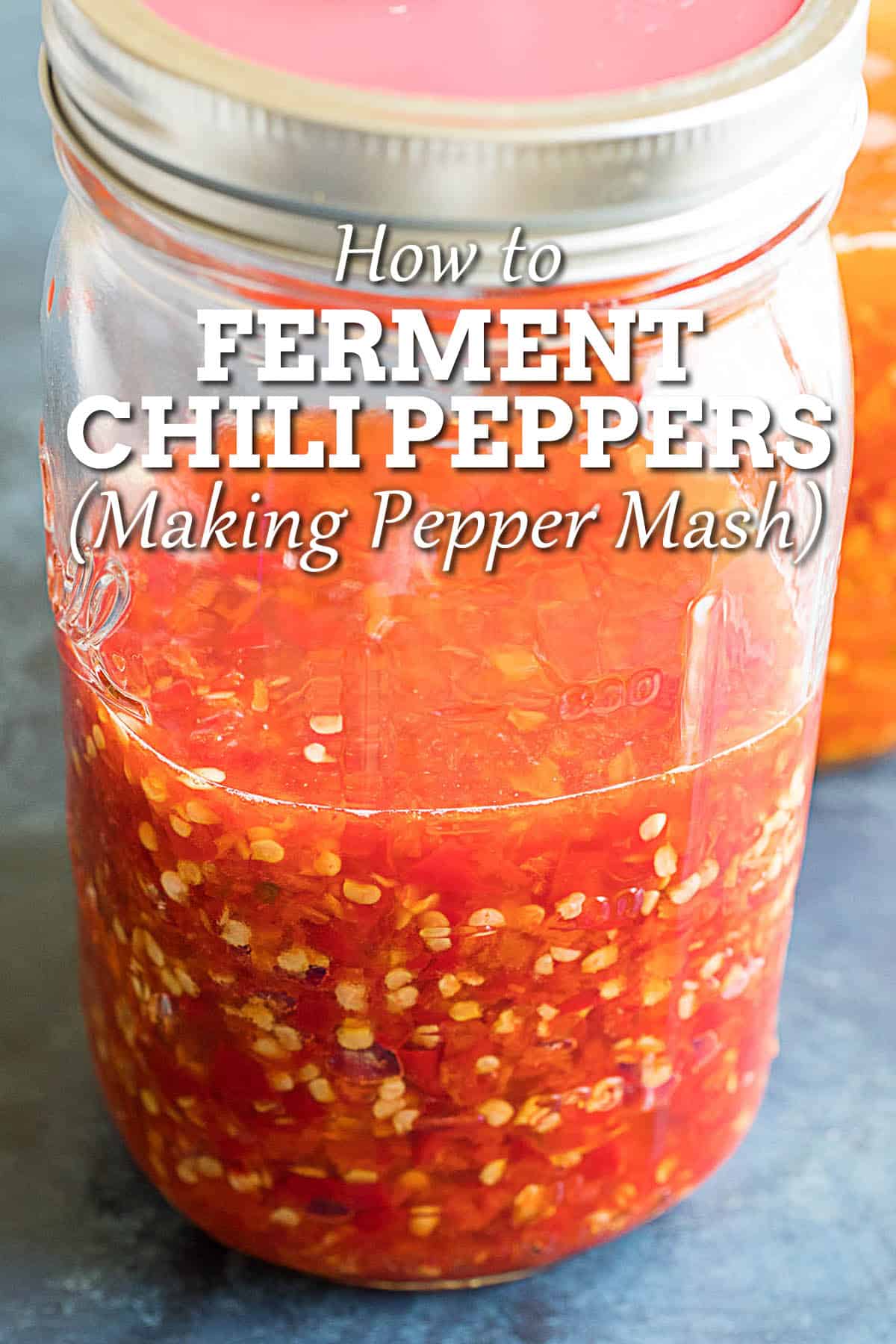
How to Ferment Peppers (Make Pepper Mash)
There are many ways to make hot sauce, and as you can tell by our Hot Sauce Recipes section of the web site, I’ve made a lot of them. However, one way we have yet to explore is making them with fermented chili peppers.
If you’ve ever enjoyed Tabasco sauce, you’ve tasted fermented chili peppers. Tabasco starts with tabasco peppers which they crush, mix with salt, and ferment in oak barrels for up to 3 years. The original Tabasco sauce only uses 3 ingredients – tabasco peppers, salt, and distilled vinegar.
A number of hot sauce makers use fermented peppers in the form of pepper mash to make their products, and a good pepper mash makes a difference in the resulting flavors. If you’re interested in making sauces from pepper mash, good news. It’s easy to make at home and you don’t need to wait 3 years for it to be ready.
But first…
What is Fermented Pepper Mash?
Pepper mash is a collection of chili peppers that have been mashed together with salt then aged until they break down chemically. Fermentation is one our oldest methods of food preservation. Humans have preserved many foods this way, from cheeses to wine to a slew of other vegetables.
Fermentation, basically, is the decomposition of foods by micro-organisms (Lactic Acid Bacteria) or enzymes. We create an anaerobic (no oxygen) environment for the peppers so the natural Lactic Acid Bacteria can thrive, and other undesirable bacteria cannot.
Bad bacteria or rotting molds, cannot survive in an anaerobic environment, which we create with salt and brine, therefore protecting the peppers while the good bacteria do their work. The salt is not actually the preservative. It is the acid produced by the fermentation process that does the preserving.
Lactic acid bacteria consumes carbohydrates in the peppers and converts them to acid. After fermenting, the carbohydrates have been predigested, leaving them with more vitamins and flavor than fresh peppers.
It is akin to a controlled decay process, and there are numerous benefits to fermentation, including more digestible foods and more desirable flavors. With peppers, you’ll notice a mellowing of flavors, changes in color, and in the pleasant smell of the resulting mash.
How Safe is Fermenting Peppers?
Fermenting peppers is very safe! Before I began my exploration into fermentation, I succumbed to the common misconception that fermenting could easily lead to rotten or even dangerous foods, but in truth, fermentation is very simple and hard to mess up.
The key is to ferment properly. You’ll know if you’ve made a mistake by the smell of a ferment. It will smell “off” or “rotten”.
The fact is, we’re fermenting in a controlled environment, so just be sure to follow the proper procedures.
Making Basic Pepper Mash
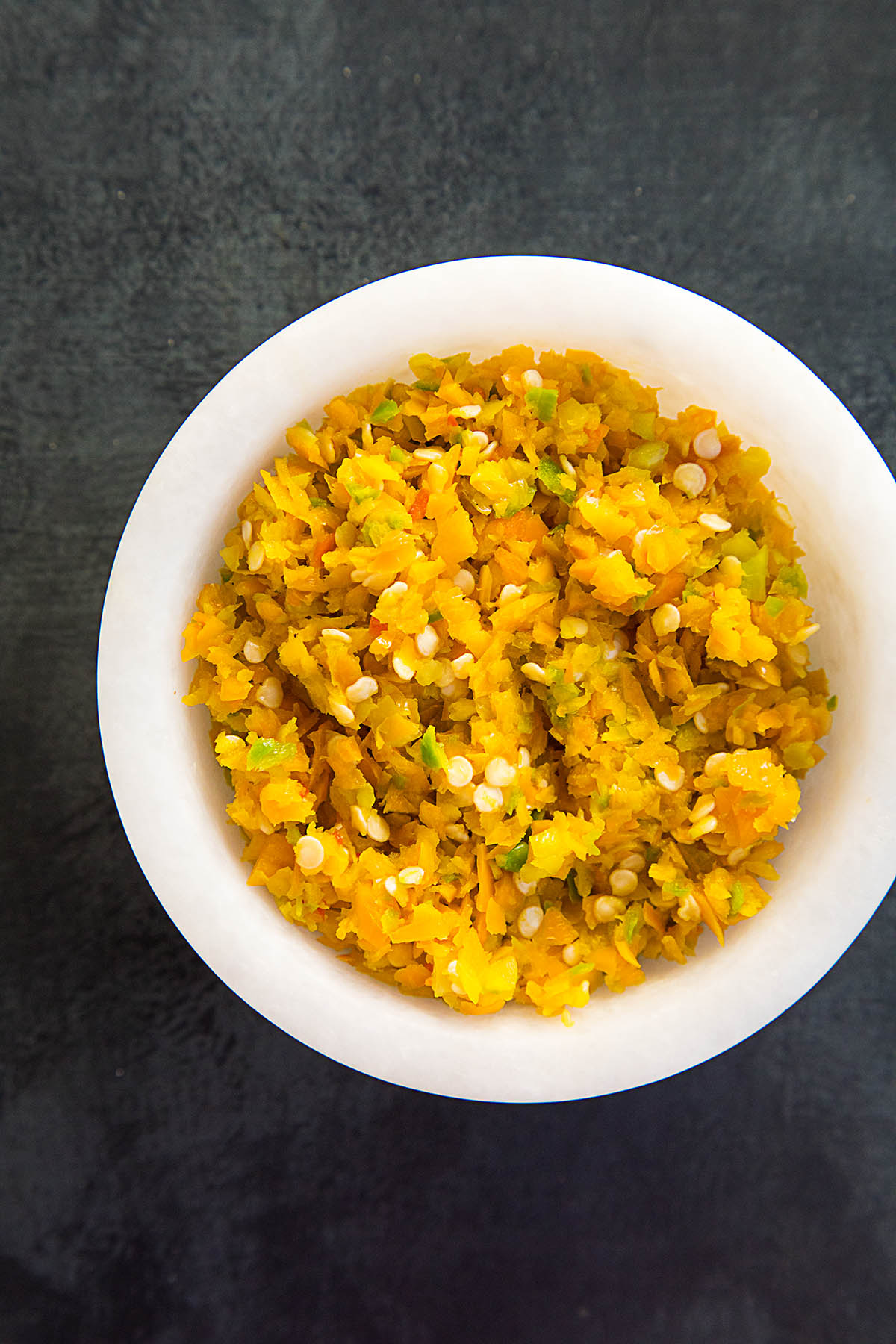
You can make fermented pepper mash from any type of chili pepper, even dried peppers. Your only consideration is the thickness of the pepper walls. Thicker walled peppers may need to be strained after the fermentation period, to remove the coarser skin, so you don’t need to seed them if you don’t want to.
Thinner walled peppers won’t need straining, so you may want to seed them first if you prefer a smoother result when you process the mash later on.
To make pepper mash, first process your fresh peppers in a food processor. If you don’t have a processor, use a mortar and pestle or simply finely chop them.
Next, mix in salt. Use 2-3% salt by weight of your chilies. For 1 pound (454 g) of chilies, that's 9-14 grams of salt, roughly 1½ to 2½ teaspoons of fine sea salt, though this varies quite a bit by salt type. Coarse kosher salt can weigh half as much per spoonful as fine sea salt, so a kitchen scale is the most reliable way to do this.
Note that mash and brine ferments calculate salt differently. With a mash there's no added water, so the salt percentage is based on the weight of the chilies. With a brine, the percentage is based on the weight of the water. That's why the brine method calls for tablespoons while the mash calls for teaspoons.
Resources vary in their salt recommendations. Most recommend 2-5% by weight and up to 10%, with 2-3% being ideal.
The peppers will begin to release their moisture right away. A note about salt: most salts are fine to use, but avoid using salts with additives, such as table salt.
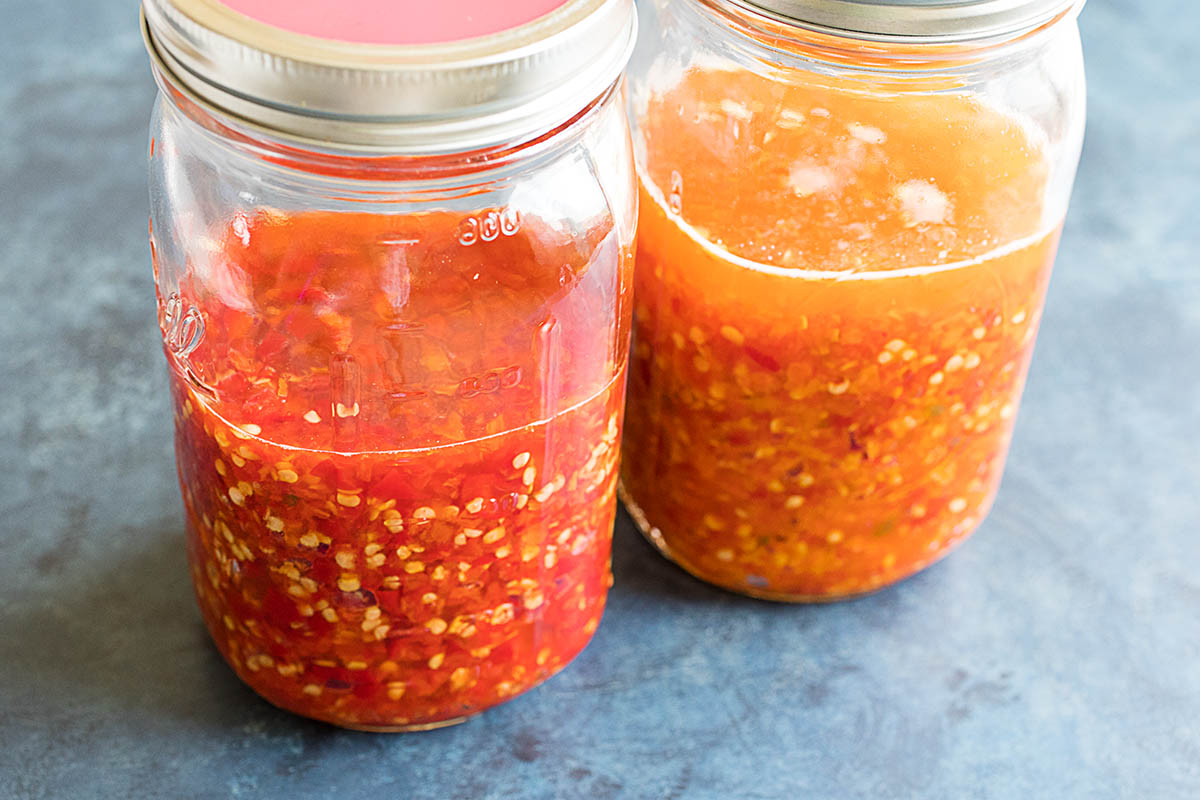
Place your mash into a jar and press it down to remove any air pockets. Leave at least 1 inch (2.54 cm) of headspace. The peppers may rise a bit when fermenting. The brine will rise up and cover the peppers. It is important to keep the peppers covered with brine to avoid spoilage. Check this daily.
Screw on the lid and set the jar away from direct sunlight to ferment for at least 1 week. Ideal temperatures are between 55-75 degrees F (12.78-23.89 C). The most active fermentation period is between 1-2 weeks, so be sure to monitor it during this time. “Burp” the jars often by unscrewing the lid a bit to let out some of the accumulating gases. Or, use an airlock or membrane for easier fermenting. See below for what I like to use.
After 1-2 weeks, the fermenting activity will diminish. Move it to a pantry where you can let it ferment longer if you’d like, or use it right away. You can ferment for months or even longer to allow the flavors to more fully develop.
Once it is ready, store it in the refrigerator where it will last for a year or longer.
Making Brine Pepper Mash
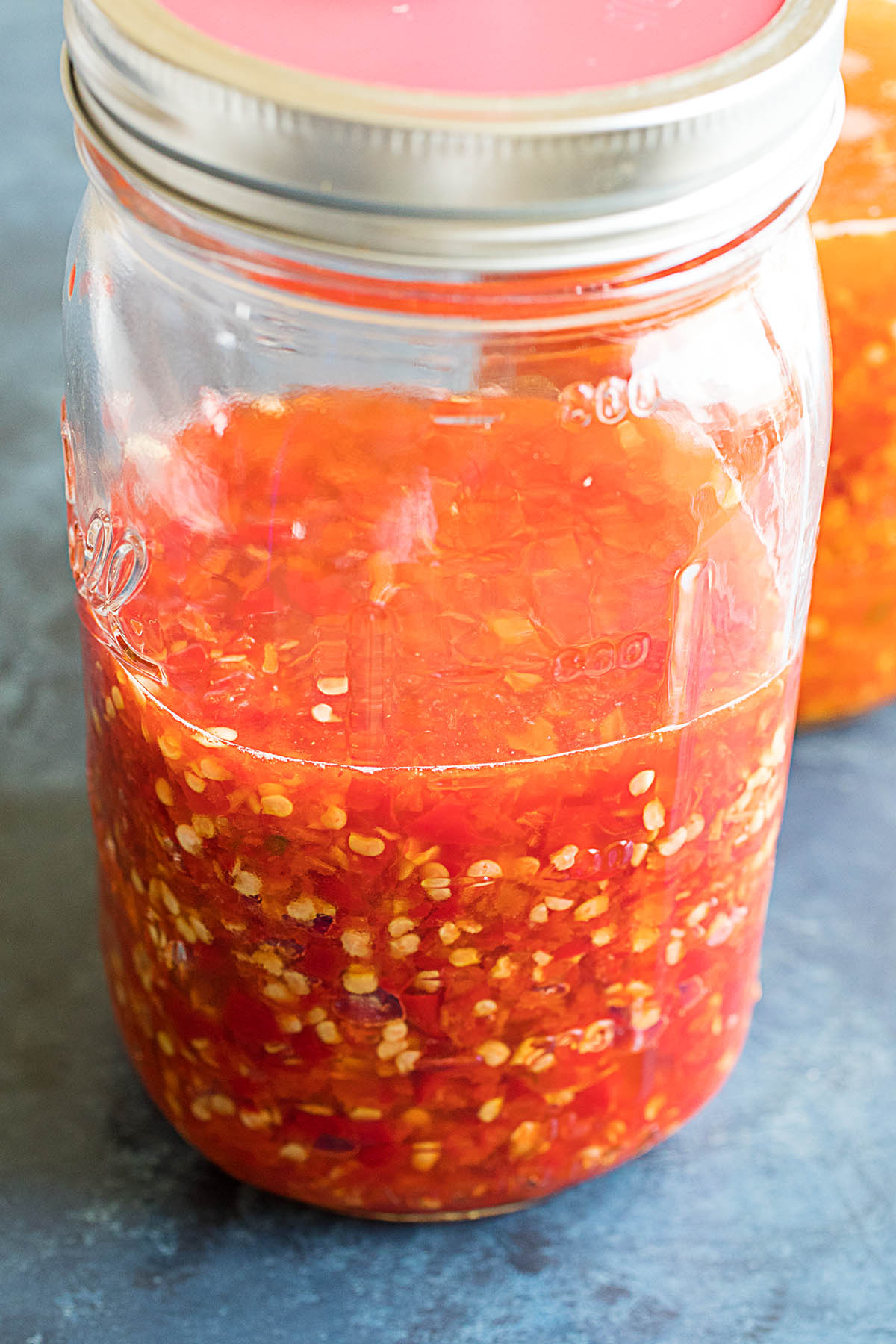
An alternate method to the basic pepper mash is using a brine, which is a salt water solution. The primary difference is that we’re adding water rather than using the natural juices from the peppers. This method ensures the peppers stay beneath the brine, and is more ideal for thinner walled peppers.
To make a brine pepper mash, first chop your fresh peppers. You can process in a food processor or use a mortar and pestle or simply finely chop them. Pack them into a jar, leaving at least 1 inch of head space. The peppers may rise a bit when fermenting.
Next, mix 1 quart (.95 liter, about 946 g) unchlorinated water with 28 g salt for a 3% brine, or up to 54 g for a 6% brine. That works out to roughly 1.5 to 3 tablespoons of fine sea salt. Pour just enough brine over the peppers to cover them, pressing them down a bit as you go. It is important to keep the peppers covered with brine to avoid spoilage. Check this daily.
Screw on the lid and set the jar away from direct sunlight to ferment for at least 1 week. Ideal temperatures are between 55-75 degrees F (12.78-23.89 C). The most active fermentation period is between 1-2 weeks, so be sure to monitor it during this time. “Burp” the jars often by unscrewing the lid a bit to let out some of the accumulating gases. Or, use an airlock or membrane for easier fermenting. See below for what I like to use.
After 1-2 weeks, the fermenting activity will diminish and the brine will turn cloudy and taste acidic. Move it to a pantry where you can let it ferment longer if you’d like, or use it right away. You can ferment for months or even longer to allow the flavors to more fully develop.
Once it is ready, process it with a food processor. You can use it right away to make hot sauce or store it in the refrigerator where it will last for a year or longer.
I personally like to add a bit of vinegar at this stage before storage.
Good luck, and happy fermenting! Let me know what you make with your pepper mash.
Frequently Asked Questions about Fermenting Peppers and Making Pepper Mash
Best Salt for Fermenting Peppers
When fermenting chilies, it is important to use salt that does not contain anti-caking agents or iodine, as these can inhibit the natural fermentation process. Here are some types of salt that are commonly used for fermenting chili peppers:
- Non-iodized Sea Salt. Sea salt is a popular choice for fermenting chili peppers, as it is minimally processed and typically does not contain anti-caking agents or iodine. Look for non-iodized sea salt, which is readily available in most grocery stores.
- Kosher Salt. Kosher salt is a coarse-grained salt that dissolves easily in water, making it suitable for fermenting. Like sea salt, kosher salt does not usually contain anti-caking agents or iodine, but it's important to check the packaging to make sure.
- Pickling Salt. Pickling salt is specifically formulated for preserving and fermenting vegetables, making it a good choice for fermenting chili peppers. It is fine-grained and dissolves easily in water, ensuring even distribution of salt in the fermentation brine.
- Himalayan Pink Salt. Himalayan pink salt is a natural salt that is often used in fermenting and has gained popularity for its trace mineral content and unique flavor. It is typically non-iodized and does not contain anti-caking agents, making it suitable for fermenting chili peppers.
When fermenting chili peppers, it's important to use the right amount of salt according to your recipe or fermentation process. Too little salt can lead to spoilage or mold growth, while too much salt can inhibit fermentation.
Why Does My Pepper Mash Taste Bitter?
I sometimes get some bitterness with my fermented pepper batches. I've seen a lot of discussion on it, whether it is from kahm yeast or from the starting peppers themselves, where the slight bitterness is amplified in the fermentation process. The best way to counter it is through the addition of other ingredients.
Also, some people report a bitterness from the pepper seeds, so try removing the seeds before fermentation and see if that affects your resulting flavor.
To counterbalance the bitterness, try adding an acid like vinegar or lime juice, which can help balance it out, then a sweetener like sugar or honey. Certain roasted vegetables can help, too, like carrots or other flavors. Garlic is good. They can all help balance out the bitterness. Give the final sauce time to rest and let the flavors meld in the refrigerator.
What is Kahm Yeast?
Kahm yeast is a whitish film that can sometimes appear on top of your ferment. It can form when all of the sugar in your ferment is consumed. The PH drops because of lactic acid buildup, allowing kahm yeast to form. It is not a mold, and can be scraped away from your ferment.
Sweeter vegetables, particular peppers, are more prone to kahm yeast.
How do I tell if peppers are fermenting?
You will often see bubbling activity in the jar as the fermentation process takes place, but not always. Sometimes you may have what is called a "quiet ferment", where it seems little activity it taking place. Fermenting peppers give off a slightly sour, pleasent smell, so trust your nose to know fermentation is taking place.
How Do You Know if the Fermentation is Bad?
You can usually tell if a fermentation is bad by sight or smell. If you see signs of fuzzy or pinkish colored mold, the ferment is infected. If the peppers are very mushy, something has gone wrong.
If the ferment smells rotten or disgusting to you, it has gone bad. Trust your nose to know if something is bad. A good ferment will have a slightly sour smell, but will smell pleasant.
Hot Sauce Recipes with Fermented Peppers
Here are some of my own recipes that use fermented chili peppers.
- Fermented Hot Sauce Recipe
- Homemade Sriracha Hot Sauce
- Fermented Aji-Garlic Hot Sauce
- Homemade Louisiana Hot Sauce
- Spicy Serrano Hot Sauce
Check out more Hot Sauce Recipes or learn more about How to Make Hot Sauce. Also see my post on Homemade Kimchi (How to Make Kimchi).
The best ph meters that I recommend are from Thermoworks. Get yourself a ph meter from Thermoworks today. I am a happy affiliate.
Got any questions? Please contact me anytime and I will do my best to help. Good luck with your pepper fermentation!
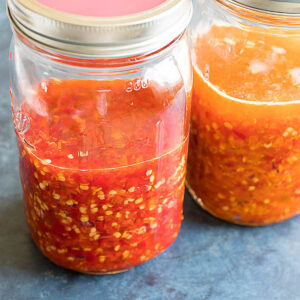
How to Ferment Chili Peppers (Pepper Mash Recipe)
Ingredients
FOR BASIC PEPPER MASH
- 1 pound chili peppers stemmed and roughly chopped (cored and seeded, if desired)
- 11 grams salt (about 2 teaspoons fine sea salt - 2.5% by weight of the chilies; use 9 g for 2%, 14 g for 3%)
FOR BRINE PEPPER MASH
- 1 pound chili peppers stemmed and roughly chopped (cored and seeded, if desired)
- 28-54 grams salt (about 1.5 tablespoons fine sea salt) for a 3% brine, up to 54 g (3 tablespoons) for 6%
- 1 quart unchlorinated water
Instructions
FOR MAKING BASIC PEPPER MASH
- Finely chop your peppers. You can blend them to fit more into jars, but this can make it harder to keep below the brine.
- Next, mix in salt. Use 2-3% salt by weight of your chilies. For 1 pound (454 g) of chilies, that's 9-14 grams of salt, roughly 1½ to 2½ teaspoons of fine sea salt
- The peppers will begin to release their moisture right away.
- Place your mash into a jar and press it down to remove any air pockets. Leave at least 1 inch (2.54 cm) of headspace. The peppers may rise a bit when fermenting. The brine will rise up and cover the peppers. It is important to keep the peppers covered with brine to avoid spoilage. Check this daily.
- Screw on the lid and set the jar away from direct sunlight to ferment for at least 1 week. Ideal temperatures are between 55-75 degrees F (12.78-23.89 C). The most active fermentation period is between 1-2 weeks, so be sure to monitor it during this time. “Burp” the jars often by unscrewing the lid a bit to let out some of the accumulating gases. Or, use an airlock or membrane for easier fermenting. See below for what I like to use.
- After 1-2 weeks, the fermenting activity will diminish. Move it to a pantry where you can let it ferment longer if you’d like, or use it right away. You can ferment for months or even longer to allow the flavors to more fully develop.
- Once it is ready, store it in the refrigerator where it will last for a year or longer.
FOR MAKING BRINE PEPPER MASH
- Finely chop your fresh peppers. You can blend them to fit more into jars, but this can make it harder to keep below the brine. Pack them into a jar, leaving at least 1 inch of head space. The peppers may rise a bit when fermenting.
- Next, mix 1 quart (.95 liter) unchlorinated water with sea salt. Pour just enough brine over the peppers to cover them, pressing them down a bit as you go. It is important to keep the peppers covered with brine to avoid spoilage. Use a glass weight or a baggie filled with water on top if needed to press the peppers down below the brine. Check this daily.
- Screw on the lid and set the jar away from direct sunlight to ferment for at least 1 week. Ideal temperatures are between 55-75 degrees F (12.78-23.89 C). The most active fermentation period is between 1-2 weeks, so be sure to monitor it during this time. “Burp” the jars often by unscrewing the lid a bit to let out some of the accumulating gases. Or, use an airlock or membrane for easier fermenting.
- After 1-2 weeks, the fermenting activity will diminish and the brine will turn cloudy and taste acidic. Move it to a pantry where you can let it ferment longer if you’d like, or use it right away. You can ferment for months or even longer to allow the flavors to more fully develop.
- Once it is ready, process it with a food processor. You can use it right away to make hot sauce or store it in the refrigerator where it will last for a year or longer.
- I personally like to add a bit of vinegar at this stage before storage.
Notes
Nutrition Information
FAQs
How Much Salt Do You Use to Ferment Peppers?
Mash and brine ferments measure salt differently.
For a basic mash, use 2-3% salt by weight of your chilies. For the brine ferment used here, use 3% salt by weight of your water.
| Method | Salt amount | For a standard batch |
|---|---|---|
| Basic mash | 2-3% of the chili weight | 9-14 g per pound (454 g) of chilies |
| Brine | 3% of the water weight | 28 g per quart (946 g) of water |
The amounts are different because you're salting a pound of chilies in one method and nearly two pounds of water in the other.
Weigh your salt if you can. A tablespoon of fine sea salt runs about 18 grams, while the same spoonful of coarse kosher salt can be as little as 9. A cheap kitchen scale is very helpful.
NOTE: This page was updated on 8/22/26 to include clarified measurements by percentages and weights, along with FAQ addition.
Adam J says
Quick question. So this is my first time fermenting peppers (serranos). Everything seems to be going good smell and taste wise, but there's little white squiggles in it, almost worm looking. After a little research, most people think they're sprouts from the seeds, but I just wanted to check here to make sure
Michael Hultquist - Chili Pepper Madness says
Adam, I'm not sure based on that description, but make sure it isn't mold. Mold is more fuzzy and would likely cause a bad odor. It also could be simple kahm yeast, which usually floats at the top of the brine.
Vanessa Dempel says
Thanks so much for the guidance! I ended up straining the mash through a fine wire strainer and the outcome was superb!
Michael Hultquist - Chili Pepper Madness says
Great, Vanessa! Enjoy!
Vanessa Dempel says
I've just ended a 3-month fermentation on some hatch chiles. Flavor and smell is so complex and beautifully acidic. The problem I'm having is that the skins are still quite fibrous, as in, they won't break down in the food processor completely and leave a sauce that has a bite to it. I probably should have rehydrated with boiling water initially, maybe these chiles just have thick skins. Any idea how I can thin the sauce? add more water?
Michael Hultquist - Chili Pepper Madness says
Vanessa, this is a hard one. I'm really surprised that the peppers didn't soften up with that much time in the brine. Yes, would have been better in this case to soften them up before fermenting, but at this point, I feel all you can do is puree them as much as possible then strain out the solids. Then adjust the taste after. Yes, you can just think with water before processing. Unless you want to forego the probiotic benefits - then you can try to heat the contents in a pot with some extra water to soften them up more, then process. Could work either way. Let me know how it goes.
John says
Hi Mike,
I just made a hot sauce with garlic and fermented cayanne peppers. It turned out great.
I strained the sauce and it seemed like a waste to through out the strained peppers.
Do you have anything you like to do with strained pepper material.
I figured I could just use it for cooking, but I was wondering if drying it would work as well?
Thank you!
John
Michael Hultquist - Chili Pepper Madness says
Hi, John. Yes, absolutely. I do like to use my dehydrator to dry the pulp and make seasoning out of it. I have a post for that here: https://www.chilipeppermadness.com/recipes/seasonings-from-hot-sauce-pulp/. Let me know if this helps. Also, you can freeze the pulp to use later to add flavor to soups, stews, etc. I hope this helps.
Jim S. says
Hello Mike, about a week and a half ago ago, I started fermenting several batches of pepper mash. One of them, a pound of beautiful habaneras, has developed a white film across the surface. I don’t see any way to attach a photo, but it looks a lot like kahm yeast (from the photos I’ve seen anyway). It does look some fermentation has taken place; there were some bubbles forming in the mash and the airlock has some small bubbles clinging to the sides of the lock. My questions are: should I open the jar and scrape off the yeast layer or just let it go and continue to ferment as-is? (I had planned to ferment a couple of weeks and then make your mango habanera sauce recipe. ) Or should I call it good and use the mash now after removing the top layer? I am worried about losing the whole batch of mash. Interestingly, I started several other batches of mash the same day and the rest all look clean. Thanks for your help and for this great site!
Michael Hultquist - Chili Pepper Madness says
Hello, Jim. Thanks. Yeah, every time you open the batch, you expose it to air, risking infection. Personally, I open mine and scrape off the kahm yeast, then keep fermenting, but I keep an eye on it.
Tim Y says
Great, thanks! I meant to say a wet ferment, as the peppers are thin walled. But yeah, good advice.
Michael Hultquist - Chili Pepper Madness says
I believe the wet ferment is easier for most.
Tim Y says
Hi Mike
This is a great, educational site!
I live in Vietnam, so it's mostly the Thai-style finger chilies and birdseye varieties here. From what I've read on your site, I should probably make a dry mash and use that to make further sauces with other ingredients - mango, pineapple, lemongrass, shallot etc etc. Chilies are obviously abundant here, but not in great variety so I think a standard mash cooked with other things will work out best. Do you concur with this idea? What would you undertake in my situation? Thanks!
Michael Hultquist - Chili Pepper Madness says
Thanks, Tim. Personally, I would make sauce several ways, by fermenting the peppers alone and also making sauces with the fresh, unfermented pods. Then you can compare and see which you like more. Or just enjoy both! =) But yes, you can easily ferment the peppers alone and then incorporate the other ingredients into the sauce later on. Enjoy!
John Shotsky says
Mike,
I'm finding mixed results in my search for this question. First, I make Sriracha using mostly Fresno peppers, some hotter some milder, and it tastes great, even after 2 years. Last year, fall came early and I didn't have enough ripe ones to make Sriracha. This year, I am not sure I'll have enough - depends on the ripening process. I have some now, but need at least double the amount.
So, my question is this: Can I pick nice, ripe peppers and freeze them while others ripen, then thaw them later to ferment? I will always have some fresh peppers to add to the frozen ones, but will that be enough to kick start the ferment?
I deseed my peppers first, and run them through the vitamix to start with a nice clean mash, then just add salt (I go 3%), my fermenting lid, and a vacuum pump to pull out the oxygen.
What say you?
Thanks!
Michael Hultquist - Chili Pepper Madness says
John, yes, you can freeze pods, then ferment them later. Adding in some fresh pods should be enough to get things going for you. Let me know how it goes.
Vanessa Gi says
Hi Mike,
It's been four days, and today I noticed that some of the pepper mash floated up above the glass pickle weight,
Should I dump that jar, and start over? It was going along fine, or so I thought until today.
Thanks,
Vanessa
Michael Hultquist - Chili Pepper Madness says
Vanessa, you can just push it down beneath the brine. Just make sure it is not infected with any growths. Otherwise, you can scoop that out.
Ethan R Townsend says
After reading about using a water bag to weight down my mash, which had already started fermenting, I am wondering if this really was necessary given that I have an airlock on the mason jar. Isn't the point of the brine over the mash to keep the fermentation anaerobic or are there other things that the brine covering the mash is doing?
thanks for the info and straightforward recipe!
Michael Hultquist - Chili Pepper Madness says
Ethan, you'll need to keep everything submerged beneath the brine even with an airlock, as any exposure above the brine could result in infection.
Stephen Clarke says
Hi Mike, thanks for the great site. Last year I made your Aji & garlic fermented sauce and it was by far my favourite sauce of all the types I made. This year, for various reasons, I want to make a mash instead of a brine immersion. I note that you recomend 2.3% salt for this but I have seen anything from 2% up to 12% recommended in various books and web sites. Now I'm confused!!! Where I live in Portugal the weather is still well into the mid 70's to early 80's and I have read that I should perhaps aim for a higher salt percentage. I'm thinking about 6% at the moment but I don't want anything that ends up that tastes too salty, whilst at the same time I achieve a safe ferment. I would appreciate any advice you can give. Thanks
Michael Hultquist - Chili Pepper Madness says
Stephen, from my experience, 2.3% is enough to allow fermentation, though some places do suggest higher concentrations. If you go higher, I would probably skip using the brine in any final recipes, or it would be too salty for my own tastes.
Vanessa Gi says
Hi Mike,
Thank you for answering my question. I appreciate it.
Michael Hultquist - Chili Pepper Madness says
Take care, Vanessa. Happy fermenting.
Vanessa Gi says
Hi,
I do have this question. Do, I keep the brine in the fridge? I am not sure. about that.
Michael Hultquist - Chili Pepper Madness says
Vanessa, no, keep it in a cool dark place, like a pantry. Refrigeration can work against the fermenting process. Let me know how it goes.