

The chiltepin pepper is a tiny, round or oval shaped chili pepper grown wild throughout much of the U.S. and Mexico. It is quite spicy, measuring up to 100,000 Scoville Heat Units. Learn More.
SCOVILLE HEAT UNITS: 50,000 to 100,000 SHU
Capsicum Annuum
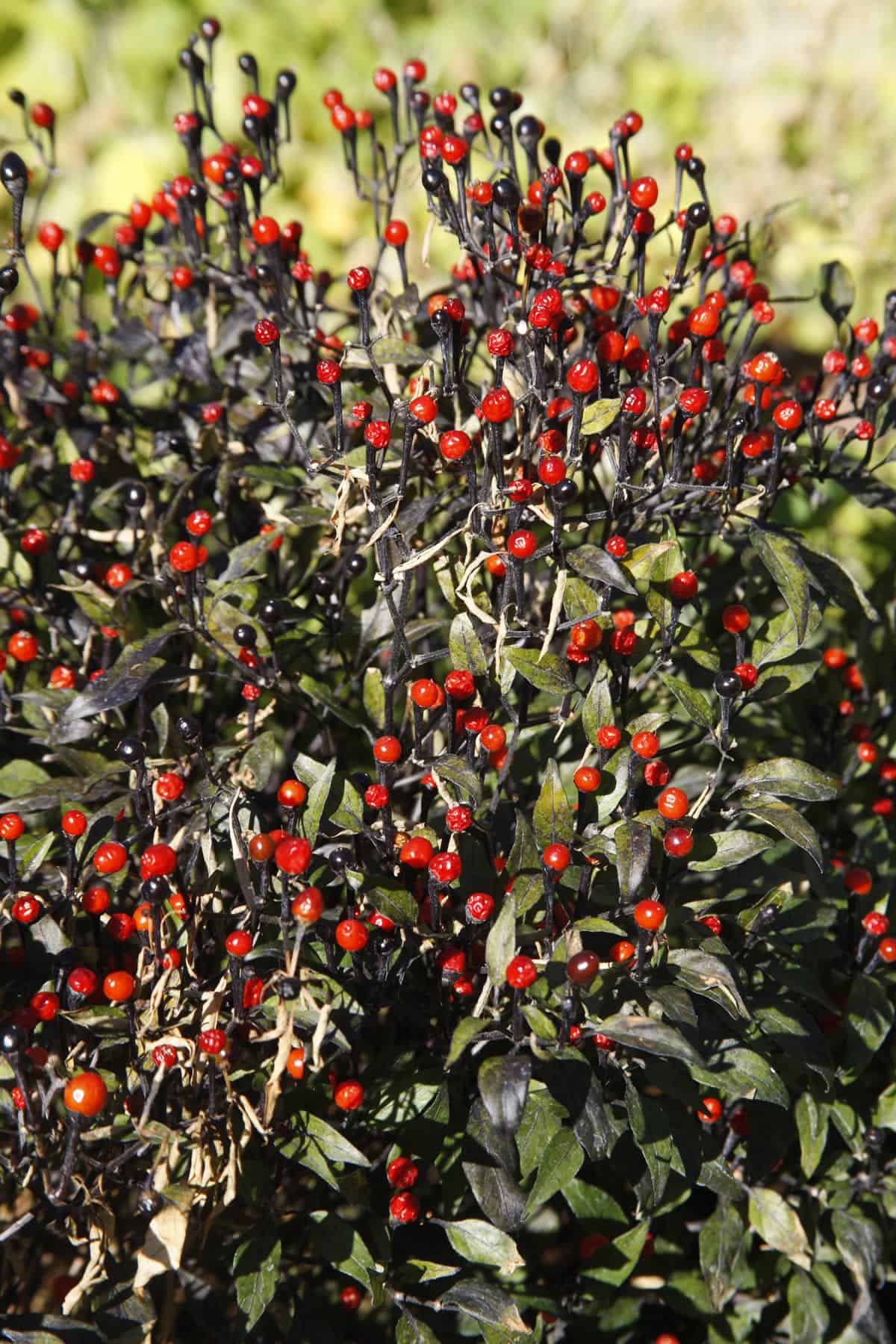
The Chiltepin pepper, "chile tepin", or "Chiltepine", is a tiny, round or oval shaped, red to orange-red chile, measuring about .8 cm in diameter. It has grown in the wild throughout much of Northern Mexico and Southern United States for generations, and there is much folklore and history involving the plant in the US/Mexico Borderland areas.
It is the only wild native chili pepper in the United States, sometimes referred to as "The Mother of All Peppers".
Efforts to grow the wild plants on farms have led to the development of the Chile Piquin, which is grown commercially in Mexico and Texas.
In fact, Texas named the chiltepin the state’s “official native pepper” in 1997.
They are also called “bird peppers” because they are eaten and spread by wild birds, or "bird's eye peppers" because of their size.
History of the Chiltepin
The pepper has been widely used as not only a food, but as a medicine (because of the capsaicin content), for generations, even rising to mythic status. Even today, many locals hold iconic rituals where families come together to harvest wild chiltepins through the mountainous region. You can collect quite a few during the wild harvest.
It is said no home should be without a collection of the dried pods. It is even used as a preservative for meats.
Chiltepin peppers are protected in the US in Coronado National Forest, Big Bend National Park and Organpipe Cactus National Monument.
It has a rich history in the Native American culture and remains highly significant today to not only the people of the Sonoran region, but to the United States. It is definitely worth exploring and enjoying if you're a chilihead or spicy food lover.
How Hot is the Chiltepin Pepper?
The Chiltepin is quite hot, and in Mexico, the heat of the pepper is considered “arrebatado” which means “rapid” or “violent” because the intense heat is not long lasting, unlike many chili peppers that have a slower and more enduring effect.
The heat measures up to 100,000 Scoville Heat Units on the Scoville Scale, which is quite hot. Compare that to an average jalapeno pepper, which averages about 5,000 Scoville Heat Units, making the pepper up to 20 times hotter than a jalapeno.
A serrano pepper measures up to 23,000 SHU, so the Chiltepin can be more than 4 times hotter.
However, a chemical study made in 2015 measured these peppers at a range of 50,000 - 1,628,000 SHU, which would place them in the realm of the superhot chili peppers.
Eating Chiltepin Peppers
Chiltepin peppers are often dried and crushed for spices and seasoning, and used in soups, stews and bean dishes. The pepper has a distinctively smoky flavor. Sun-dried chiltepins is a favorite way to dehydrate them.
The green fruit can also be used in salsas to bring in a nice level of heat, or are sometimes pickled with other ingredients and spices for a relish-like condiment that can accompany any number of dishes.
They're also great for making hot sauce from them, though admittedly, you'll need a lot of them.
The peppers are a big part of Sonoran cuisine, as they are native to the area.
How to Dry Chiltepin Peppers
You can easily dry these peppers with a dehydrator by cleaning them, then drying them whole on dehydrator sheets in your dehydrator at 135-140 degrees F. You can also dry them in an oven if your temperatures can go that low.
Dry them whole, or you can attempt to sun dry them in the open air, but beware of moisture in the air. Otherwise, the peppers will rot.
Where Can You Buy Chiltepin Peppers?
You can usually purchase the dried pods online, or purchase seeds through online resources for growing in your own garden. Here are a couple affiliate links to help get you started.
Have any questions? Contact me anytime! Happy to help you learn more. -- Mike H.
NOTE: This post was updated on 12/22/20 to include new information. It was originally published on 10/3/13.
Dan B says
I just went to the Chilipeppermadness.com site because I (correctly) suspected I could figure out what these peculiar little peppers were.
I started my chili pepper garden a bit late this year (mid March in Fresno) so in a hurry I opted to buy many of that mega-producer Bonnie Plants have in every large home supply store in America. Very mixed results, and I hope to never resort to such a supply in future years.
Well one of the plants that grew produced these peculiar little round balls, which are plentiful but annoying to pick because of their small size. Easier to pick, though, than the Bonnie Plants Thai chilis, which seem to max out at a 1/4" or so in length and don't fall off so easily as do the tepins, which are VERY hot!
Tepins. Never heard of them before. Now I know, and will certainly add them to my ever growing list of chilis I enjoy growing.
Michael Hultquist - Chili Pepper Madness says
Thanks, Dan!
Michele says
I was very excited to find two "volunteer" bushes of these hot red tiny peppers in our backyard this morning. Boy, they are HOT -- but great! For a large blenderful of my faux V8-juice I added 2 regular and 2 baby sized chiltepen peppers (which are also known as bird peppers because wild birds eat and distribute them). The regular are very small, smaller than most pearls, and the babies were half or a third that size so it was very little and that amount added the PERFECT "kick" to my drink! I live in Texas and we've been feeding the birds this year, so I guess that may have been the reason these babies popped up! Very exciting! I used to live near a very large bush of them and always wished I had such a bush. Our new little bushes are quite small but I know how big they can become -- and be enough to feed the birds for free and still have some for us!
Michele says
P.S. I forgot to mention that I also just found out that the chile chiltepin pepper is the Texas State Pepper (as of 1997 I believe).
Matt says
I bought what was labelled a Tabasco pepper at home depot but i believe it was one of these. The fruit is tiny and completely spherical. The plant is quite large and has an estimated 100+ fruits and blooms. I hope that it is a chiltepin.
Michael Hultquist - Chili Pepper Madness says
Sounds like it, Matt! I hope you enjoy them.
Mitch says
My ultimate favorite pepper. My wife puts them in watermelon BBQ Sauce and Pineapple BBQ sauce as well. We always have a jar of old school the fridge for...well everything. You cannot go wrong with Tepin! My current plants are three years old and producing more than we can eat but they don't go to waste cause I share.
Michael Hultquist - Chili Pepper Madness says
I love it, Mitch. Nice. I'd love to try some of your watermelon hot sauce! Sounds wonderful.
Debbie says
I grew these peppers as a child to make pickle sauce for my grand-father over 50 years ago, I had a pepper bush that grew to about 6-7 feet tall that produced enough peppers to make it worthwhile until a hard freeze killed it . I just put them in white vinegar and put them in the refrigerator and let them marinate. I used to layer them in colors; green and red. The green ones are really good, also. I didn't like them that much back then, but made them for myself about 10 years ago and found that it only takes a dash of this sauce to liven up anything. The sauce is particularly good with melted cheese and chopped tomato for a cheese dip. I think they taste better than any pepper; the flavor is unmistakable. I have a hard time growing them now, the birds get everything. Going to try again this year growing them under a net. I live in Houston, Texas, and they used to grow wild here everywhere, but not anymore. I called them Piquins.
Michael Hultquist - Chili Pepper Madness says
Thanks, Debbie! This all sounds wonderful.
brent says
Mike after decades of cooking with dried arbols I am done. Tepins are much better tasting and just as hot. Bought a chiletepin 'basco-type sauce. My world was changed. it's fruity and robust and tasty like a guajillo or a habanero, but unique. Scovilles like an arbol. I knew I had to make my own salsa.
So for any global audience wanting a recipe like many people above:
2 vine-ripened tomatoes (same size as a roma but not a roma)
1/4 of white onion
1 clove of garlic
1" of cilantro stems
juice of 1/4 of a lime
dash salt
fistful cilantro leaves
10 chilietepins
BEST salsa I made in 10 years.
I blackened the first three ingredients. Pull the garlic early, though. Throw garlic in blender with the 5 (of the10) tepin peppers that you toasted on the stovetop.
Blend hard.
Add the charred tomatoes.
Blend normal.
If you dig it, add the next 5 tiny peppers with the cilantro stems and lime squeeze. Blend normal.
This should make it HOT but not REAL HOT. There is a difference. I'll use 15 next time.
I pulse the cilantro leaves and charred onion and salt to finish it a little thick.
Heat can be adjusted with cilantro and lime if too hot.
I thought arbol peppers made the only dried chile salsa. I was wrong. I will use 15 little tepins and one more garlic. It's almost perfect.
With such a generous taste, I'm wondering how versatile I can be with these chilitepins. I live in the SW but never seen them fresh in stores.
Michael Hultquist - Chili Pepper Madness says
This sounds wonderful, Brent! I greatly appreciate your sharing. I agree, these are great peppers. I enjoy them.
Christine says
I have a question for you. I live in Tempe, AZ and just discovered I have Chiletepin plants. I have a bunch of green peppers but it looks like they're starting to turn black. Is that the color they're supposed to be when ripening?
Michael Hultquist - Chili Pepper Madness says
Christine, I believe some chiltepin peppers can grow black, but normally they're red or red-orange. I would check them for signs of rot to make sure they aren't going bad.
Rachael says
Yes, they get dark before they get red. When they easily come off the stem they are ready to be picked.
Michael Hultquist - Chili Pepper Madness says
Thanks for your input, Rachael. I appreciate it!
Shane Johnson says
Yes they turn black before red, especially near the stem.
rayford latham says
My Mexican brother=in-law gave me some seed and said they were very hot. I am always making hot sauce and he wanted me to grow these seeds, which I did. They finally did around the middle of Otcober. I did some research and they are Chilipen peppers. Not enough to do anything with, but enough for seed for next year. I really enjoyed watching them grow and produce. New spring around Feb. I will plant them in a pot and by April I will plant them in my garden and will have plenty to share with my Mexican Brother-in-law. Ray Latham, Alabama.
Michael Hultquist - Chili Pepper Madness says
Sounds GREAT, Ray! Let me know how it turns out for you. Best of luck!
Lloyd Broen says
I was given some small peppers, about half an inch in diameter, by a co-worker. He didn’t know what they were called, but said he got the seeds for his bush in Mexico. I grew a couple bushes and took some to work and a different co-worker, from Guyana, said he recognized them and they are called wiri wiri.
From their size it seems they should be wiri wiri but from their origin they should be chiliepen. Is there difference between wiri wiri and chiliepen?
Mike H. says
Hi Lloyd, yes those are two distinct types. Wiri wiri are native to Guyana and typically small, round and red when ripe. Chiliepen (Chilean pequin) are native to South Americam (Chile and Peru) and are similar in size to wiri wiri but they can vary in color - while some are red, others can be orange or yellow. Flavor and culinary use are different, too.
Jearl Reagan says
They remind me of the silver bullet peppers I use to eat when I was younger. Dont know the real name of them but they where as hot as a habanero
Hal Lane says
As I am on a renal diet, chile's are my free reign. Chiltepens, Pasilla Bahia, habaneros and Bute jjalokias have become my beautiful pleasure, even when they are too hot to eat.
Kalum Rush says
Had 3 Chiltepin plants sprout out of nowhere in my backyard in South-east Queensland, Australia when I was about 6. I'm now 22 and they are still there constantly sprouting fresh peppers for me to pick and eat.
Michael Hultquist - Chili Pepper Madness says
I love that! Sort of jealous, actually.
Hal Lane says
They are my favorites. To hear your history with them is so valuable. I am growing( from seed) 8 plants in my first attemt. I made a few mistakes but have had a marvelous time bringing them along. Long ago I tried growing them and finally got fruit at 5 years. There were so many that season. I had them for 7 yEars. They ran out and I am having the time of my overflowing them.
Thank you.
Michael Hultquist - Chili Pepper Madness says
Thanks for commenting, Hal. I do love these peppers.
Becky Gammons says
Hi Mike,
I have chilpetin peppers and would love to make hot sauce or salsa out of them. I looked for a canning recipe so I can keep it longer, but nothing yet. I've never made either so I'm lost in the process and need a recipe to follow. Not sure but if can send you some peppers I will.
Becky from Willis, Texas
Michael Hultquist - Chili Pepper Madness says
Becky, you can use pretty much any of my hot sauce recipes or salsa recipes with your chiltepin peppers, then refer to this page for canning pickled peppers: How to Pickle Chili Peppers. It details the water bath method, which you can basically use for your hot sauce or salsa. Just be sure to check the overall ph and keep it at 4.0 or below for home storage. I hope this helps.
Becky Gammons says
Thanks, I will give it a try
JASON KUGINSKI says
No chile tepin hot sauce recipes?
Michael Hultquist - Chili Pepper Madness says
I'll have to work on that soon!
Chuy says
I have these growing all over my back and front yard an I live by houston lom
Michael Hultquist - Chili Pepper Madness says
I'm jealous!
Gary says
Wish I could find a reliable source to buy seeds. I live in California and would love to grow these ????
Michael Hultquist - Chili Pepper Madness says
Gary, check out my Chili Plants and Seeds Resources page to help you get started: https://www.chilipeppermadness.com/resources/