


Thai peppers are spicy chili peppers with a wide range of heat, and despite common belief, there is no single type of Thai pepper, with at least 79 separate varieties. Learn more about them, their heat ranges, how to cook with them, and more.
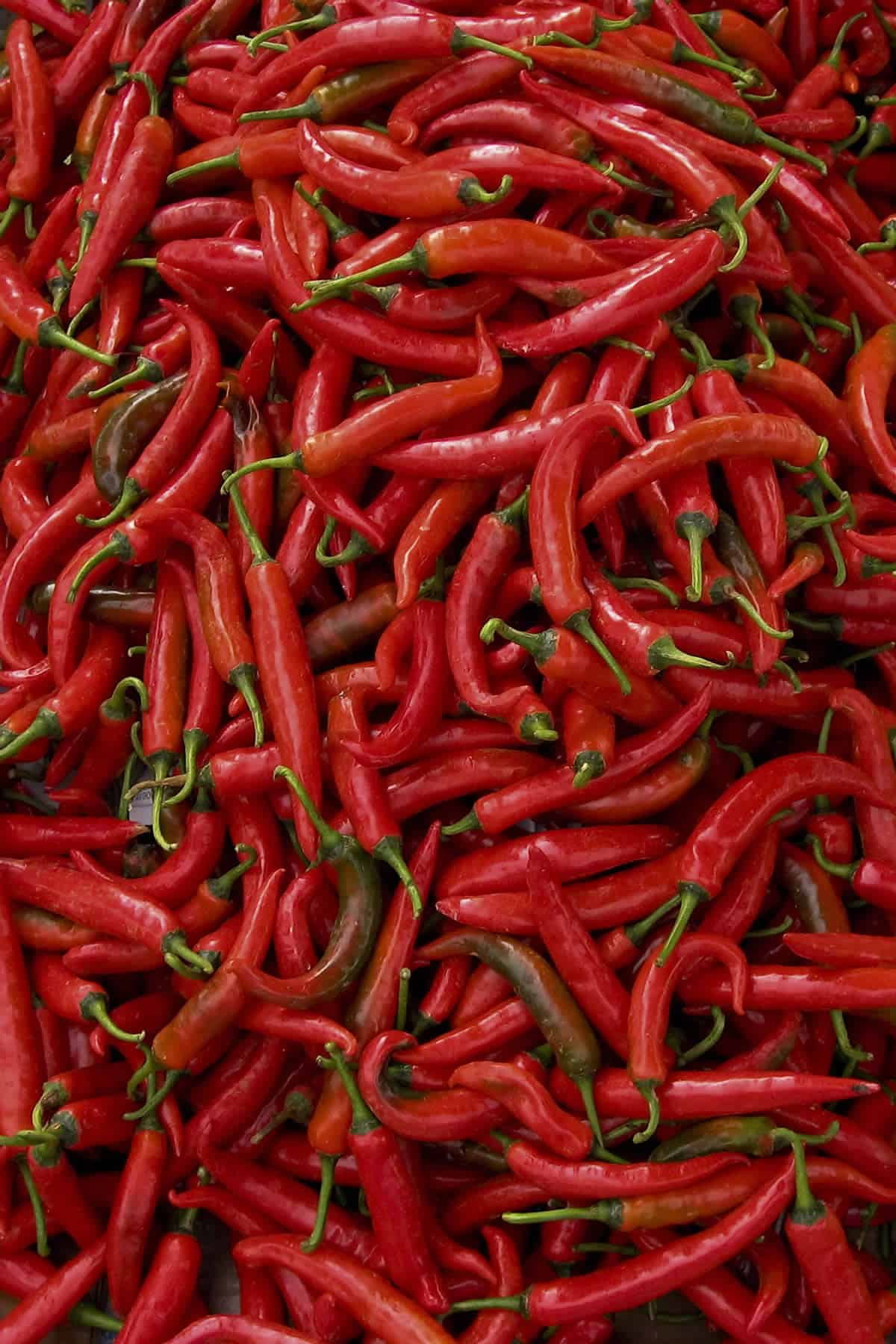
Scoville Heat Units: From 0 (very mild) to many in the range of 50,000 - 100,000 SHU
Capsicum Annuum
Despite what is commonly believed, there is no single "Thai pepper", though most peppers referred to as Thai are small in size and high in heat or pungency. There are at least 79 separate varieties of the pepper that have appeared from three species in Thailand, and they grow in green or red.
As with many other types of chili peppers, there is strong debate about them, and a particular confusion when it comes to Thai peppers.
Types of Thai Peppers
Prik num or "banana peppers," for example, resemble a New Mexican pepper, and they are also grown in Kashmir, India, and thus are also known as Kashmir peppers. It is further confusing as the Kashmir is ALSO known as the Sriracha, a name associated with the famous sauce originally made from these peppers in the Thai seaside town of the same name.
Others are called prik yuak (milder, sweet), prik chee fah (milder, green and red varieties), prik leuang (with milder heat, great for pickling), prik jinda (hot peppers), and prik kee noo (very hot, similar to bird's eye chilies).
Agriculturally speaking, we specify that two types of chili peppers grow for harvest in Thailand: the prik khee nu (or prik kee noo) or "bird pepper" and the prik khee fah or plain "chili pepper."
How Hot is a Thai Pepper?
Because of the wide variety, Thai peppers typically range from 50,000 to 100,000 Scoville Heat Units. Compare this to a typical jalapeno pepper, which ranges from 2,500 to 8,000 Scoville Heat Units, making the average Thai pepper about 15 times hotter than the average jalapeno.
The red bell pepper, by contrast, measures 0 Scoville Heat Units.
Cooking with Thai Peppers
Thai peppers are typically ground to add heat to curry pastes, and to add both spiciness and alluring color to Thai food. Discerning chefs and cooks love them for garnishing hot and spicy dishes, and cooking them into all manner of foods.
Thai peppers also appear in other Thai dishes and Asian cuisine including that of Myanmar, where they are known as "nga yut thee", often cooked into curries like spicy green curry, as well as in "balachuang", a common spicy relish.
Laotian cuisine incorporates similar peppers called "mak phet", which are used in pastes or stuffed and steamed to create spicy vegetable and fish dishes.
Cambodia and Vietnam have related peppers as well, featuring them in various chili pastes and sauces. They are often stir fried and essential to Thai cuisine, often added to fried rice and so many other dishes.
My Personal Experience
I have grown a few different varieties of Thai pepper in my own home garden and have had great success. They grow very easily and most plants are very productive.
These were grown in my garden. You can use other chili peppers as a substitute for Thai peppers, but I definitely encourage you to grow and cook with a variety.
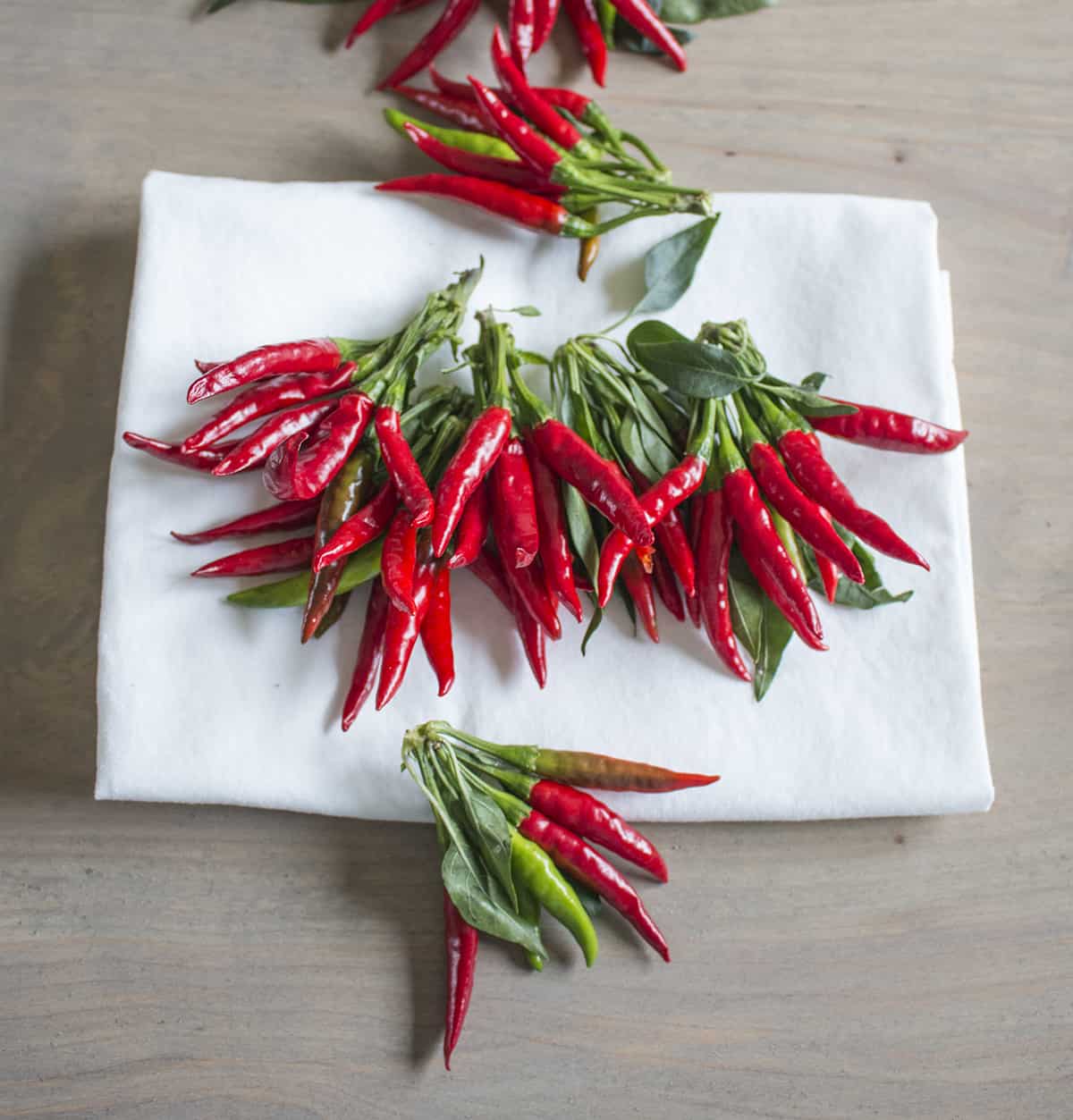
They're outstanding for dehydrating and grinding into chili flakes or chili powders, and also for making hot sauce.
Try some of these recipes that love to include Thai peppers.
See also these Types of Thai Chili Peppers
About Mike
Mike is the author of "The Spicy Food Lovers' Cookbook" and "The Spicy Dehydrator Cookbook". He is a chili pepper enthusiast who has run Chili Pepper Madness for many years.
NOTE: This page was updated on 4/26/22 to include new photos and information. It was originally published on 10/3/13.
Ed says
will thai chili cross with jalapeno, cayenne or chile de arbol?
Mike Hultquist says
Ed, I have not done this personally, but pepper varieties within the same species and even some from different ones can cross to create viable pods.
Watashi says
For fun, run prik kee noo through Google translate
Watashi says
Regarding prik khee nu. When I was in Thailand, I found that the bars had bowls of small red berries, much like bars in the US have popcorn. The locals would grab a handful of the berries, chew them up and wash it down with local beer (another story, there). Curious, I tried one, not even the whole thing. Imagine a cherry bomb going off in your mouth. Provided lots of entertainment to the locals...
Mike Hultquist says
Wow, amazing!
soundos says
The site is very rich in important and valuable information.
Mike Hultquist says
Thanks so much!
Peggy Heil says
Thai pepper that's mild but supposedly the most flavorful. The first word is non...
David Clements says
Mike
Someday we need an article on the peppers and food from Guam and the islands in that area. I had lunch at work with a coworker who was from a small island around Guam and he introduced my to some incredible chilies and food. I never thought I would eat shrimp heads in Island Chilies and soy, or mangos in vinegar with Island chilis and Habaneros or smoked bacon marinated in soy and Siracha. The Thai peppers reminded me of the Tinian peppers he brought one year after his favorite Island chilies didn't produce after a typhoon.
Anyway at least one fan would like to see it!
Dave
Mike Hultquist says
Thanks so much, Dave. I would absolutely LOVE to learn more about the cuisine of Guam and include recipes here. So many amazing spicy recipes in the world I wish I could share!!
David Clements says
Here is my version of Dennis's spicy marinated smoked bacon, the only Guam recipe I unashamedly stole and made my signature dish. It's worth a try.
https://www.food.com/recipe/spicy-marinated-bacon-536089
DustyDave
michael says
Dianne.
You may have to grow them yourself. But try getting some seeds for Buena Mulata peppers. They are cayenne-shaped heirloom peppers that also provide a comparable amount of heat to the cayenne (30,000 to 50,000) (not too hot). These chilli's start purple and turn red.
Mary Kambalu says
i desperately need long Thai chilli cabscum annum seeds to grow in Malawi. any leads please?
Miguel says
Hi mike! Love the information on your website! Native New Mexican here our green chile is no joke! However banana peppers always seem to have a vinegary flavor to me while green Chile is usually earthy and robust! Keep up the good work.
Michael Hultquist - Chili Pepper Madness says
Thanks, Miguel. I appreciate it.
Dianne says
Hi, I have cashew chicken at a small restaurant in Bangkok when I go there for work. Their recipe includes a very deep purple pepper (some version of Thai chili) that I really like. Note: I am kind of a wimp - so I'm sure it isn't at the typical Scoville ratings although spicy to me. This restaurant is in the American Embassy where employees go to eat so likely they tone it down a bit when choosing the chilis. I would really like to buy a similar pepper here if possible. I was surprised when one the lady's I was having lunch with who is from Bangkok stated it was a Thai chili. She said they become milder when dried which made sense then why I was able to tolerate it and really liked it
It is really deep purple, very flat, shiny, and smooth (not wrinkled like typical ones), and kind of tough to chew through. I attempted to attach a picture but I guess that is not allowed here.
So of the 79 types, any recommendations for me to "copy" what I had over there? I am craving the dish and likely won't be back there until next year now.
Michael Hultquist - Chili Pepper Madness says
Dianne, it's hard to say, as it is probably a local Thai chili that they dry there and use in dishes. They probably get fried into the sauce and/or ingredients for some heat/flavor, and can be tough to chew as they are still dried. You can send me a photo if you'd like via email. You can use other peppers that you find available to you locally. Not sure what is around you. Chile de Arbol (https://www.chilipeppermadness.com/chili-pepper-types/medium-hot-chili-peppers/chile-de-arbol-chili-peppers/) is an attainable dried Mexican pepper, though fairly hot. Japones (https://www.chilipeppermadness.com/chili-pepper-types/japones-pepper/) are good Japanese dried pods, about double jalapeno heat. You can also use fresh peppers. The typical jalapeno might be a good choice for you for heat and flavor. I'm happy to help you adapt. See my Cashew Chicken recipe here as a reference: https://www.chilipeppermadness.com/chili-pepper-recipes/chicken/sweet-and-spicy-cashew-chicken-with-peppers/
Stefanie says
Hello Mike
Loving your site!
I have a nice quantity of small Thai reds that I’m anxious to get fermenting. Any tips on how to de-stem the little beasts?
Michael Hultquist - Chili Pepper Madness says
Hi, Stefanie. Thanks. Yeah, they are small peppers and you have to destem a lot of them to get a good sized batch. I usually just slice them off with a knife.
Dan B says
These are called sili in the Philippines, where they are one of two types of chilis that seem to make up 90%+ of the market. Cheapest and readily available. They also go by the name Siling lanugo, which translates as "wild chili".
My wife is from the Bicol region, renowned in the rest of the Philippines for the heat of its cuisine. Sili is everywhere.
I grow them at our retirement home in Bicol and they are very easy to grow and very productive. Short of weeding they don't need much care.
Michael Hultquist - Chili Pepper Madness says
Thanks for the info, Dan!
Sandi Sherwood says
Hi --
I'm making a Thai chicken salad for 4 that calls for 2 shredded red chili peppers. It doesn't specify what kind. Although I have the common small red Thai peppers, I can't take a lot of heat. Do you think I should use the full amount of the ones I have or would you recommend substituting another type of pepper (available in a grocery store or an international market) -- or, alternatively, perhaps using one of my Thai peppers with a different, less fiery, kind for the second?
Thanks,
Sandi
Michael Hultquist - Chili Pepper Madness says
Sandi, you can realistically use any red peppers for your recipe. It really depends on your heat tolerance. If you can't take much heat, go with milder peppers. Thai peppers can be pretty hot. You might consider something like using a red bell pepper and 1 or 2 Thai peppers to bring a touch of heat. You can always add more, as desired. Let me know if this helps. Enjoy!