



Learn how to make hot sauce from dried peppers by easily rehydrating them. You can make just about any sauce or hot sauce recipe with this method. Very easy!
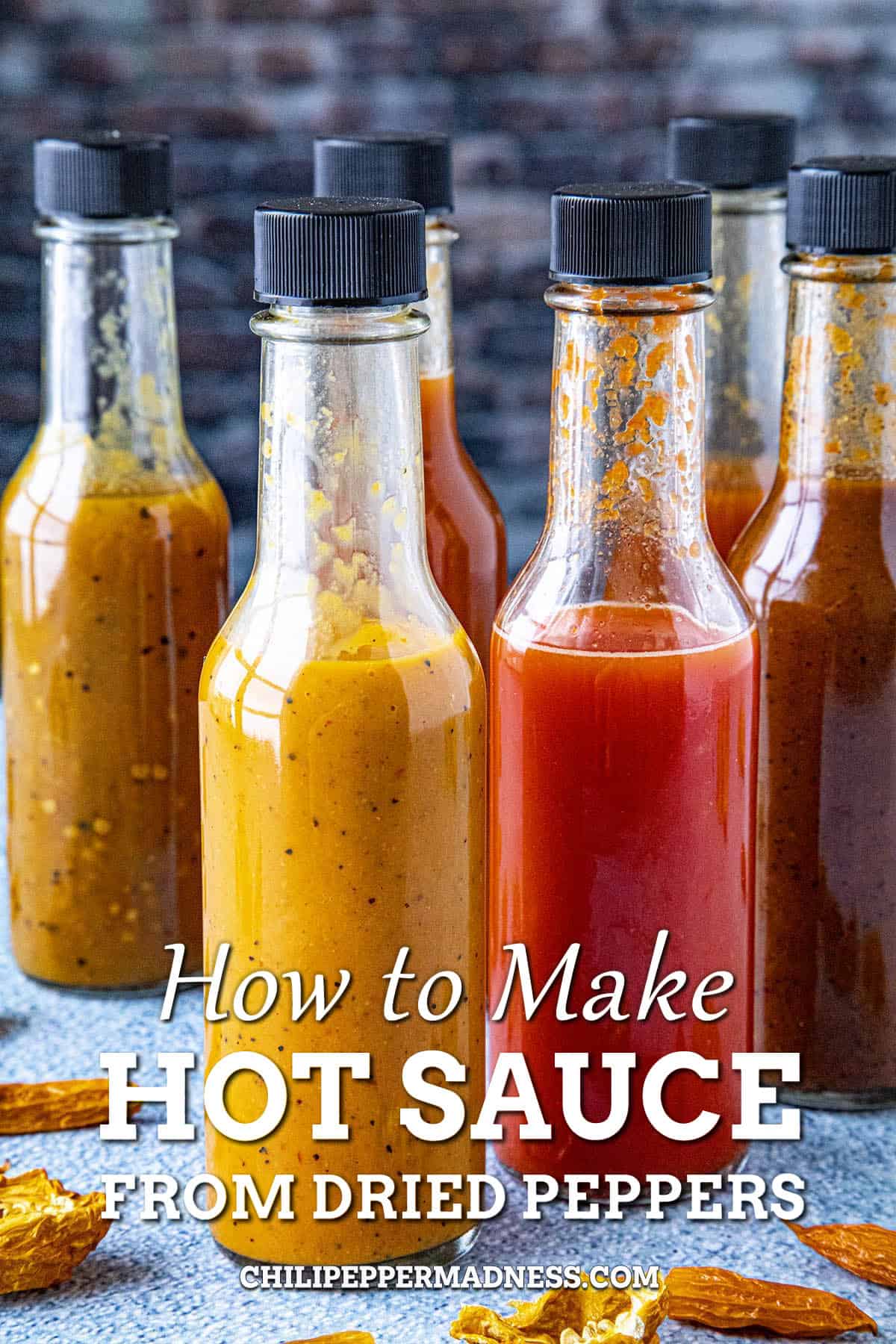
How to Make Hot Sauce from Dried Peppers
Hey, everyone! A question I get here on the site quite often is "Hey, Mike, can I make your hot sauce recipes with dried peppers?" The answer is -- Absolutely Yes!
You can very easily make hot sauce from dried peppers. In fact, you can make just about of the hot sauce recipes on my site with them, which is great because some times it is more difficult to get your hands on fresh chili peppers. I grow chili peppers in my home garden every year, but with my climate, I only get fresh pods on a limited basis.
To preserve my peppers, I often dry them whole, which allows me to keep them for years if I want. Whenever I want to make a hot sauce, no problem! I just rehydrate and hot sauce in on the way!
It really is a simple process. You only need to rehydrate the peppers, but there are a few other components to discuss to help you make the best hot sauce for you.
Let's talk about how to make sauces and hot sauce from dried peppers, shall we?
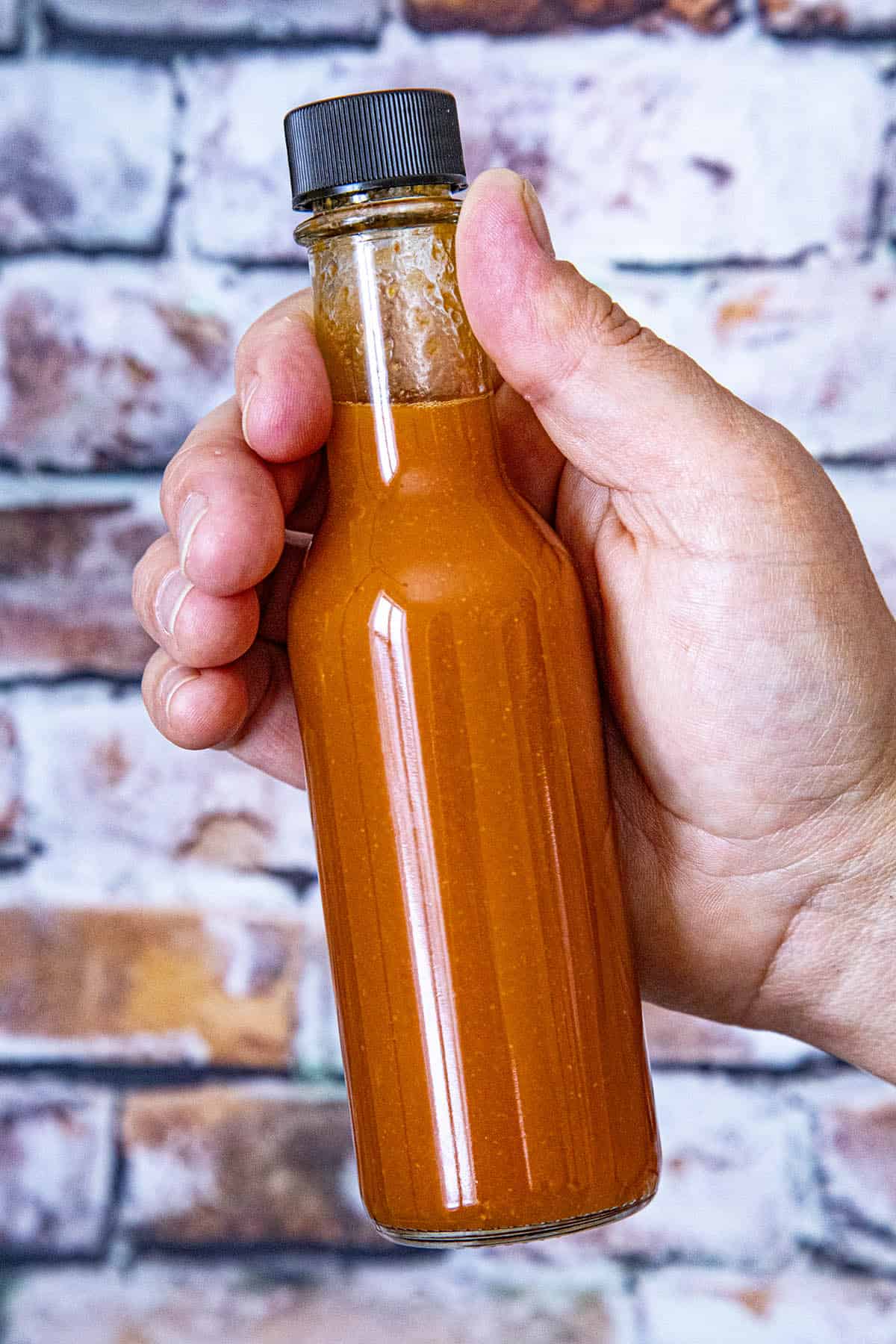
About the Chili Peppers
You can use any dried peppers to make hot sauce. You can also make sauces and salsas, like adobo sauce or chile de arbol salsa, with them. Dried peppers are extremely versatile and hugely flavorful.
When choosing peppers, choose good quality dried pods. Freshly dried peppers are best, but you can still make sauces and hot sauce from older dried pods. They don't spoil. They can lose flavor and potency, however, as they age.
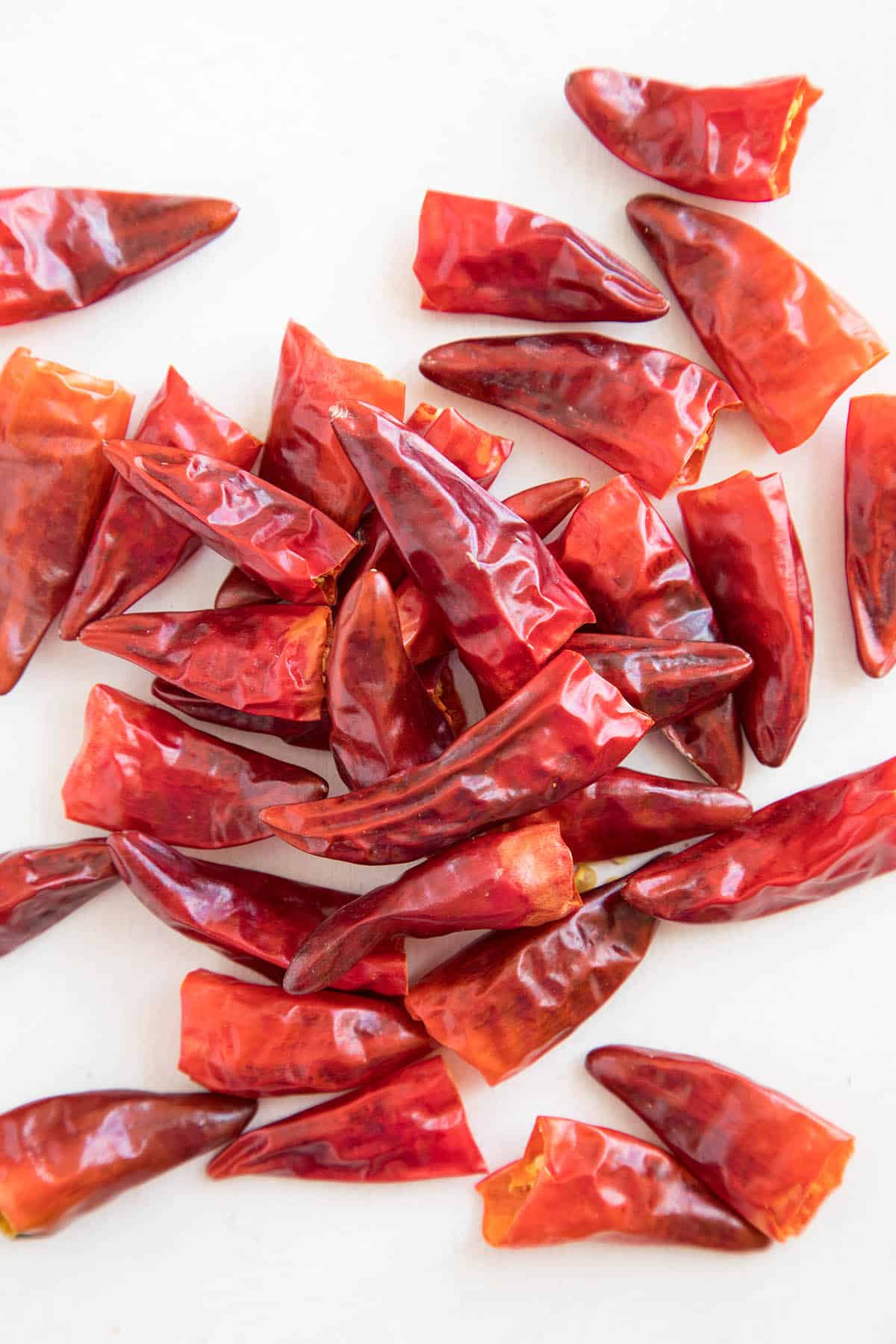
Seeding the Peppers. You don't have to remove the seeds from the dried chili peppers, but most people do. Some people report a slight bitter flavor in the seeds. Also, the seeds can wind up floating in your final sauce, so they become a texture issue. For some, this is not an issue. The choice is yours.
How to Rehydrate the Peppers
The easiest way to rehydrate peppers is to add them to a bowl and cover them with very hot water. The peppers will steep and soften up in anywhere from 20 minutes or longer. Once they are softened, you can use them as desired.
Another method is to simmer the dried peppers in water or a mixture of vinegar and water until they are softened.
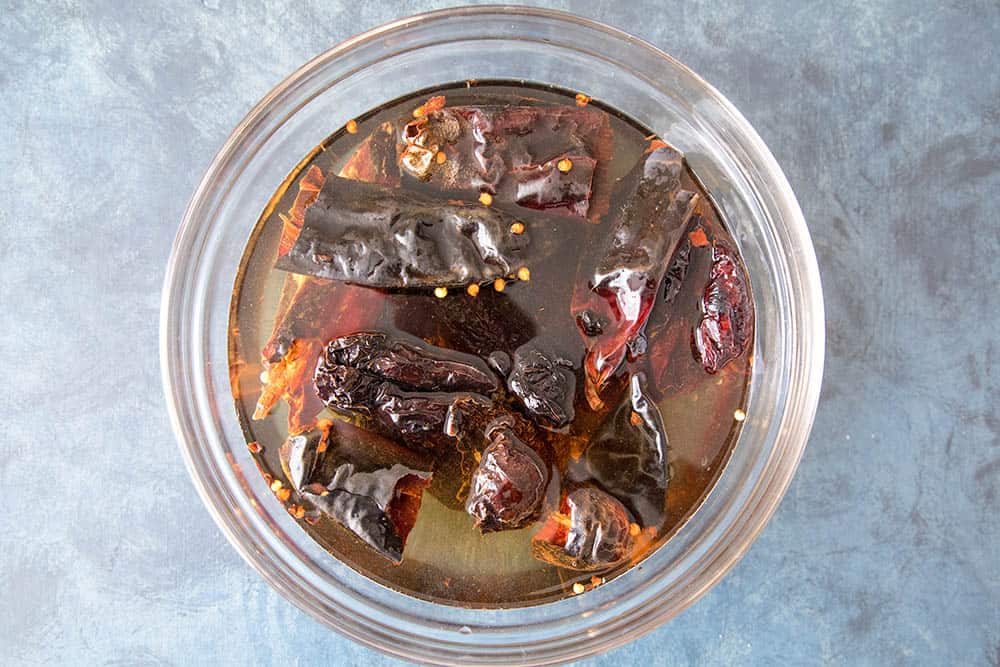
Steeping Water
You'll notice with some darker peppers that the water used to steep them and rehydrate them turns very dark. This is because some of the nutrients from the peppers leaches into the water. That nutrient rich water can be great to thin your sauces and hot sauce. However, some people feel it is somewhat bitter in flavor.
If you find it bitter, use fresh water or more vinegar or citrus to thin out your sauces.
Best Vinegar for Making Hot Sauce
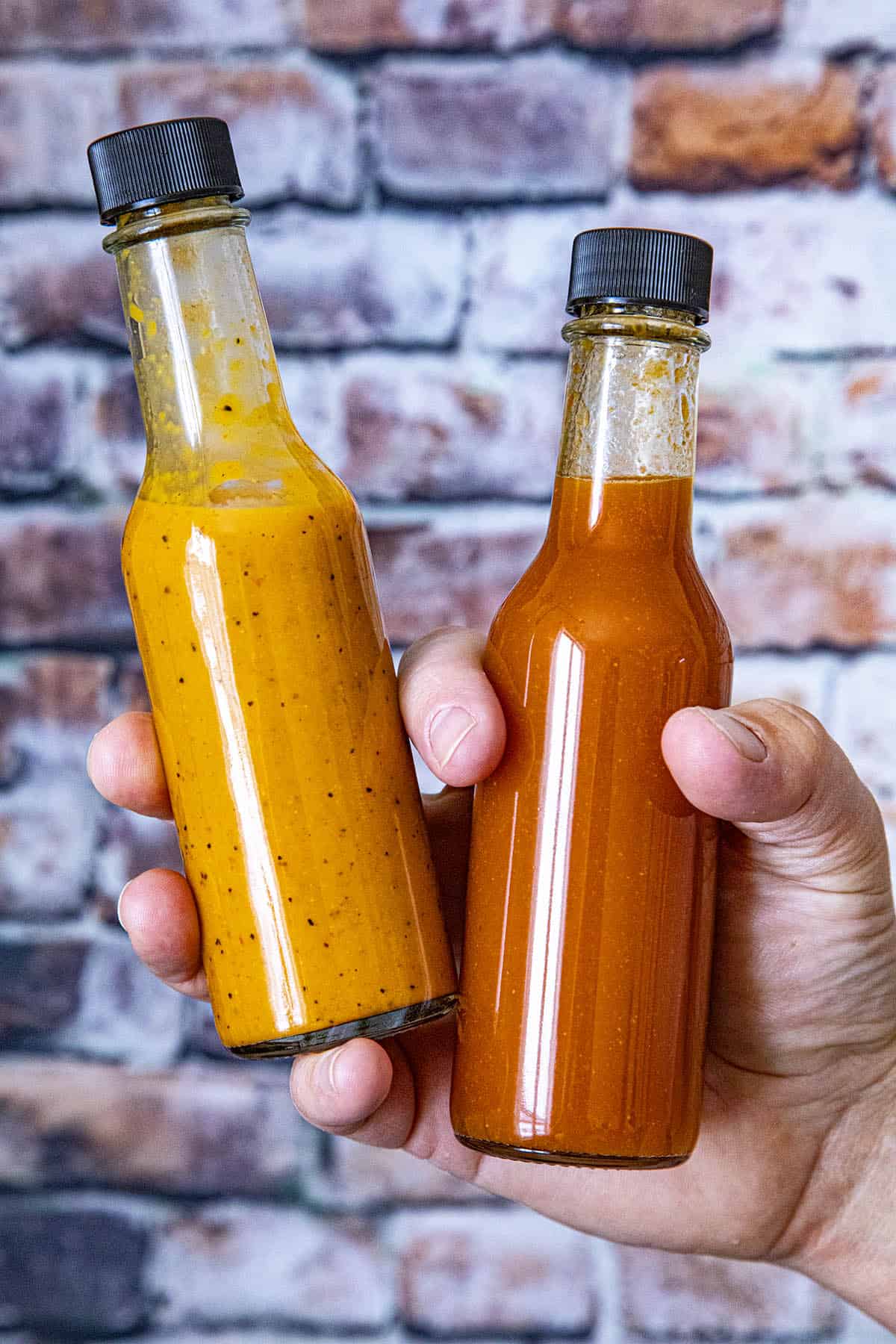
You can use any edible vinegar for making hot sauce. I have made hot sauce with simple white vinegar, champagne vinegar, malt vinegar, apple cider vinegar and more. The key in choosing the appropriate vinegar is to consider the final flavors of your sauce. Some vinegars are sweeter and some are milder.
The best vinegar to use, in my opinion, is a good quality vinegar that you love. A better tasting vinegar will give you a better tasting hot sauce.
Ingredients for Making Hot Sauce from Dried Peppers
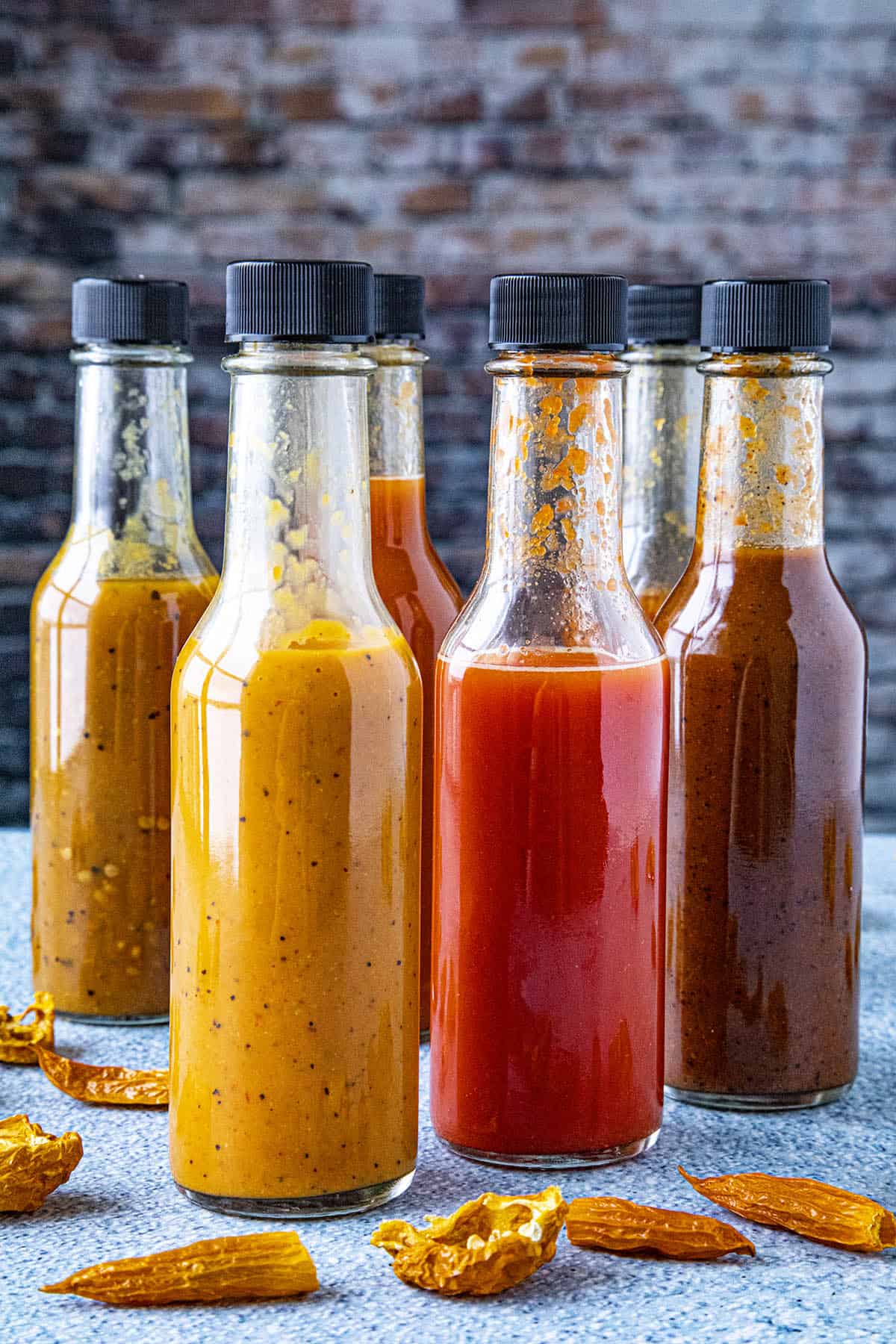
The only ingredients you need for making hot sauce is chili peppers, vinegar and salt. You can make some outstanding hot sauce with just those three ingredients, like this Homemade Tabasco Hot Sauce. However, that is only the beginning.
You can add in all sorts of other flavor building ingredients, like onion, garlic, other peppers. vegetables, herbs and spices, citrus, fruits, juices, alcohol, and so much more.
How to Make Hot Sauce from Dried Peppers - the Recipe Method
For Method One
- Lightly toast the dried chili peppers in a hot pan for a minute or 2 per side, until they become slightly pliable and loosen the oils in the skins. This step is optional and develops more flavor.
- Remove from heat and add enough very hot water to cover the peppers. Let them steep for 15 to 20 minutes to soften.
- Strain the peppers but keep the steeping water.
- Add the rehydrated peppers to a food processor or blender along with up to 1 cup of the steeping water (or use fresh water) vinegar (use anywhere from 2 tablespoons to 1 cup), garlic powder, salt, and other optional ingredients. Process until smooth.
- Taste and adjust with salt and vinegar. Strain if desired.
- Pour into bottles and enjoy, or simmer then in a pot for 10-20 minutes to develop the flavors even more, then cool and bottle. Store in the refrigerator.
For Method Two
- Lightly toast the dried chili peppers in a hot pan for a minute or 2 per side, until they become slightly pliable and loosen the oils in the skins. This step is optional and develops more flavor.
- Add water and vinegar (use anywhere from 2 tablespoons to 1 cup), garlic powder, salt and other optional ingredients. Use less vinegar or water for thicker hot sauce. Simmer the peppers for 15 to 20 minutes to soften.
- Add the mixture to a food processor or blender along with garlic powder, salt, and other optional ingredients. Process until smooth.
- Taste and adjust with salt and vinegar. Strain if desired.
- Pour into bottles and enjoy, or simmer then in a pot for another 10 minutes to develop the flavors even more, then cool and bottle. Store in the refrigerator.
The Difference Between the Two Methods: The first method rehydrates the dried peppers with water only, allowing you to add other ingredients later as desired. The second method simmers the dried pods and other ingredients together in vinegar and water, then simply processes it all to make the final sauce. Both methods work great.
Check out my resource on How to Make Hot Sauce: The Ultimate Guide, with a great deal more information on history, hot sauce types, fermenting and more.
See my post on "Does Hot Sauce Need to be Refrigerated?"
That's it, my friends! I hope you enjoy your hot sauce. Let me know how yours turned out for you. I'd love to hear it!
Try Some of My Other Hot Sauce Recipes
- How to Make Hot Sauce from Chili Powders
- Carolina Reaper Hot Sauce
- Homemade Sriracha (both fermented and non-fermented varieties)
- Roasted Red Jalapeno Hot Sauce
- Cayenne Pepper Sauce
- Honey Roasted Hot Pepper Hot Sauce
- Ti-Malice – Hatian Creole Hot Sauce
- Ghost Pepper Hot Sauce
- Datil Pepper Sauce
- More Hot Sauce Recipes
Relevant Links
Got any questions? Ask away! I’m happy to help. If you enjoy this recipe, I hope you’ll leave a comment with some STARS. Also, please share it on social media. Don’t forget to tag us at #ChiliPepperMadness. I’ll be sure to share! Thanks! — Mike H.
How to Make Hot Sauce from Dried Peppers - Recipe Method
Ingredients
- 2 cups lightly crushed and seeded dried chili peppers
- 2 cups water or enough to cover the peppers - FOR METHOD ONE
- 1 cup vinegar or as desired, FOR METHOD TWO
- 1 teaspoon garlic powder
- 1 teaspoon salt
- *Other ingredients as desired. See notes.
Instructions
FOR METHOD ONE
- Lightly toast the dried chili peppers in a hot pan for a minute or 2 per side, until they become slightly pliable and loosen the oils in the skins. This step is optional and develops more flavor.
- Remove from heat and add enough very hot water to cover the peppers. Let them steep for 15 to 20 minutes to soften.
- Strain the peppers but keep the steeping water.
- Add the rehydrated peppers to a food processor or blender along with 1 cup of the steeping water (or use fresh water) vinegar (use anywhere from 2 tablespoons to 1 cup), garlic powder, salt, and other optional ingredients. Process until smooth.
- Taste and adjust with salt and vinegar. Strain if desired.
- Pour into bottles and enjoy, or simmer then in a pot for 10-20 minutes to develop the flavors even more, then cool and bottle. Store in the refrigerator.
FOR METHOD TWO
- Lightly toast the dried chili peppers in a hot pan for a minute or 2 per side, until they become slightly pliable and loosen the oils in the skins. This step is optional and develops more flavor.
- Add water and vinegar (use anywhere from 2 tablespoons to 1 cup), garlic powder, salt and other optional ingredients. Use less vinegar or water for thicker hot sauce. Simmer the peppers for 15 to 20 minutes to soften.
- Add the mixture to a food processor or blender along with garlic powder, salt, and other optional ingredients. Process until smooth.
- Taste and adjust with salt and vinegar. Strain if desired.
- Pour into bottles and enjoy, or simmer then in a pot for 10-20 minutes to develop the flavors even more, then cool and bottle. Store in the refrigerator.
Video
Notes
Nutrition Information
Denise says
Hi. If you use method 1, steeping in just water (no vinegar), is there still a concern of leaching metal from the pan?
Michael Hultquist - Chili Pepper Madness says
No worries, Denise.
Bill says
My only comment is that if you are going to simmer and steep anything in vinegar, please use a quality ceramic or glass pot that can take direct heat such as Asian-style ceramic rice pots, or Corning's "Visions" glass cookware. The vinegar can and will leech heavy metals from metal pots into solution and then into your brain/body, and also pit your metal cookware to some degree.
If you must use metal, use one coated with traditional ceramic enamel that is not damaged or chipped.
Teflon, although indicated as being toxic itself, is actually very resistant to acids. I still wouldn't use it. At the very least, use a high-quality stainless-steel pot, although some leeching will still occur to some degree.
Never use cast iron, or any soft metal such as aluminum or copper.
Eric Nelson says
Hi Mike. I finally tried to take a mix of our dried chilies, cascabels, guajillos, pasillas, possibly anchos and chipotles as well (they're not labled!) and ferment them and make a hot sauce out of them. I rehydrated them then roughly chopped them and soaked them in a brine solution, from your recipe. The chilies were covered, but there was say 2 to 3 inches of air in the jar above them. They've been hanging out in the cellar for about 5, 6 weeks. I burped them often with no burp action. This definitely allowed air to get in though. I didn't notice the brine getting cloudy at all. I did notice some mold start to form on top though. I looked up and found this website: http://fermentationpodcast.com/five-questions-mold-food-safety/ . So I scooped out the mold and processed my chilies after fermenting, only adding one third of a cup of organic apple vinegar to about 2 cups combined brine, chilies - to keep the first batch simple. All seemed a-ok. But the sauce was a bit too thin. So I simmered it for about a half an hour (definitely no more mold spores now) and thinned it down to a third. It made a mess, got way more salty, is nice and thick now and the flavor is wonderful! This is a wonderful site!! Thanks for sharing all your knowledge! I've got more dried chilies in the cellar. . . Eric
Michael Hultquist - Chili Pepper Madness says
Thanks, Eric. Glad it worked out as desired! Enjoy.
Andrew Corradini says
Got a bone to pick with you! (and I'm saying that with a really big smile and lots of love, so don't take it the wrong way!) I've been a happy/grateful ChiliPepperMadness-devotee for years -- been growing my own peppers (including superhots) forever, used all kinds of things about fermenting mash; recipes, etc. from here, and am eternally grateful. But I was just looking up something as a reference when this one stuck in my craw:
"The best vinegar to use, in my opinion, is a good quality vinegar that you love. "
Oh, come ON. All that's saying is (a) don't use crap, and (b) use stuff you like -- so, that's advice?
Here's my advice: if you're making basic pepper mash or basic hot sauce, use apple-cider vinegar: it's flavorful, and it's reasonably inexpensive. Using distilled plain white vinegar is going to give you no character/flavor -- it's cheap, and you'll get basically the vinegar equivalent of water in your sauce/mash. Next up is just ordinary white or red wine vinegar -- depending on how much you spend, and what you get, those will be significant alterations to the flavor of your hot sauce (especially the red) -- so choose wisely.
Now if you want to try to use something like malt vinegar? or something even fancier/more expensive like balsamic -- more power to you -- but that's going to really alter your flavor profile (way beyond even red wine vinegar). You're making hot sauce, here -- but if you're shooting for something *custom* - like a pickapeppa, or whatever - - this is where your choice of vinegar is going to significantly alter what you come out with.
Other'n that -- I can't imagine using much beyond basic white, cider, or white-wine (if that), for your *typical* hot sauce *bases*. Anything else is an *ingredient* in and of itself, contributing taste to the profile.
So -- "best vinegar to use is a good quality vinegar that you love" -- man, I love your site, but I'm still going to call that out as a dodge. You need to recommend something, and it's probably either just straight white bulk, straight cider bulk, or "if you prefer, better-quality cider vinegar", etc. Seriously -- just pick something and commit! 🙂
Again, love the site. About to make some mash - from your instructions. 🙂
Michael Hultquist - Chili Pepper Madness says
Hey, Andrew. I appreciate the nice comments and can certainly take criticism, but I'm not quite sure you read the entire paragraph on vinegar? I mean, I'm sure I could elaborate more (I'm usually much too verbose for most), but I do mention flavor profiles, etc. Think I should expand the discussion to detail particular vinegar flavors? I figured hot sauces makers could do that on their own. Much love, my man. Here is the vinegar section, including the final offending paragraph:
"You can use any edible vinegar for making hot sauce. I have made hot sauce with simple white vinegar, champagne vinegar, malt vinegar, apple cider vinegar and more. The key in choosing the appropriate vinegar is to consider the final flavors of your sauce. Some vinegars are sweeter and some are milder. The best vinegar to use, in my opinion, is a good quality vinegar that you love. A better tasting vinegar will give you a better tasting hot sauce."
I'd hate to discourage any hot sauce maker from trying a different vinegar, such as malt vinegar, which of course is not traditional, but that they might enjoy. Best!
Michael Rafferty says
Cheers Michael
I think I became accustomed to the pickled taste, but switching from distilled white malt to red wine vinegar seemed to mellow it out. I also added some cassia and cloves to the dried chilli soak, removing them before blending. It might all be in my head (it is chilli pepper madness after all) but I'm convinced that adds layers of subtle flavour.
I tried a very small batch ferment - UK supermarkets sell chillies in 30g to 50g packs (1 oz to 1.8 oz). It was excellent. I thought the dried chilli hot sauce might seem inferior after, but it was still good, just different.
I've found a UK supplier selling chillies by the kilo (2.2 lb). Happy Days! Have got half a batch of a cayenne cultivar bubbling away in a brine, and have just set the other half off in a mash. I'm following your ratios with both.
Thanks again for a brilliant site.
Michael
Northumberland, England
Michael Hultquist - Chili Pepper Madness says
Outstanding, Michael. Yes, Madness it all is. I love to hear how others experiment with and develop flavor. It helps everyone else get ideas. Flavor first! Cheers, sir!
Chad says
Nice, my hot sauce addiction is costing too much so I'm giving this a first try. Question: is it easiest to remove the seeds from the dried peppers before rehydrating or after?
Michael Hultquist - Chili Pepper Madness says
Thanks, Chad. Yeah, you can make your own anytime! I find it easier to remove them before, especially with larger pods. You can always strain if you want as well. Good luck with your hot sauce making!
Hariet says
I just finished a batch of habanero hot sauce, guajillo hot sauce and California chili hot sauce all from dried peppers with this method and they are absolutely wonderful. Thank you so much for another great recipe.
Michael Hultquist - Chili Pepper Madness says
Thanks so much, Hariet! Super happy to be useful!
Maggie Mehaffey says
Oh my God! How do you get through this process without making the air in your house toxic?! I just drove me and my husband out of the house, eyes streaming, noses running, coughing!! I finally removed the toxic cauldron outside and opened all the doors and windows! I don’t dare complete the next step of blending. Thinking about setting a table up outside for the blender! Even with 15” of snow on the ground.
Michael Hultquist - Chili Pepper Madness says
Maggie, yes, you can get fumes from hot peppers in the house, as you are experiencing. It is best to work with the kitchen fan on, and open windows if you are able. This is more of an issue in smaller spaces, though I have had some issues in a giant kitchen when working with superhots. It can happen. Try to get a box fan going and keep air circulating if you can, or yes, outside or in a garage is always an option if it gets too bad for you.
Katie says
Great recipe! I used dried cayennes that I grew last year. The finished product definitely has some heat to it, are there any milder varieties you can recommend? Thank you for the recipe!
Michael Hultquist - Chili Pepper Madness says
Katie, not sure what you have access to, but Fresno peppers make for a great jalapeno-level hot sauce. There are a lot of great aji peppers you might grow. Or, next time try mixing your cayennes with dried bell pepper to really cut the heat.
Fleischman says
Hello Michael,
Two questions:
1. So, if I wanted to make hot sauce out of dried crushed red pepper flakes, would you suggest rehydrating them first? What about straight mixing the flakes with vinegar in a pot, simmering, then straining, done?
2. If you wanted to add hot sauce (say your homemade Tabasco) to ground beef while cooking it, what amount of hot sauce would you start with for every pound of beef?
Thank you,
Fleischman
Michael Hultquist - Chili Pepper Madness says
Fleischman, I'm not sure if you'd get much directly from the chili flakes, though if there are enough of them (flesh, not seeds), they will rehydrate in the simmering liquid. You can then process it to blend it more. For ground beef, I would start with a tablespoon or 2, then taste and adjust from there. Let me know how it goes. Enjoy!
fleischman says
Thank you, Michael.
Interesting. Do the seeds not add hotness or flavor?
Also, are you concerned about long term gastrointestinal issues from routinely using hot sauces? Should I be? 😉
F
Michael Hultquist - Chili Pepper Madness says
The seeds don't add any heat or flavor. You can remove them if you'd like. Some people find them bitter and don't like them floating in their sauces. I have no gastro issues! Haha, though some people may! I eat hot peppers every day. No issues!
Mike Smith says
If you clean the seeds out of the jalapeños with a spoon or your fingers . Use gloves. I found out the hard way & they burnt my fingers up for hours
Mike Hultquist says
Yes, Mike. They can really burn you. I have a post on how to stop the burn here: https://www.chilipeppermadness.com/cooking-with-chili-peppers/how-do-you-stop-the-chili-pepper-burn/
B says
I use red pepper flakes for hot sauce. What I did was I ground the flakes in a grinder and then I simmered them in olive oil to bring out the heat. Then I followed the recipe. You only need like an eighth of a cup or less as the seeds are really hot. You could probably just strain the sauce after if you don't have a grinder. Also, the seeds are pretty hot just boiled in water. I know because I make a cayenne pepper tea when I get the flu in the winter.
I also want to mention I like to use bay leaves in my hot sauce recipe.
Charlotte Molrine says
I just finished bottling my first batch of fermented chili peppers; I had both red and green serrano peppers from this year's garden. I was very impressed with the quality of the finished product.
I have LOTS of dried peppers and want to make your hot sauce with dried peppers. Could I ferment them for a week or two like the fresh chili pepper sauce or would that long soak time degrade the dried chili too much?
Michael Hultquist - Chili Pepper Madness says
Thanks, Charlotte. You can ferment dried pods, no problem, but you might need a fermentation starter or some fresh pods to get fermentation going. Let me know how it goes for you.
John says
Love this recipe and can't wait to try it. Would toasting the peppers on a gas grill impart any added flavor, as opposed to using a frying pan? Thanks!
Michael Hultquist - Chili Pepper Madness says
John, you can toast them on the grill, no problem. It would be a great way to loosen them up. Enjoy!
Randy says
I just made this using chili de arbol's and one ghost pepper (all dried). I added juice of a 1/2 lime to boot.
I go to your site and roam around almost every day.
Fantastic recipe.
Randy
Michael Hultquist - Chili Pepper Madness says
Thanks, Randy! The sauce sounds great! I love. Thanks for roaming!